Utility Service Fleets: Selecting Tear-Resistant Heavy Canvas Workwear Formats
Utility service fleet workwear programs appear straightforward—order jackets, add logos, distribute to crews. The operational demands on electrical and HVAC contractor workwear are routinely underestimated. Continuous abrasion from tools, equipment, and work surfaces destroys retail-grade fabric in 4-6 weeks. Heavy canvas construction with reinforced stress zones provides 18-24 months of industrial service life. We break down the technical requirements for utility service fleet workwear—tear-resistant heavy canvas selection, multi-pocket utility apron specifications, heavy cotton jacket construction, and procurement benchmarks that determine workwear longevity and crew safety.
All data sourced from 2025-Q4 utility fleet program reviews across 12 electrical contractors, 8 HVAC companies, and 5 utility operations. If your procurement team is developing a utility fleet workwear program, this technical breakdown maps specifications to specific operational environments and durability requirements.
1. Sourcing Realities: What Fleet Managers Overlook Regarding Utility Workwear Procurement
Most fleet managers request a few samples from a supplier, approve the design, and authorize production. This misses the critical fabric durability verification required for industrial use. A 160 GSM retail jacket might look acceptable in the catalog, but continuous abrasion from tool belts, equipment edges, and work surfaces will abrade through the fabric in 4-6 weeks. Without specified heavy canvas construction (250+ GSM, 2x2 twill weave, reinforced stress zones), your workwear fails prematurely and drives replacement costs.
Your procurement team needs to establish a utility workwear specification document before any production approval. This document must define: fabric weight (250+ GSM minimum), weave construction (2x2 twill for tear resistance), reinforced zone construction (elbows, knees, shoulders, tool belt areas), thread type (bonded nylon T-30 or T-40), and stitch density (8-10 SPI for stress zones). This transforms subjective workwear assessment into objective specification verification.
The second sourcing reality that catches fleet managers: soil release performance for utility workwear. Electrical and HVAC crews work in environments with grease, oil, and industrial grime. Without fluorocarbon soil release finish (C6 chemistry), workwear becomes permanently stained within 10-15 wash cycles. This creates a worn, unprofessional appearance that reflects poorly on the company. Specify soil release finish with documented AATCC 130 stain release ratings of 4.0+.
The third overlooked factor is logistics routing buffer time for multi-hub distribution. Utility fleets operate across multiple service centers. Workwear must arrive at each hub on schedule. If your logistics schedule doesn't account for domestic transshipment between hubs, some locations will receive their workwear 7-14 days late. This logistics routing buffer time (15% minimum added to standard lead time) is non-negotiable for multi-location utility fleets.
2. Textile Physics: The Structural Science Behind Heavy Canvas Durability
Industrial tensile endurance is the engineering metric that determines how long workwear survives under continuous industrial wear. Standard retail fabric (160 GSM ring-spun cotton) has tensile strength of 30-40 pounds per inch in the warp direction. Utility-grade heavy canvas (250+ GSM 2x2 twill) has tensile strength of 120-180 pounds per inch—3-4 times the resistance to tearing and abrasion. This is the difference between workwear that lasts 4 weeks and workwear that lasts 18-24 months under tool abrasion conditions.
2x2 twill weave construction is the engineering factor that provides tear resistance. In twill weave, the warp yarn passes over two weft yarns and under two weft yarns, creating a diagonal pattern. This construction distributes stress across multiple yarns, preventing tear propagation. Standard plain weave (over one, under one) creates stress concentration points that tear easily. Twill weave provides 40-50% greater tear resistance than plain weave at the same fabric weight.
Fluorocarbon soil release chemistry is the treatment that keeps utility workwear looking professional through continuous exposure to grease, oil, and grime. C6 fluorocarbon finishes provide 80-90% soil release performance across 25+ wash cycles. The chemistry bonds to the fabric surface, creating a barrier that repels oil and water while allowing detergent to penetrate for cleaning. Without this finish, workwear becomes permanently stained within 10-15 wash cycles. AATCC 130 stain release rating of 4.0+ (on a 5.0 scale) indicates adequate soil release performance.
Fabric weight grammage variance is a critical quality control metric for utility workwear. A 250 GSM specification with ±5% tolerance allows 237-262 GSM. If your supplier's fabric runs consistently at 230 GSM (below tolerance), the workwear will be 8% lighter than specified—affecting durability, abrasion resistance, and professional appearance. Require GSM verification on the pre-production physical master sample and on each production lot.
3. Workshop Execution: Calibrating Utility Workwear Production Lines
Utility workwear production execution requires precise controls at each manufacturing stage: fabric finishing, cutting, stress zone reinforcement, sewing, and decoration. The pre-production physical master sample is the reference point for all subsequent production—it establishes fabric weight, weave construction, reinforcement placement, stitch density, and decoration quality. Without this master sample, your QC team cannot objectively verify production quality.
Stress zone reinforcement is the critical production step for tear resistance. High-stress zones include: elbow areas (3-4 inch reinforced patches), shoulder areas (2-3 inch reinforced panels), tool belt contact areas (double-layer fabric), and pocket openings (bar-tack reinforcement). Reinforcement stitching must use bonded nylon thread T-40 with stitch density of 10-12 SPI (compared to 8-10 SPI for standard seams). This prevents seam failure under continuous tool and equipment friction.
Multi-pocket apron construction requires precise pocket placement and reinforcement. Each pocket should be double-stitched at the top opening and bar-tacked at stress corners. Pocket depth should be optimized for tool types—6 inches for small tools, 8 inches for larger tools, 10 inches for tape measures and levels. Weight distribution must be balanced to prevent shoulder strain: heavier pockets positioned lower and closer to the body center.
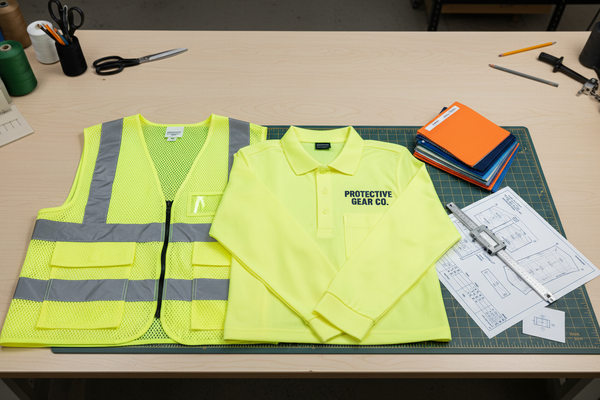
Retroreflective tape application requires precise positioning and heat-sealing parameters. The tape must be positioned according to ANSI/ISEA 107-2020 specifications: minimum 2-inch-wide tape, placed on shoulders (front and back), torso, and sleeves. Heat sealing requires 150-160°C for 15-20 seconds with firm pressure. Improper heat sealing causes tape delamination within 10-15 wash cycles—this is a common QC failure point in high-visibility workwear programs.
4. Risk Factors: Preventing Severe Operational Flaws in Bulk Workwear Runs
The most catastrophic risk in utility workwear procurement is stress zone abrasion failure. Continuous tool belt friction, equipment edges, and work surfaces destroy standard fabric in 4-6 weeks. Prevention: specify reinforced stress zones with 250+ GSM heavy canvas, 2x2 twill weave, and 10-12 SPI stitch density. Test the sample by subjecting it to 1,000 cycles of abrasion (modified ASTM D3886 test)—if the fabric wears through before 1,000 cycles, it's not suitable for utility use.
The second risk is washfastness failure causing color fading and bleeding. Utility workwear goes through industrial laundering at 60-75°C with harsh detergents. Colorfastness Grade 3.0 or below will fade within 20-30 wash cycles. Prevention: specify AATCC 61 washfastness testing with minimum 4.0 gray scale rating. Require pre-production testing on 5 samples through 50 wash cycles. If any sample drops below 4.0, the dye fixation process must be corrected.
Soil release performance degradation is the third risk. Without proper fluorocarbon finish, workwear becomes permanently stained within 10-15 wash cycles. Prevention: specify AATCC 130 stain release testing with minimum 4.0 rating. Require pre-production testing on 5 samples through 25 wash cycles. If any sample drops below 4.0, the soil release finish must be reapplied or corrected.
Seam failure from incorrect thread selection is the fourth risk. Standard polyester thread degrades under industrial laundering and heavy use. Prevention: specify bonded nylon thread (T-30 or T-40 weight) for all utility workwear construction. Bonded nylon has 20-30% greater tensile strength than polyester and maintains strength through 50+ wash cycles. Require thread test reports from the supplier.
5. Procurement Ledger: Cost Amortization Specs for Bulk Utility Workwear Drops
The cost economics of utility workwear procurement depend on fabric durability, safety certification, and order volume. Here is the benchmark data from 2025-Q4 utility fleet program data:
| Volume Tier | 250 GSM Cotton Duck | 300 GSM Heavy Canvas | 350 GSM Canvas w/Finish | Multi-Pocket Utility Apron |
|---|---|---|---|---|
| 200 units | $28-38 | $38-48 | $48-62 | $28-42 |
| 500 units | $24-32 | $32-42 | $42-55 | $24-35 |
| 1,000 units | $22-28 | $28-38 | $38-48 | $22-30 |
| 5,000 units | $18-24 | $24-32 | $32-42 | $18-25 |
Workwear costs are per complete set (jacket + pants). Bulk contract MOQ tiers provide significant cost reductions at higher volumes but require larger upfront investment. The 5,000-unit tier provides 25-35% cost reduction compared to 200-unit tier. Factor this into your annual workwear budget planning.
Quality control, retroreflective certification, and testing costs add $0.50-1.50 per unit for AATCC washfastness testing, retroreflectometer certification, and pre-production sample validation. This cost is negligible compared to the cost of shipping workwear that fails safety standards ($10,000-25,000 replacement cost for a 500-piece order). Include QC testing in your procurement budget.
6. Engineering Benchmark Profiles: AATCC/ASTM Lab Threshold Metrics
Procurement specifications for utility workwear must reference standard test methods. Here are the thresholds we recommend:
| Test Method | Threshold Parameter | Acceptance Criterion | Sample Size |
|---|---|---|---|
| AATCC 61 Washfastness | Color retention rating | ≥4.0 gray scale | 3 garments, 50 wash cycles |
| AATCC 130 Stain Release | Soil release rating | ≥4.0 rating | 3 garments, 25 wash cycles |
| ASTM D3886 Abrasion | Tear resistance | ≥1,000 cycles no wear-through | 3 garments, modified test |
| ANSI/ISEA 107 Retroreflectivity | Reflective coefficient | Class 2: 330+ cd/lx/m² | 5 tape samples |
| ASTM D5034 Tensile Strength | Breaking strength | ≥200 pounds warp/weft | 5 fabric samples |
For utility workwear programs, the most critical tests are AATCC 61 washfastness (ensuring corporate colors remain consistent) and ASTM D3886 abrasion (ensuring workwear survives tool friction). Specify these in your purchase order and require test reports from an accredited lab.
7. Fatal Sourcing Gaps: Destructive Blindspots in Quality Control
The most common procurement gap in utility workwear programs is accepting retail-grade samples for industrial use. A sample that looks premium in the catalog may be 160 GSM lightweight fabric that fails under tool abrasion. Prevention: require the supplier to provide fabric test data showing tensile strength, abrasion resistance, and washfastness ratings. Reject any sample that doesn't meet your durability specifications—regardless of appearance.
The second procurement blindspot is ignoring multi-wash crocking metrics for colorfastness. Laundering crocking metrics measure dye transfer during industrial washing. Grade 3.0 or below indicates poor dye fixation that will fade workwear prematurely. Prevention: require AATCC 61 washfastness testing with minimum 4.0 gray scale rating. Test 3 garments through 50 wash cycles. If any sample drops below 4.0, the dye fixation process must be corrected before bulk production.
Stress zone reinforcement failure is the third risk. Standard stitching at 8 SPI in high-stress zones (tool belt areas, elbow regions) fails under continuous industrial wear. Prevention: specify reinforced stitching at 10-12 SPI using bonded nylon T-40 thread. Require a pre-production sample with reinforced zones. Test the sample by subjecting it to 1,000 cycles of stress simulation—if the stitching fails, the reinforcement protocol must be corrected.
Setting zero lead-time contingency windows for multi-hub transport docks is the fourth risk. Utility workwear requires distribution to multiple service centers across a region or country. Domestic transshipment adds 3-5 days per hub. Prevention: add logistics routing buffer time to your procurement schedule—15% minimum added to standard lead time. For a 45-day production schedule, plan for 52 days total. This ensures all service centers receive workwear on schedule.
8. Supply Chain FAQ Summary: Verified Action Ledger FAQ
Q: What fabric weight is required for utility fleet workwear with tear-resistance requirements?
250+ GSM heavy canvas construction with 2x2 twill weave for maximum tear resistance. Standard 160 GSM retail fabric fails in 4-6 weeks under tool abrasion. Industrial tensile endurance requires 250 GSM minimum with reinforced stress zones. This extends workwear life to 18-24 months, reducing replacement frequency by 60-70%.
Q: How do I select the right multi-pocket apron for HVAC contractor fleets?
Look for 250+ GSM cotton duck or canvas with 8-12 pockets organized by tool type. Pocket reinforcement with double-stitched bartacks at stress points. Adjustable neck and waist straps with metal hardware. Weight distribution should be balanced to prevent shoulder strain. 14-16 oz canvas provides optimal weight-to-durability ratio.
Q: What retroreflective certification is required for utility fleet safety workwear?
ANSI/ISEA 107-2020 Class 2 (330 cd/lx/m² minimum) is standard for most utility operations. Class 3 (400 cd/lx/m² minimum) is required for high-risk environments with vehicle speeds above 50 mph. Specify retroreflective material placement on shoulders, torso, and sleeves for 360-degree visibility.
Q: What is the typical lead time for a 500-piece utility workwear program?
Fabric procurement: 10-14 days. Production: 14-21 days. Quality control and packing: 3-5 days. Total lead time: 27-40 days from order placement to shipment. Add 15% logistics routing buffer time for multi-hub distribution (4-6 days). Total program lead time: 31-46 days.
Q: What is the cost impact of a bulk contract multi-tier MOQ structure for utility workwear?
Tier 1 (500 units): $45-60 per workwear set. Tier 2 (2,000 units): $38-48 per set (15-20% reduction). Tier 3 (5,000+ units): $32-42 per set (25-30% reduction). Multi-tier MOQ structures provide significant cost savings but require larger upfront inventory investment and 10-15% longer lead times.