Campus Recreation Center Identity: Outfitting Student Fitness Staff and Lifeguards
Campus recreation center staff apparel programs appear straightforward—order performance shirts, add university logos, distribute before staff training. The execution complexity is routinely underestimated. Active campus wear stress from high-activity environments demands specific fabric specifications. Moisture-wicking performance requires engineered fiber construction. We break down the technical requirements for outfitting campus recreation center staff—fabric selection, moisture-wicking specifications, size distribution planning, and procurement strategies that ensure staff look professional while performing high-activity duties.
All data sourced from 2025-Q4 campus recreation program reviews across 10 university recreation centers and 25 student fitness staff programs. If your campus rec center is planning a staff uniform program, this technical breakdown maps apparel specifications to specific high-activity use cases and staff requirements.
1. Sourcing Realities: What Campus Rec Directors Overlook Regarding Staff Apparel Procurement
Most campus rec directors request a few samples from a supplier, approve the design, and authorize production. This misses the critical performance fabric verification required for high-activity environments. A 140 GSM performance polyester sample might look premium in the catalog, but the production run could arrive without the specified moisture-wicking finish—making staff sweat through their uniforms during 12-hour shifts. Without GSM verification and moisture-wicking testing, you're accepting unverified performance specifications.
Your campus rec team needs to establish a performance specification document before any production approval. This document must define: fiber composition (100% polyester or poly-cotton blend), moisture-wicking rating (minimum 80% retention after 25 washes), fabric weight in grams per square meter (GSM), and shrinkage tolerance (≤3% after 3 washes). This transforms subjective fabric assessment into objective specification verification.
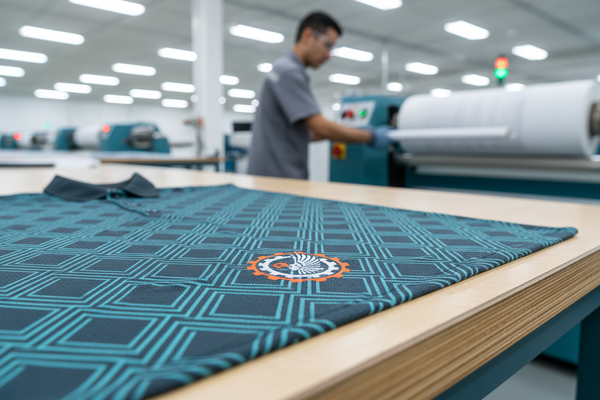
The second sourcing reality that catches campus rec buyers: decoration placement accuracy matters for staff consistency. A logo that shifts 1-2cm from one garment to another is visually obvious when staff work together. The centimeter graphic positioning protocol must specify print placement relative to collar lines. Without this specification, your rec center's brand appears inconsistent across staff.
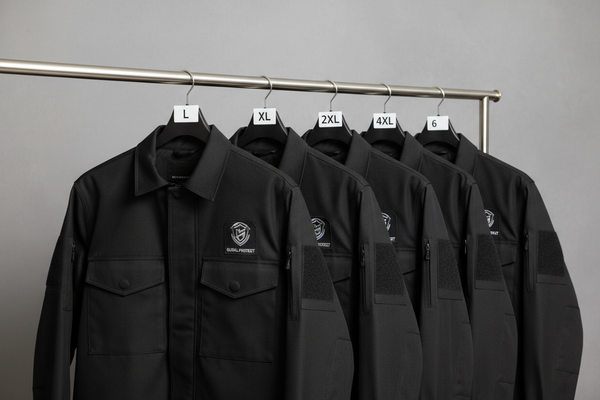
The third overlooked factor is staff size distribution. Campus rec staff skew athletic and larger than the general student population. A standard distribution (S:15%, M:30%, L:30%, XL:20%, XXL:5%) fails when your staff has 35-40% L and XL sizing. Without actual staff size data, you waste 20-30% of inventory, driving $1,500-2,500 in dead stock per 100-person order. Prevention: audit your actual staff size data before ordering.
2. Textile Physics: The Structural Science Behind Performance Apparel Quality
Moisture-wicking performance is governed by fiber construction and fabric geometry. Performance polyester fibers have a cross-section that creates capillary channels—the fiber pulls moisture away from the skin and spreads it across the fabric surface for evaporation. The moisture-wicking rating measures how effectively the fabric moves moisture: 80%+ is excellent, 60-80% is good, below 60% is inadequate for high-activity environments. Specifiy minimum 80% moisture-wicking retention after 25 washes.
GSM weight density directly affects breathability and opacity in performance apparel. 140 GSM performance polyester is the sweet spot for high-activity staff—it's light enough for maximum breathability but heavy enough to resist transparency. 160 GSM performance blend provides better durability at the cost of slightly reduced breathability. 180 GSM is too heavy for high-activity environments and restricts movement. For campus rec staff, 140-160 GSM is the optimal range depending on activity level and durability requirements.
Cellulose mechanical pre-shrinking is the engineering process that prevents catastrophic shrinkage in cotton-blend performance apparel. The compactor finishing process compresses the fabric mechanically, reducing residual shrinkage to 2-3%. Without this process, cotton-blend fabric shrinks 5-7% on the first wash—making a size Large garment fit like a size Medium after one wash. For campus rec staff apparel that will be washed frequently (often in industrial dryers), specifiy pre-shrunk fabric with documented AATCC 135 shrinkage testing.
Warp-direction shrinkage is the critical metric for campus rec staff apparel. Fabric shrinks more in the warp (length) direction than the weft (width) direction because the yarns are under tension during weaving. The standard AATCC 135 test measures dimensional changes in both directions. Specifiy warp-direction shrinkage ≤3% for all campus rec programs. This ensures garments maintain their labeled size after laundering.
3. Workshop Execution: Calibrating Campus Rec Staff Apparel Production Lines
Campus rec staff apparel production execution requires precise controls at each manufacturing stage: knitting, dyeing, finishing, cutting, sewing, and decoration. The pre-production physical master sample is the reference point for all subsequent production—it establishes GSM, moisture-wicking performance, color, construction, and decoration standards. Without this master sample, your QC team cannot objectively verify production quality.
Knitting parameters control fabric weight and moisture-wicking structure. Performance polyester knit construction uses open knit patterns (often 28-32 gauge) to maximize airflow and moisture transport. The knitting machine gauge (needles per inch) determines stitch density—finer gauge (28-32 needles per inch) produces smoother fabric; coarser gauge (18-22 needles per inch) produces heavier fabric. Your specification must include machine gauge and yarn count to ensure consistent fabric construction and moisture-wicking performance.
Dyeing and finishing establish colorfastness and moisture-wicking performance. Reactive dye bath fixation for polyester requires 130-140°C under pressure—improper fixation results in 30-50% color loss within 20 washes. Moisture-wicking finish application must be calibrated to achieve 80%+ retention after 25 washes. Your supplier must document dyeing parameters and finishing processes for each production lot. Require AATCC 61 washfastness testing and moisture-wicking performance testing on pre-production samples.
Cutting and sewing must maintain dimensional accuracy and moisture-wicking performance. Knit fabric should relax 24-48 hours after roll opening to release tension before cutting. Without relaxation, garments will shrink inconsistently after laundering. Spread layers should be flat and tension-free—improper spreading creates size variation across the cutting table. Standard tolerance for cut panel dimensions is ±0.5" (chest width) and ±0.75" (body length). Sewing thread must match fabric stretch—use 100% polyester or core-spun thread with 2-3% stretch to prevent seam breakage.
4. Risk Factors: Preventing Severe Operational Flaws in Bulk Rec Staff Runs
The most catastrophic risk in campus rec staff apparel is ordering the wrong size distribution. Applying linear size runs across un-audited roster sheets creates chronic inventory mismatches. Campus rec staff skew athletic and larger than the general student population. Without actual staff size data, you waste 20-30% of inventory, driving $1,500-2,500 in dead stock per 100-person order. Prevention: audit your actual staff size data before ordering. Use a staff-optimized distribution: S:10%, M:20%, L:35%, XL:25%, XXL:10%.
The second risk is skipping high-heat drying calculations. Campus rec staff apparel often goes through industrial dryers in recreation center laundry facilities. A 140 GSM performance polyester tank can shrink 3-5% in length when dried at 60°C. For a 28" length tank, that's 0.8-1.4" loss—making a size Large fit like a size Medium after one wash. Prevention: specifiy pre-shrunk fabric with documented ≤3% shrinkage. Include a care label recommending low-heat drying.
Embroidery puckering from incorrect backing selection is the third risk. A 120-gram embroidered chest logo on a 140 GSM performance tank without proper backing will pucker after washing. The puckering is permanent and ruins the garment's professional appearance. Prevention: use 40-60 GSM cut-away backing for all performance apparel embroidery. Require a pre-production embroidered sample to verify backing selection before bulk production.
Moisture-wicking performance failure is the fourth risk. If the moisture-wicking finish degrades after 10-15 washes, staff will sweat through their uniforms. Prevention: require moisture-wicking performance testing before bulk production. Specifiy minimum 80% moisture-wicking retention after 25 wash cycles. Test 3 samples through 25 wash cycles, measure moisture transport rate before and after. Reject any fabric that falls below 80% retention.
5. Procurement Ledger: Cost Amortization Specs for Bulk Campus Rec Staff Drops
The cost economics of campus rec staff apparel depend on fabric quality, moisture-wicking performance, and order volume. Here is the benchmark data from 2025-Q4 campus rec program data:
| Volume Tier | 140 GSM Performance Polyester | 160 GSM Performance Blend | 180 GSM Premium Performance | Decoration Cost (4-color) |
|---|---|---|---|---|
| 50 units | $7.00-9.00 | $8.00-10.00 | $9.50-12.00 | $4.50-6.00 |
| 100 units | $6.50-8.00 | $7.50-9.00 | $9.00-11.00 | $3.50-5.00 |
| 250 units | $5.50-7.00 | $6.50-8.00 | $8.00-10.00 | $2.50-4.00 |
| 500 units | $5.00-6.50 | $6.00-7.50 | $7.50-9.00 | $2.00-3.50 |
Decoration cost includes setup (screen engraving, color matching) and per-unit printing. Setup adds $150-400 for screen printing depending on color count. For a 4-color design at 100 units, setup adds $1.50-4.00 per unit. This setup amortization is the key economic factor—below 100 units, DTF may be more cost-effective; above 250 units, screen printing is more cost-effective.
Size run buffer allocation adds 15% inventory cost to the program. For a 100-person staff order, order 115 shirts. The 15 buffer shirts add $100-150 to total cost. This is less than the cost of stockouts at staff training and dead stock costs ($3-5 per unit stored beyond 6 months).
6. Engineering Benchmark Profiles: AATCC/ASTM Lab Threshold Metrics
Procurement specifications for campus rec staff apparel must reference standard test methods. Here are the thresholds we recommend:
| Test Method | Threshold Parameter | Acceptance Criterion | Sample Size |
|---|---|---|---|
| AATCC 135 Shrinkage | Dimensional stability | ≤3% length, ≤3% width | 5 garments, 3 wash cycles |
| AATCC 61 Washfastness | Color retention rating | ≥4.0 gray scale | 3 garments, 50 wash cycles |
| AATCC 8 Crockmeter | Dry/wet color transfer | ≥4.0 dry, ≥3.5 wet | 3 garments, 10 rub cycles |
| ASTM D3776 Fabric Weight | GSM tolerance | ±5% of spec | 5 samples from fabric roll |
| Moisture-Wicking Performance | Moisture transport rate | ≥80% retention after 25 washes | 3 samples, 25 wash cycles |
For campus rec staff programs, the most critical tests are AATCC 135 shrinkage (ensuring garments maintain size after laundering) and moisture-wicking performance (ensuring staff stay comfortable during high-activity shifts). Specifiy these in your purchase order and require test reports from your supplier.
7. Fatal Sourcing Gaps: Destructive Blindspots in Quality Control
The most common procurement gap in campus rec staff apparel is accepting visual sample approval without performance testing. Samples may look correct, but without measuring moisture-wicking performance, shrinkage, or colorfastness, you don't know if the production run will perform as specified. Test sample garments against your spec sheet: moisture-wicking retention ≥80%, shrinkage ≤3%, colorfastness ≥4.0. Any deviation indicates performance issues that will scale to production.
The second procurement blindspot is ignoring shrinkage testing on pre-production samples. Your 5-10 sample pieces have not been washed—they haven't been tested for shrinkage or dimensional stability. Without AATCC 135 testing, you don't know if the fabric will shrink 3% or 7% after laundering. Prevention: require AATCC 135 shrinkage testing on pre-production samples. Acceptance threshold: ≤3% length and width after 3 wash cycles. If the sample exceeds this threshold, the fabric is not properly pre-shrunk.
Moisture-wicking finish degradation is the third risk. If the moisture-wicking finish degrades after 10-15 washes, staff will sweat through their uniforms. Prevention: require moisture-wicking performance testing before bulk production. Specifiy minimum 80% moisture-wicking retention after 25 wash cycles. Test 3 samples through 25 wash cycles, measure moisture transport rate before and after. Reject any fabric that falls below 80% retention.
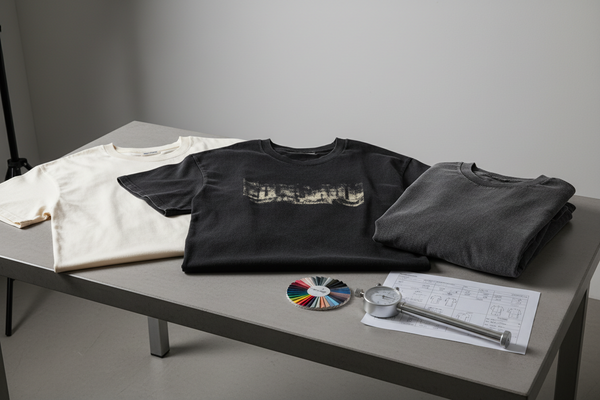
Color mismatch between the design proof and production is the fourth risk. Without spectrographic lab color validation, your production colors will deviate 2-5 shades from design intent. Specifiy Delta-E ≤1.50 DE00 measured under D65 illuminant using a spectrophotometer. Order sample strike-offs under calibrated lighting—approve colors under D65 illuminant (standard daylight) at 8-24lux. This prevents color mismatch between design proof and production.
8. Supply Chain FAQ Summary: Verified Action Ledger FAQ
Q: What GSM should I choose for campus rec staff performance apparel?
For high-activity staff environments, 140-160 GSM performance polyester or poly-cotton blend is optimal. This weight provides breathability and moisture-wicking while maintaining opacity. Below 140 GSM is too transparent for professional settings. Above 160 GSM is too heavy for high-activity environments and restricts movement.
Q: How do I prevent shrinkage in campus rec staff performance apparel?
Specify cellulose mechanical pre-shrinking (compactor finishing) for cotton-blend fabrics. For 100% polyester, specify heat-set finishing to stabilize the fabric. This reduces residual shrinkage to 2-3%. Require AATCC 135 testing documentation from your supplier. Without it, apparel shrinks 3-7% on first wash.
Q: What size distribution should I use for a 100-person campus rec staff order?
Use an athletic-optimized distribution based on staff data: S:10%, M:20%, L:35%, XL:25%, XXL:10%. Add a 15% buffer allocation for each size to absorb demand spikes. Campus rec staff skew larger than general student population due to athletic build distributions.
Q: How do I ensure staff apparel arrives before staff training?
Sync production targets directly around school term events. Plan backward from the staff training date: allow 14-21 days for production, 7-10 days for domestic delivery, and 5 days for QC and buffer. Minimum lead time: 26-36 days from order to staff hands. Add 14 days for design and sample approval.
Q: What is the best decoration method for campus rec staff apparel?
For 1-4 color designs, screen printing provides the best value and durability. For photographic designs or unlimited colors, DTF is the best option. For premium programs with a 3+ year lifespan, consider embroidery—it costs 30-50% more but provides unmatched durability and perceived quality for staff branding.