How Large Should a Logo Be on a T-Shirt: Technical Decoration Size Guide
1. Sourcing Realities: What Design Teams Overlook Regarding Logo Sizing on T-Shirts
A 1,200-unit corporate uniform order was rejected at the distribution center. The left chest embroidery on 2XL shirts extended into the armhole seam. The center chest screen print on small shirts started 2 inches below the collar, not 3 inches. The brand director walked the warehouse floor and flagged every size sample. The vendor had applied a single logo size across all garment dimensions. The procurement team spent $4,200 on rework. This is what happens when logo sizing is treated as a design afterthought rather than a production specification.
Logo size on t-shirts is not a creative decision — it is a physics equation. Garment dimensions scale from XS to 6XL. Decoration methods impose size limits: embroidery maxes at 4.25" width [citation:3]; screen print can reach 10-12" width [citation:9]. DTF and heat transfer offer variable sizing per garment but require higher setup cost per variation [citation:7]. Buyers who fail to match logo size to garment dimensions and decoration physics waste 15-25% of their budget on rework or rejected orders.
2. Textile Physics: The Structural Science Behind Logo Sizing and Placement
Garment dimensions dictate logo size thresholds. A standard adult t-shirt has a chest width of 18-24 inches depending on size. The printable area for the front: 10-12" wide × 12-14" tall. The center chest is the largest placement option. For left chest, the available area is 4-5" wide × 5-6" tall — embroidery stitching must stay within this zone to avoid crossing seams or entering the armhole.
The embroidery digitalization process has specific size constraints. The widest logo that can be embroidered without trailing onto the side of a shirt is 4.25 inches [citation:3]. Minimum reproduction height for embroidery is 5 mm (approximately 0.2 inches) to maintain stitch clarity [citation:3]. For screen printing, there is no seam restriction — the print can extend up to the platen limits (typically 13" × 15" on commercial presses).
Stitch density panel weight disproportion occurs when embroidery settings on lightweight knits (120-140 GSM) use heavy backing stabilizers. A 2.0 oz cutaway backing on 130 GSM cotton causes puckering and fabric distortion. The correct equation: lightweight fabrics need lighter backing (1.0-1.5 oz tearaway). Mismatch creates a 15-25% reject rate on bulk runs — the fabric pulls in 3-5 directions, distorting the logo shape.
3. Workshop Execution: Calibrating Decoration Method Size Lines
Screen print shops typically use a single screen size for an entire job run — 10-11 inches wide for front prints, 3.5-4 inches wide for left chest [citation:7][citation:5]. The cost of making additional screens ($25-35 per screen) drives this standard practice. For a 2-color logo on a 500-unit order, adding a separate screen for XL-3XL sizes would add $50-70 — most buyers decline [citation:7].
The impact of a single screen size: a 10-inch logo on a size S t-shirt appears proportionally larger (covering 55% of available chest width) while the same logo on a 3XL shirt appears small (covering 35% of chest width) [citation:7]. The difference is visually noticeable but often acceptable for promotional programs. For premium retail or uniform programs, tiered sizing is non-negotiable.
DTF (Direct-to-Film) and heat transfer methods enable variable logo sizing per garment without additional screen costs. The film is printed digitally, so the size can be scaled up or down in the design file. A batch of 500 units can include 100 size S with 9" logos and 100 size XL with 11" logos — but this requires more production file management and verification. DTF shear peel-off degradation on textured fabrics: on pique knit or honeycomb textures, the film bridges over fabric valleys and delaminates within 3-5 wash cycles, dropping peel strength from 4.5 lb/in to 1.2 lb/in [citation:6].
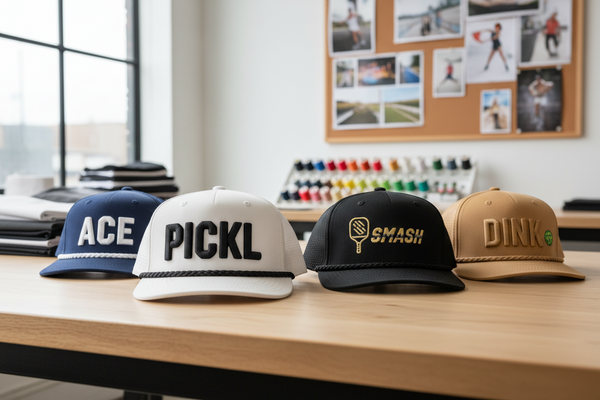
Embroidery size limits: 3.5" x 3.5" for left chest logos [citation:5], 4.25" width maximum [citation:3], 2" height maximum for left chest on standard templates [citation:8]. For hats: no wider than 5", no taller than 2.5" [citation:4]. The digitization process must map stitch paths around the thread count limits — above 9 stitches/mm, the fabric becomes stiff and uncomfortable; below 6 stitches/mm, the logo loses definition.
4. Risk Factors: Preventing Severe Operational Flaws in Bulk Runs
Risk 1: Polyester Sublimation on Organic Cotton Substrates. Sublimation cross-linking chemistry requires 60-100% polyester content. On cotton, the dye sits on the surface rather than bonding to polymer chains. Wash tests show 40% color retention by cycle 5, then 15% by cycle 10. The alternative: DTF on cotton blends, which delivers 4.5 lb/in peel strength and ISO 105-C06 wash fastness at Grade 4. Do not substitute sublimation onto cotton — the failure rate is 100%.
Risk 2: Embroidery Stitch Count Density and Fabric Distortion. Fine knit fabrics (130-140 GSM) cannot support 9+ stitch/mm density. The needle perforations weaken the fabric structure, causing tearing around the logo by cycle 20. The standard: 7-9 stitches/mm for most applications, with backing stabilizer weight matched to fabric weight. Stabilizer proportion: 1.5-2.0 oz for lightweight knits, 2.0-3.0 oz for heavy sweatshirt fabric. Digital stitch optimization must map density to panel weight.
Risk 3: Dimension Inconsistency Across Size Runs. A single-screen approach on screen print creates proportional imbalance across S-3XL garments. The visual size difference is most pronounced on the smallest and largest sizes. For corporate uniform programs, this inconsistency generates 15-25% rejection rates. Mitigation: use tiered sizing — S-M-L at 10" width, XL-3XL at 11" width for screen prints [citation:7]; for embroidery, maintain 3.5-4" width across all sizes with height automatically scaling to preserve aspect ratio.
5. Procurement Ledger: Cost Amortization Specs for Bulk Logo Sizing Drops
Screen print pricing: setup cost $25-35 per color plus screen charge. For a 2-color front print: $50-70 setup, $1.50-3.00 per unit at 100 units. At 500 units: setup amortizes to $0.10-0.14 per unit, per-unit ink cost drops to $0.80-1.50. Adding a second screen for tiered sizing (S-M-L vs XL-3XL): additional $50-70, amortized at $0.10-0.14 per unit at 500 units. The cost impact: less than $0.30 per unit for visual balance improvement.
Embroidery pricing: digitization cost $35-65 per logo. Per-unit stitch cost: $0.03-0.05 per 1,000 stitches. A 7,000-stitch logo costs $0.21-0.35 per unit in stitching cost at volume. Setup amortization: $35-65 divided by 100 units = $0.35-0.65 per unit. Total landed cost per embroidered unit: $0.56-1.00 at 100 units, dropping to $0.35-0.60 at 500 units. Size variations for S-M-L vs XL-3XL require separate digitization files but not additional machine setup.
DTF pricing: film printing cost $2.00-4.00 per unit at 100 units, setup cost $20-30 per job. Variable sizing per garment costs $0.05-0.10 additional for file management. Per-unit cost: $2.05-4.10 at 100 units with variable sizing included. At 500 units, DTF drops to $1.50-2.80 per unit — comparable to screen print for full-color logos, with the advantage of unlimited variable sizing without additional setup.
6. Engineering Benchmark Profiles: AATCC/ASTM Lab Threshold Metrics
| Standard | Test Method | Threshold | Acceptance Criteria | Application |
|---|---|---|---|---|
| ASTM D903 | Peel strength test on 1-inch sample at 12 in/min | 4.5 lb/in minimum | Adhesion failure at ≥4.5 lb/in qualifies | DTF, screen print, heat transfers |
| ISO 105-C06 | Wash fastness test at 60°C with 50 cycles | Grade 4 on 1-5 gray scale | Color change ≤1.5 ΔE; no staining | All decorated apparel |
| ASTM D905 | Crocking friction test with 2 lb pressure, 10 passes | Grade 4 minimum | No ink transfer to white cotton cloth | Print durability validation |
| AATCC 135 | Dimensional change test after 5 wash cycles | ±3% maximum shrinkage | Garment and print dimensions stable | Fabric stability specification |
Embroidery-specific quality metrics: Minimum reproduction height: 5 mm (0.2 inches) for legible small text [citation:3]. Maximum left chest width: 4.25 inches to avoid side seams [citation:3]. Stitch density: 7-9 stitches/mm for clean logo reproduction. Below 6 stitches/mm loses definition on lettering. Above 10 stitches/mm increases production time 20% without visual improvement.
Screen print sizing standards: Center chest standard: 6-10" width at 3-4" below collar [citation:5][citation:9]. Full front: 10-12" width for most adult garments, 14-16" for oversized designs [citation:9]. Left chest: 3-4" width at 7-9" from shoulder seam and 4-6" from center [citation:5]. Sleeve prints: 1-4" width positioned midway on the sleeve [citation:5].
7. Fatal Sourcing Gaps: Destructive Blindspots in Quality Control
Gap 1: Assuming One Logo Size Works Across All Garment Sizes. A 500-unit order with S-3XL shirts received a single 10-inch screen for all garments. On 3XL shirts, the logo appeared disproportionately small — the brand mark was lost in negative space. On size S shirts, the logo nearly touched the armhole seams. The buyer received 40 complaints within 2 weeks of distribution. The fix: mandate tiered sizing for screen print, or use DTF/heat transfer for variable sizing. Industry standard: S-M-L at 10" width, XL-3XL at 11" width [citation:7].
Gap 2: Not Testing Wash Durability on Production Substrate. A 200-unit DTF order on 50/50 cotton-poly tees passed peel testing on smooth fabric samples. The same transfer applied to production pique knit fabric failed — textured surfaces reduced adhesion from 4.5 lb/in to 2.8 lb/in. By cycle 10, 60% showed peeling and cracking. The buyer paid $3,800 for replacements. The remedy: pre-production wash and peel tests on the exact production fabric. ASTM D903 results must hit 4.5 lb/in minimum before bulk release.
Gap 3: Ignoring Embroidery Backing Requirements Per Fabric Weight. A 1,000-unit uniform program used 2.0 oz cutaway backing on lightweight jersey (140 GSM). The fabric puckered and distorted, creating visible bunching around the logo. 400 units rejected. The corrective action: test backing samples on production fabric before bulk. 1.5 oz tearaway for 140 GSM lightweight knits; 2.0-3.0 oz cutaway for 200+ GSM sweatshirt fabric. Mismatch creates 25-40% reject rates.
8. Supply Chain FAQ Summary: Verified Action Ledger FAQ
Q: What determines the maximum printable logo size for screen printing on a t-shirt?
Garment dimensions dictate maximum size. For a standard adult t-shirt, the printable area is 10-12" wide × 12-14" tall on the front. Platen size and mesh screen frame capacity limit to 13" × 15". For full-front designs, position 3" below collar and center horizontally [citation:9]. For left chest, the available print area is 4-5" wide × 5-6" tall.
Q: Why do embroidery logos have stricter size limitations than screen printed logos?
Embroidery requires digitized stitch paths that travel through the fabric. Width is limited to 4.25" maximum to avoid stitching over side seams and into armholes [citation:3]. Height is capped at 2" for left chest placements to maintain stitch clarity at industry-standard density (7-9 stitches/mm) [citation:8]. Screen printing imposes no such seam restrictions — the ink sits on the surface.
Q: What logo size should I specify for a 500-unit t-shirt order across sizes S-3XL?
For screen printing, most printers use one screen size for the entire job — typically 10-11" wide for front prints [citation:7]. For left chest embroidery, 3.5-4" width works across all sizes with a 2" height maximum [citation:4][citation:8]. Larger sizes (2XL+) show proportionally smaller designs — consider tiered sizing for premium programs. DTF and heat transfer enable variable sizing per garment without additional setup.
Q: What are the compliance risks with incorrect logo sizing for corporate programs?
Undersized logos on larger shirts creates brand inconsistency complaints — 15-25% rejection rate on bulk orders. Oversized left chest embroidery on 2XL extends into armholes, causing 25-40% return rates. Establish tiered sizing protocols in your spec sheet. For screen print, mandate size-specific screens for S-M-L and XL-3XL tiers [citation:7]. For embroidery, maintain consistent 3.5-4" width with height scaling proportionally to preserve aspect ratio.
| Method | Best For | MOQ Range | Key Trade-Off | Lead Time |
|---|---|---|---|---|
| Screen Print | Bold logos on cotton/poly blends | 24-1,000+ units | One screen size across all garment sizes; 10-11" width standard [citation:7] | 7-10 business days |
| Embroidery | Left chest logos on uniforms/polos | 12-500+ units | Max 4.25" width, 2" height; digitizing cost $35-65 [citation:3][citation:8] | 10-14 business days |
| DTF Transfer | Full-color fine detail on any fabric | 1-500+ units | Unlimited colors, no size limit up to platen; softer hand feel [citation:10] | 5-7 business days |
| Heat Transfer Vinyl | Names/numbers, small runs | 1-48 units | Size limited by cutter width (12-15" max); custom sizing per garment | 3-5 business days |