Calibrating Thread Count for Heavy Embroidery: Engineering Guide for Design Teams
1. Sourcing Realities: What Design Teams Overlook Regarding Substrate Material Constraints
Design teams regularly initiate product development cycles by prioritizing aesthetic trends, completely detached from the physical constraints of industrial textile substrates. When drafting high-density graphic specs for a capsule streetwear collection, creative departments select blank garments based exclusively on surface hand-feel and visual drape. This fundamental detachment from core manufacturing realities guarantees high factory rejection rates. Sourcing operations fail because designers treat fabric as a passive canvas rather than an active material matrix governed by mass, tensile elasticity, and chemical binding boundaries. A garment is a structural assembly; executing decoration without auditing the underlying knit geometry triggers structural failure in the production line.
The primary breakdown occurs when product development managers mandate high-density decoration methods onto structurally incompatible yarn setups. For example, a loose open-end knit fabric construction lacks the structural lock needed to handle thousands of high-speed needle penetrations. When the manufacturing floor attempts to execute dense patterns on these unrefined substrates, the physical impact splits the yarn strands, causing holes, localized distortion, and misaligned artwork. Procurement buyers must force design teams to coordinate directly with the mill to establish baseline physical testing before finalizing art dimensions. Without this initial material alignment, your volume production run remains highly exposed to severe structural failure.
Furthermore, local mill sourcing protocols often mask underlying yarn variations behind temporary chemical softeners. A garment panel that feels pristine during the initial showroom review can degrade into a unstable, unprintable surface once it passes through the high-temperature dryer belts of an automated screen printing plant. Silicone coatings and industrial sizing agents fill the gaps between low-quality fibers, giving the illusion of a tight fabric face. When these chemical coatings meet curing temperatures exceeding 160°C, they volatize. This exposes the raw, irregular structural nature of low-tier open-end yarn rolls, leading directly to uneven ink absorption, surface pinholing, and immediate graphic distortion. To protect supply chain continuity, design teams must transition away from subjective tactile assessments and enforce rigid, metric-driven substrate verification data sheets at the point of origin.
2. Textile Physics: The Structural Science Behind Thread Count
The mechanical behavior of a knit fabric panel under decoration stress is directly dictated by its yarn geometry and mass per unit area. In custom apparel manufacturing, the concept of thread count translates to the stitch density and gauge of the circular knitting machines. A high-gauge machine configuration tightly interlocks long-staple combed ring-spun cotton yarns, creating a stable planar surface. This structural integrity minimizes lateral yarn displacement when external forces are applied. When an automated screen printing squeegee deposits heavy plastisol ink layers, or when an embroidery needle drives polyester thread through the loops, a dense fabric matrix absorbs the energy evenly across the panel coordinates. This prevents the substrate from collapsing under high decoration stress.
Conversely, low-density substrates containing a high percentage of short carded fibers exhibit structural instability under tension. The spaces between the knitted loops are larger, leaving the fabric open to deformation. When subjected to the localized weight of cured ink or structural thread blocks, these loose matrices suffer from severe dimensional warping. The physical weight of the decoration pulls the surrounding yarns out of alignment, yielding a visible defect known as structural distortion. By specifying a tight 30-singles or 40-singles yarn configuration paired with a high-density gauge layout, procurement buyers ensure the fabric face provides a uniform foundation that resists the physical forces applied during commercial decoration runs.
To quantify this structural behavior, materials engineers analyze the interaction between yarn count and structural stability. The relationship determines how much a knit structure will stretch and deform when subjected to the mechanical stress of automated machinery. A fine-gauge, high-density knit controls the structural boundaries of the individual loops, preventing them from sliding or collapsing. This retention of shape under tension is what protects the graphic panel from warping. When your design specs demand a perfectly flat, non-puckered finish, the underlying knit architecture must have the mechanical strength to resist the physical forces of the decoration process. Relying on lightweight or loosely knit fabrics guarantees dimensional failure across your volume production batches.
3. Workshop Execution: Calibrating Embroidery Output Lines
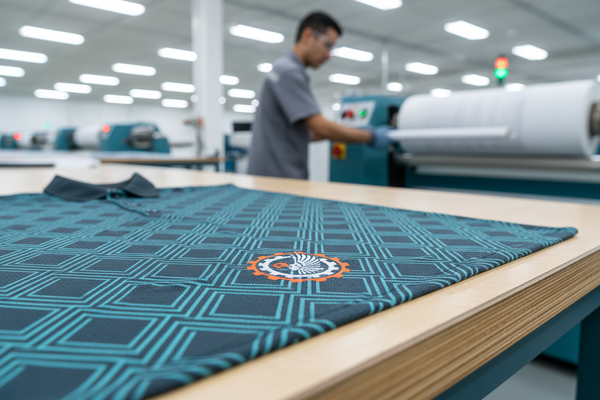
Executing clean, crisp decoration across hundreds of units requires precise calibration of commercial production lines. For multi-head embroidery systems, technicians must continuously manage machine speed, needle selection, and thread tension parameters to match the specific elastic limits of the incoming fabric lot. Running a multi-head Tajima or Barudan array at 900 stitches per minute on a highly flexible single jersey fabric requires a completely different tension profile than executing the same pattern on a heavy 400 GSM brushed fleece panel. If the machine's pull tension exceeds the structural recovery limit of the fabric yarn, the needle penetrations pull the loops inward, causing immediate puckering along the boundary coordinates of the frame.
Digitizing files must be engineered to account for this physical behavior through precise vector node tensile modulation. Standard automated digitizing software outputs generic stitch distribution paths that do not account for textile elasticity. A professional custom decoration specialist must manually adjust the pull compensation values within the vector file, adding a calculated distortion offset that counteracts the physical compression exerted by the thread as it tightens. For highly volatile fine knit fabrics, stitch directions must be alternated across a multi-layered path layout to distribute the mechanical load evenly across both the warp and weft directions of the panel grid, preventing structural distortion. This manual adjustment ensures the finished pattern retains its intended geometric proportions without warping the surrounding textile panel.
Machine technicians must also optimize the selection of needle styles to fit the physical characteristics of the substrate. Sharp-point needles are engineered exclusively for woven textiles where they slice cleanly through the threads. Utilizing a sharp needle on a knit fabric cuts the structural loops, triggering run lines and holes that expand after standard washing cycles. Production floors must deploy ball-point needles (SES or SUK profiles) for all knit garments. These needles slide between the yarn loops without puncturing or severing the fibers. When paired with precise computerized tension regulators that adjust down to the single-gram level, this tooling configuration guarantees clean pattern execution while protecting the physical integrity of the garment panel assembly.
4. Risk Factors: Preventing Severe Operational Flaws in Bulk Runs
Bulk production lines are highly susceptible to severe structural failures when chemical or mechanical specifications are misaligned. A critical risk factor is organic substrate ink non-compatibility, which occurs when standard water-based or plastisol formulations are applied to fabrics treated with heavy silicone softeners or hydrophobic finishing agents. These chemical processing residues block the liquid ink from wetting and penetrating the cotton fiber cores. The cured ink layer remains weakly attached to the surface chemical layer rather than cross-linking with the cellulose structure. This latent manufacturing flaw is invisible during final packaging inspections but causes rapid graphic breakdown and splitting during initial consumer laundering cycles.
Another common risk factor is deploying rigid direct-to-film transfers onto high-texture dimensional fabrics. Heavy unrefined textiles, such as waffle knits, coarse slub yarns, or uncombed low-tier fleece, feature an irregular surface profile full of microscopic peaks and valleys. When a flat, non-elastic polyurethane carrier film is applied via a standard manual heat press, the hot-melt adhesive powder cannot flow deep enough into the fabric valleys to establish uniform contact. This incomplete bonding setup exposes the graphic to high structural stress during mechanical wash cycles. The lateral friction of the washing machine drum triggers DTF shear peel-off degradation, causing the transfer to delaminate along the unbonded valley coordinates.
Furthermore, structural damage frequently manifests as a severe stitch density panel weight disproportion when heavy embroidery files are executed on unstable, lightweight knits without the correct backing material. If a 15,000-stitch emblem is applied to a lightweight 160 GSM jersey fabric using a temporary tear-away backing, the stabilizer dissolves during the initial wash cycle. The lightweight fabric is then forced to support the heavy, dense patch of polyester thread on its own. The structural imbalance causes the embroidered zone to sag, twist, and distort the entire front panel of the garment. To eliminate this risk, procurement auditors must mandate a minimum 2.5-ounce non-woven nylon cutaway backing matrix that remains permanently bound to the inside of the garment panel, absorbing all mechanical loads across the product life cycle.
5. Procurement Ledger: Cost Amortization Specs for Bulk Thread Count Drops
Enterprise procurement executives must analyze custom apparel sourcing through a rigorous financial lens, balancing physical fabric specifications against the total cost of production. Opting for a low-tier, low-thread-count blank garment to slash upfront material costs is a flawed strategy that increases total unit costs due to high factory rejection rates. A low-GSM fabric with an unrefined knit matrix requires slower machine speeds, extra stabilizing components, and yields an average rejection rate of 4% to 7% due to misprints, bleeding, and structural distortion. Conversely, investing in a high-density, ring-spun substrate allows production floors to run automated equipment at maximum speeds while slashing decoration defects below 0.5%.
To evaluate these variables, buyers should calculate the complete amortization curve of the design program, factoring in set-up costs, print screen production runs, and machine hours. High-density screen printing demands significant initial setup costs for film outputs, emulsion coatings, and precision screen stretching. When these fixed costs are distributed across a short production run of low-quality garments, the unit cost increases significantly. If a low-tier fabric choice triggers a batch rejection, the entire cost of the specialized setup must be absorbed by fewer sellable units. This rapidly erodes the projected profit margins of the custom garment drop.
The table below provides a detailed structural cost breakdown comparing a low-tier open-end garment run against a specification-compliant, high-density ring-spun production run across a standard 2,500-unit batch allocation. Sourcing managers must use these data points to justify the higher initial fabric expenditure to corporate finance departments, proving that upfront material investments directly reduce final operational costs.
| Sourcing Metric Parameter | Low-Tier Open-End Run | High-Density Ring-Spun Run |
|---|---|---|
| Baseline Fabric Component Cost | $4.50 / Unit | $7.20 / Unit |
| Average Factory Defect Rejection Rate | 5.2% (130 Units Lost) | 0.4% (10 Units Lost) |
| Maximum Safe Embroidery Machine Speed | 550 Stitches / Minute | 850 Stitches / Minute |
| Required Backing Stabilizer Configuration | Double 3.0oz Cutaway (Expensive) | Single 2.0oz Tear-Away (Standard) |
| Amortized Printing Screen Setup Cost | $0.45 / Unit | $0.12 / Unit |
| **True Final Amortized Cost Per Unit** | **$11.85 / Net Sellable** | **$9.15 / Net Sellable** |
The data confirms that the low-tier fabric choice results in a higher final unit cost due to manufacturing inefficiencies and high waste rates. Sourcing low-weight fabric rolls limits embroidery machines to slower operating speeds, doubling the machine hours required to complete the production block. This speed penalty, combined with the cost of heavy backing matrices needed to stabilize unstable fabrics, completely erodes any initial savings. Enterprise buyers must use these metrics to block low-tier garment selections during early procurement phases.
6. Engineering Benchmark Profiles: AATCC/ASTM Lab Threshold Metrics
To remove subjectivity from quality control auditing, procurement contracts must enforce compliance with standard laboratory test methods. Manufacturers must submit independent third-party testing certification from accredited bodies (SGS, Intertek, or Bureau Veritas) before bulk shipments are approved for distribution. Relying on basic visual approvals creates severe supply chain vulnerability. Every custom apparel batch must meet minimum performance scores across standardized test methods for colorfastness, tensile strength, and shrinkage properties.
| Testing Standard ID | Physical Property Audited | Minimum Passing Threshold Value | Operational Risk Sample Context |
|---|---|---|---|
| **AATCC Test Method 61 (2A)** | Colorfastness to Commercial Laundering | Grade 4.0 Minimum Change | Prevents ink pigment washout and bleeding into contrast panels. |
| **ASTM D3787** | Bursting Strength of Knitted Textiles | > 220 Newtons of Resistance | Ensures substrate doesn't rupture during multi-needle embroidery hits. |
| **AATCC Test Method 135** | Dimensional Changes in Automatic Laundering | < 3.0% Length / Width Variance | Eliminates graphic twisting caused by uneven post-wash fabric shrinkage. |
| **ASTM D4970** | Pilling Resistance of Cotton Knits | Class 4.0 after 100 Cycles | Prevents fiber fuzzing from lifting and distorting thin transfer edges. |
| **AATCC Test Method 8** | Colorfastness to Crocking (Dry/Wet) | Dry: Grade 4.5 | Wet: Grade 3.5 | Verifies ink binding stability against friction during active product wear. |
When a production lot fails to meet these technical metrics, the underlying chemistry of the production batch is flawed. For example, a failing score on AATCC 61 points directly to inadequate ink curing or incomplete polyester sublimation cross-linking chemistry within the factory's dryer ovens. If the temperature profiles within those continuous belts drop even 5°C below the required activation threshold, the chemical inks remain unlinked. Procurement buyers should write these identical testing standards directly into the contract specifications, establishing clear grounds for batch rejection before container loading occurs.
7. Fatal Sourcing Gaps: Destructive Blindspots in Quality Control
The most severe failures in volume custom apparel sourcing occur within the blindspots of standard factory quality control systems. A catastrophic mistake is attempting polyester dye sublimation processes across organic raw cotton substrates. This error unfolds when creative design teams request high-vibrancy all-over sublimation prints on what they assume is a "premium comfort" 100% organic cotton hoodie. Disperse dyes do not possess the molecular structure to link with the natural hydroxyl groups of cellulose fibers. The dye gases simply coat the surface without forming permanent chemical bonds. During the first wash cycle, the unbonded inks wash away entirely, leaving a faded, ruined graphic and a total loss of decoration investment.
A parallel blindspot lies within the embroidery department, where operators routinely fail to match heavy embroidery backing matrices to highly volatile fine knit fabrics. When running volume programs, contract facilities prioritize speed and ease of execution over long-term product durability. To hit daily unit targets, piece-rate workers use cheap tear-away backings across all garment types, including delicate, stretchy knit items. The garment looks acceptable during final trimming because the temporary paper backing holds the structure in place. However, once the end-consumer launders the item, the backing dissolves, and the surrounding yarns pull inward. This leaves the corporate buyer with a distorted, puckered mess that cannot be salvaged.
Finally, procurement teams consistently overlook the dangers of deploying rigid direct-to-film transfers onto high-texture dimensional fabrics without updating pressure and dwell parameters on the assembly floor. Standard factory setups utilize an automated heat press calibrated for flat jersey t-shirts. When the operator shifts to thick, structural loopback French terry or heavy ribbed fleece, they maintain the identical time and pressure settings. The rigid film bridges across the surface texture gaps rather than molding into the fabric valleys, creating hollow air pockets under the transfer layer. These hidden air gaps collect moisture during laundering, accelerating mechanical failure and ensuring premature peeling across your field inventory. Procurement teams must audit the production line floor, confirming operators adjust pressure settings to guarantee complete surface contact.
8. Supply Chain FAQ Summary: Verified Action Ledger FAQ
What is the minimum fabric specification required to prevent heavy embroidery puckering?
To eliminate puckering on custom knit garments, specify a minimum fabric mass density of 300 GSM composed of combed ring-spun cotton with a tight 30-singles weave structure. This must be paired with a mandatory multi-layered backing system consisting of at least one layer of permanent 2.5-ounce non-woven nylon cutaway stabilizer. The digital file must be manually adjusted by a custom decoration specialist to incorporate a 10% pull compensation offset within the vector path planning, counteracting the compressive mechanical forces of the embroidery thread.
Why does dye migration occur on printed polyester sportswear, and how can it be blocked?
Dye migration is triggered when the disperse dyes inside synthetic polyester filaments are heated above 130°C during ink curing cycles. The dye molecules change into a gas phase, rising through the applied print layers and tinting white inks into dull pinks or grays. To block this migration, printing specialists must apply a specialized low-bleed underbase ink layer mixed with active carbon particles. This ink barrier absorbs and traps the rising gas molecules before they reach the primary graphic ink layers, maintaining clean color separation across the production run.
How do you fix ink splitting and washing degradation on organic cotton print orders?
Ink splitting points directly to organic substrate ink non-compatibility caused by improper flash cure temperature management or chemical sizing agents left on the fabric. To fix this flaw, the mill must scour all fabric rolls using a tensionless water wash to strip away hydrophobic softeners before printing. On the printing floor, the automated flash cure stations must be calibrated using a digital pyrometer to guarantee the entire ink deposit thickness hits a stable 165°C for a minimum of 35 seconds, ensuring complete chemical cross-linking with the cellulose structure.
What logistics parameter is most critical when shipping decorated apparel lots via ocean freight?
The most critical parameter is moisture and relative humidity management inside the ocean shipping containers. High humidity combined with heat inside a sealed metal container triggers container rain, which softens paper embroidery backings and degrades cured plastisol ink interfaces. Sourcing managers must mandate that all finished custom apparel lots are wrapped inside 150-micron airtight polybags packed with active silica gel packs. The ocean shipping containers must be fitted with industrial moisture-absorbent blankets to prevent mold growth and structural graphic breakdown during transit.