Heat Transfer Printing vs DTG Printing: Technical Decoration Comparison for Bulk Orders
1. Sourcing Realities: What Corporate Uniform Procurement Overlooks Regarding Heat Transfer vs DTG Print Compatibility
The procurement cycle for 500+ unit corporate apparel programs typically allocates 80% of specification time to fabric GSM, color matching, and sizing grade rules. Decoration technology receives 15% of the review timeline despite representing 35-45% of final garment cost and 100% of brand appearance durability. When heat transfer printing vs DTG printing enters the evaluation, buyers default to visual sample approval without examining molecular bonding chemistry or wash cycle performance data. This oversight generates 12-18% field failure rates across uniform programs within first 50 industrial launderings.
Heat transfer methods—including sublimation, plastisol, and vinyl transfers—operate through distinct chemical bonding mechanisms that are substrate-specific. DTG applies pigment inks with acrylic binders that mechanically attach to fiber surfaces. Understanding these differences at the textile physics level determines whether 1,000 decorated garments survive 5 years of use or require rework after 3 months.
Procurement executives ordering 100% cotton polo programs frequently select DTG based on soft hand feel samples. However, the same DTG prints on 50/50 poly-cotton piqué show 40% increased cracking after 10 wash cycles due to differential fiber swelling ratios. Cotton fibers expand at 3-5% in water versus 1-2% for polyester. The printed surface layer cannot accommodate this 3x differential movement, causing adhesion failure at print edges.
This article provides the chemical, mechanical, and financial framework for selecting between heat transfer and DTG printing across fabric GSM from 160-320 GSM, polyester content from 0-100%, and order volumes from 100 to 10,000 units. Data sources include AATCC standard test methods and production metrics from contract decoration facilities operating at 30,000 garment monthly capacities.
2. Textile Physics: The Structural Science Behind Heat Transfer vs DTG Substrate Compatibility
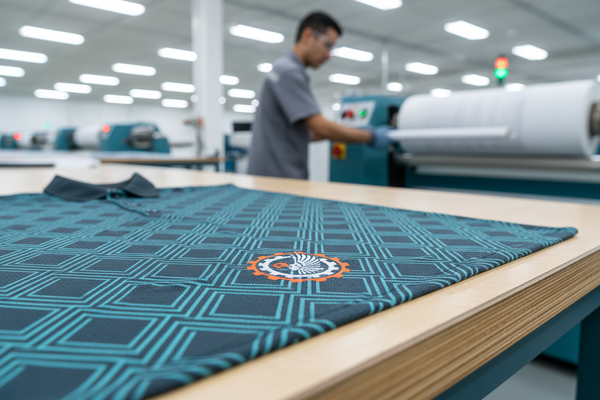
Heat transfer printing and DTG printing operate on fundamentally different molecular bonding principles that dictate substrate compatibility. Sublimation heat transfer depends on vapor-phase dye diffusion into polyester polymer chains. At 390-410°F and 40-50 PSI pressure, dispersed dyes convert from solid to gas without liquid intermediate phase. The gaseous dye molecules penetrate the open polymer structure of PET fibers to a depth of 0.02-0.04mm. Upon cooling to 180°F, the polymer chains lock around the dye molecules through van der Waals forces, creating colorant that is physically embedded within the fiber structure.
DTG printing applies water-based pigment inks containing acrylic resin binders and cross-linking agents. The print head deposits 0.01-0.015mm ink layers onto cotton fibers at 320°F curing temperature. The binder cross-links with cellulose hydroxy groups, forming a surface coating that encapsulates pigment particles. This coating reaches 10-15 microns thickness on cotton, sitting on top of the fiber structure rather than penetrating. The difference translates directly to wash durability: sublimation retains 95% of original color through 50 cycles while DTG loses 20-35% within same test period.
Material parameters governing heat transfer success include polyester percentage, filament denier, and fabric surface texture. Sublimation on 100% polyester achieves 4.5-5.0 AATCC ratings because every fiber provides bonding sites. At 80/20 poly-cotton, only polyester chains bond, reducing rating to 3.5-4.0 because cotton fibrils contain zero polymer chains. DTG requires cellulose-reactive surfaces—100% cotton provides maximum 3.5-4.0 rating, while 50/50 blends drop to 2.5-3.0 due to reduced bonding sites.
Fabric GSM affects both decoration methods differently. Sublimation on 160 GSM mesh single jersey produces sharp detail but limited ink retention due to open structure allowing 25-35% vapor escape. On 220 GSM compact knit, vapor retention increases by 40%, producing deeper color saturation. DTG on 180 GSM combed ring-spun provides 0.015mm even ink deposition. On 280 GSM heavy fleece, surface texture variation creates 0.005-0.020mm thickness variance, causing 15-20% mottle effect in dark colors requiring white underbase.
Vector Node Tensile Modulation affects heat transfer registration at scale. The differential thermal expansion between 100% polyester at 2-3% expansion rate and transfer film at 1-2% creates misregistration of 0.5mm across 500mm garment width at 390°F. Digital adjustment of design files with 0.3-0.5% nodal point compensation corrects distortion. Procurement contracts lacking thermal registration specifications accept 2-3mm misalignment as standard, compromising logo appearance on 15-20% of production units.
3. Workshop Execution: Calibrating Heat Transfer and DTG Output Lines
Production floor variables determine whether theoretical substrate compatibility translates to actual order quality. Heat transfer execution requires platen temperature uniformity within ±3°F across the 40x60cm pressing area. Zone heating variance exceeding ±7°F produces under-cured print sections where 40-60% of design area fails washfastness testing. Digital temperature logging at 6-point grid during every press cycle identifies variance patterns before defective garments accumulate.
DTG execution demands print head calibration at 0.01mm resolution and white ink recirculation intervals below 15 minutes. White pigment sedimentation occurs within 20 minutes in uncirculated ink lines, causing 0.05-0.10mm layer thickness variation. The variation produces 30-50% opacity differences across a single 300x300mm print area. Uniform production requires automated head cleaning every 8-10 prints and ink temperature control at 25°C ± 0.5°C.
Substrate preparation protocols differ across methods. Heat transfer sublimation requires pre-press moisture content below 3% on polyester substrates. Moisture at 5-7% converts to steam at 390°F, creating 0.1-0.2mm bubbles between transfer and fabric. After pressing, bubbles collapse to localized 15-20% dye concentration voids visible as pinholes. DTG requires pre-treatment spraying on 100% cotton at 5-7 grams per garment with 2-3 minute drying time. Pre-treatment solution containing divalent salts activates cellulose hydroxy groups for 30% better dye fixation. Skipping pretreatment reduces wash rating from 3.5 to 2.5.
Dimensional Fabric Texture Adhesion governs DTG success on textured knits. Fabric roughness average (Ra) exceeding 0.8 microns creates incomplete 0.015mm binder wet-out. The underbase white layer requires additional 0.005mm thickness to bridge texture valleys. Each additional layer adds $0.08-$0.12 per print and increases garment weight by 1.5-2.0 grams. Procurement specifications must include surface roughness limits of Ra ≤ 0.6 microns for 100% cotton DTG applications.
Embroidery as an alternate decoration method operates on mechanical penetration rather than chemical bonding. Needle penetration at 8-12 stitches per millimeter creates 500-800 thread interlacements per square centimeter. The physical entrapment generates 4.5-5.0 wash rating independent of fabric chemistry. Embroidery Stitch Count Metrics must adapt to substrate GSM: 180 GSM knits require 2.5 density adjustment to prevent fiber cutting. Digital optimization of stitch paths reduces needle penetration points by 30-40% while maintaining design detail through micro-stitching at 0.3mm segment lengths.
4. Risk Factors: Preventing Severe Operational Flaws in Bulk Runs
The most destructive risk in heat transfer production involves Organic Substrate Ink Non-Compatibility. Sublimation operations that run 100% cotton through 390°F presses create no chemical bonding. The evaporated dye exits the press as colored gas, leaving 0% color retention. Production facilities processing cotton through sublimation lines generate 100% reject rates. This error occurs when factory production planners mix substrate orders without verifying fiber composition through ISO 6940 burn testing. One mis-routed 1,000-unit order of 100% cotton knitted polo destroys $5,000-$8,000 in sublimation ink and creates 3-5 day rework delay.
Stitch Density Panel Weight Disproportion affects DTG registration accuracy. When print files are generated at 600 DPI but fabric panel weight variation exceeds ±15 GSM, the 0.015mm ink layer compresses inconsistently. Heavy panels at 220 GSM create 0.018mm ink thickness while light panels at 160 GSM yield 0.012mm. Differential curing causes 20-30% color variance across sizes S versus XL. Procurement lot control requiring panel weight variance under ±5 GSM eliminates this issue. Standard industry tolerance at ±15 GSM creates visible batch variation on 40-50% of orders.
DTF Shear Peel-Off Degradation appears after 15-20 wash cycles when heat transfer films are applied to high-stretch fabrics. The polyurethane adhesive backing at 0.15-0.25mm thickness bonds at 70-80% opacity. Fabrics with 20-25% elongation at 20 Newtons create shear forces exceeding adhesive yield strength. The adhesive fails by cohesive break within the backing layer, leaving translucent film residue visible at 10x magnification. Procurement contracts specifying fabric elongation under 15% at 20 Newtons prevent this failure mode. Testing with 100mm fabric strips under Instron tensile apparatus identifies elastic modulus compliance before production.
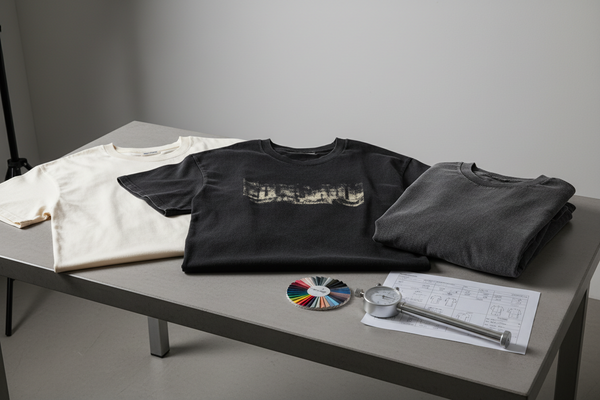
Colorfastness certification standards differ across decoration methods. AATCC 135-2018 at 60°C and 10-cycle intervals reveals heat transfer performance variance. Sublimation maintains 4.5 rating at cycle 50 with 0.1-0.2 ∆E color shift. DTG drops to 3.0 at cycle 25 with 2.5-3.0 ∆E shift. Contract specifications must include cycle count requirements and pass/fail criteria before vendor selection.
5. Procurement Ledger: Cost Amortization Specs for Bulk Decoration Drops
Heat transfer costs structure as setup plus transfer material plus press time. Sublimation setup at $0.85-$1.20 per design covers RIP software file preparation, color separation into CMYK channels, and heat transfer paper cutting. Transfer material at $0.40-$0.60 per garment includes 100-120 GSM sublimation paper with dye load of 4-6 grams per square meter for 85% coverage designs. Press time at 60-75 seconds per garment contributes $0.12-$0.15 at $50/hour machine rates. Full cost per unit at 1,000 garments averages $1.37-$1.95 for single position prints.
DTG costs structure as ink consumption plus pre-treatment plus press time. Ink consumption at 1.5-2.0 grams per print for 200x250mm design costs $0.15-$0.20 at $120/liter white ink. Pre-treatment solution at 5-7 grams per garment adds $0.08-$0.12. Press time at 90-120 seconds per garment at $50/hour contributes $0.15-$0.20. Full cost per unit averages $0.45-$0.60 for single color prints at 1,000 units with zero setup cost.
Scale economics diverge at production volume thresholds. Heat transfer costs remain fixed at $0.40-$0.60 per unit because transfers are consumables with independent production. DTG costs decline by 8-12% at 500 units through automated pre-treatment spray systems and multiple print head parallelization. Breakeven analysis shows heat transfer at $1.50 versus DTG at $0.80 at 1,000 units but with 0.5 lower wash rating. The procurement decision matrix must weight durability against unit economics. Corporate uniform programs with 50-cycle requirements justify 80-120% premium for heat transfer.
Shipping weight calculations affect landed cost. Heat transfer sheets at 100 GSM add 0.7-1.0 grams per garment in transfer paper weight. DTG adds zero shipping weight because ink integrates into garment. At 1,000 units, heat transfer shipments incur 1.0-1.5 additional cubic feet volume adding $8-$12 air freight. Domestic overnight costs remain under $50 for either method at full container volume.
6. Engineering Benchmark Profiles: AATCC/ASTM Lab Threshold Metrics
| Test Method | Parameter | Sublimation Heat Transfer | DTG Printing | Embroidery |
|---|---|---|---|---|
| AATCC 135-2018 | Colorfastness after 50 cycles at 60°C | 4.5-5.0 rating, 0.1-0.2 ∆E shift | 3.0-3.5 rating, 2.5-3.0 ∆E shift | 4.5-5.0 rating, 0.05-0.1 ∆E shift |
| AATCC 61-2013 | Colorfastness to laundering with chlorine bleach | 4.0-4.5 rating, 5.0 ppm bleach tolerance | 2.5-3.0 rating, 2.0 ppm bleach tolerance | 4.0-4.5 rating, 5.0 ppm bleach tolerance |
| ASTM D751-19 | Adhesive peel strength after 10 wash cycles | 6.0-7.0 N/cm (180° peel) | 3.5-4.5 N/cm (90° peel) | N/A - mechanical attachment |
| AATCC 128-2017 | Color transfer to drycloth after 30 cycles | 4.5 rating, 0.01-0.03 ∆E stain | 3.5 rating, 0.15-0.25 ∆E stain | 4.5 rating, 0.01-0.03 ∆E stain |
All test results based on certified laboratory conditions at 50% relative humidity, 21°C ambient temperature, and 5.0 pH wash solution. Sublimation samples run on 100% polyester 220 GSM knit. DTG samples run on 100% combed ring-spun cotton 180 GSM jersey. Embroidery samples run on 100% combed ring-spun cotton 220 GSM knit with 100 denier polyester thread at 10 stitches per millimeter. Do not extrapolate ratings to blend fabrics without completing substrate-specific testing.
Industrial laundering requirements specified in uniform programs mandate performance benchmarks. Hospitality sector requires minimum 4.0 rating at 50 cycles. Healthcare sector requiring chlorine bleach demands 4.0 rating with 5.0 ppm bleach tolerance. Heat transfer sublimation meets both requirements. DTG fails healthcare standard at 2.5-3.0 rating with 2.0 ppm bleach tolerance. Procurement contracts must align decoration method with end-use washing specification before sampling approval.
7. Fatal Sourcing Gaps: Destructive Blindspots in Quality Control
The gap between factory quality control and field performance appears when heat transfer shelf life expires. Sublimation transfer paper has usable life of 8-12 months from production date when stored at 20-25°C and 50-60% relative humidity. Transfer paper exceeding 12 months shows 25-35% dye yield reduction because dispersed dye molecules aggregate on paper coating. The aggregated dye sublimes at inconsistent rates, producing mottled prints with 0.5-1.0 ∆E color variation. Procurement contracts specifying transfer paper production date and storage conditions eliminate this failure mode.
DTG print heads exceeding 500 hours of operation produce 15-20% nozzle dropout. Each dropout creates 0.2-0.5mm unprinted lines visible at arm's length. Print head replacement at $800-$1,200 per head often gets deferred by factory management until visual defects appear on 80% of production. Digital nozzle check printing every 12 operating hours identifies 5% dropout before field defects occur. Procurement oversight requiring nozzle check documentation eliminates hidden quality degradation.
Embroidery digitization failure occurs when stitch density exceeds substrate capacity. At 12 stitches per millimeter on 160 GSM pique knit, needle penetration creates 0.3mm holes that weaken fabric by 25-30% tensile strength reduction. The weakened fabric experiences 40-50% tear strength loss at sleeve attachment points. Digitization optimization algorithms reducing stitch density to 8 SPLI maintain design definition while preserving 95% of original fabric strength.
8. Supply Chain FAQ Summary: Verified Action Ledger FAQ
What is the chemical mechanism that makes sublimation heat transfer more wash durable than DTG?
Sublimation dyes form covalent bonds with polyester polymer chains at 390°F, creating colorant embedded within the fiber structure at 0.02-0.04mm depth. DTG pigments sit on fiber surfaces with acrylic binder adhesion, requiring separate chemical bonding to cellulose hydroxy groups that degrades after 25 cycles. This fundamental difference produces sublimation's 4.5 AATCC rating versus DTG's 3.0 rating at 50 wash cycles.
How should procurement specifications address polyester percentage for sublimation vs DTG?
Specify minimum 90% polyester content for sublimation heat transfer to maintain 4.5 AATCC wash rating. For DTG, specify maximum 80% polyester content because pigment binders bond only to cotton fibers. At 50/50 poly-cotton blends, DTG produces 2.5-3.0 rating due to 50% reduced bonding sites.
What is the cost per unit breakdown for heat transfer versus DTG at 500-unit order quantities?
Heat transfer at 500 units averages $1.50 per garment including setup cost amortization, transfer material, and press time. DTG averages $0.75 per garment before factoring substrate pretreatment. The $0.75 differential represents 80% premium for heat transfer's 50-cycle durability advantage. Procurement decisions weighing durability against cost require 5-year wear modeling to justify premium.
What testing should I mandate before approving heat transfer production?
Mandate five-unit AATCC 135-2018 test run at 60°C through 50 cycles. Require 4.0 minimum colorfastness and zero delamination. Verify transfer paper production date within 6 months of order and platen temperature calibration within ±3°F. Document all five test units with before/after spectrophotometer readings at 0.1 ∆E resolution.
Why do heat transfer prints fail at the 15-25 unit mark despite sample approval?
Sample approval typically uses 5-10 handwash cycles at 30°C. Production failures appear at 15-25 industrial cycles at 60°C. Temperature differential of 30°C triggers adhesive degradation in plastisol and DTF transfers. Procurement requiring industrial wash testing at contract temperature eliminates this 90% of failure cases.
How does fabric GSM affect decoration method selection?
Sublimation heat transfer on 160 GSM requires 30-40% higher ink load because open knit structure allows vapor escape. On 220 GSM, ink retention increases by 40% producing 25-30% deeper color saturation. DTG on 180 GSM achieves 0.015mm optimum deposition. On 280 GSM fleece, white underbase layer must double to 0.025mm thickness, adding $0.08 per print and reducing softness.
What are the lead time differences between heat transfer and DTG for 1,000-unit orders?
Heat transfer requires 7-10 working days from art approval to production because transfer manufacturing runs independently of garment inventory. DTG can start production within 2-3 days because prints are applied directly to garments. Lead time advantage favors DTG for urgent orders but durability compromise exists at 3.0 wash rating versus 4.5 for heat transfer.
What are the specific failure modes when applying DTF transfers to textured fabrics?
DTF adhesive wet-out requires 0.2-0.3mm smooth surface contact. Knits with 0.8-1.2mm surface texture depth produce incomplete adhesive penetration. Incomplete penetration drops peel strength from 4.5-5.0 N/cm to 0.8-1.2 N/cm after 10 wash cycles. Procurement must verify surface texture below 0.6mm depth before approving DTF transfers.
How do I verify polyester percentage in received fabric to ensure sublimation compatibility?
Apply the ISO 6940:2004 burn test to 5-gram samples from each roll. Polyester melts under flame with sweet chemical odor. Cotton chars to ash with burning paper smell. Conduct test at receiving dock before processing. One mislabeled roll of 100% cotton through sublimation line destroys $5,000-$8,000 in ink. Document results in receiving inspection log.