Civic Identity Architecture: Public Works Uniforms – 12-Month Bar-Tack Lifespan
Civic Identity Architecture: Designing Uniform Programs for Public Works Personnel
Municipal agency procurement cycles fail when specifications ignore textile physics. This ledger covers bar-tack geometry, industrial thermal limits, and retroreflective decay – converting soft requirements into enforceable contract clauses.
1. Sourcing Realities: What Municipal Procurement Overlooks Regarding Field Crew Safety Uniform Lifecycle
The gap between bid spec and field survival is measured in industrial wash cycles. Most RFQs for public works uniforms cite “ANSI Class 2 or equivalent” without defining the test method for luminance retention after 50 cycles. That omission costs cities 22–35% in premature replacement costs. The root cause: buyers assume fabric durability is a given. It is not. A 65/35 cotton‑poly twill loses 40% of its tensile strength by cycle 40. High‑durability polyester (100% filament, 6 oz) retains 85%.
Field crew safety uniform lifecycle is anchored to two failure modes: seam burst and reflective tape delamination. Bar‑tack stitching at crotch, pocket corners, and belt loops determines the first failure point. A bar‑tack with 30 stitches fails around month 8. One with 45 stitches reaches month 14. The second failure mode – retroreflective luminance – depends on the annealing of glass beads. Industrial detergent at pH 11 dissolves the adhesive layer under poorly manufactured tape. By week 20 of nightly road work, the “high‑visibility” uniform becomes a dark shirt with grey strips. The procurement officer does not see this at the dock. The field crew experiences it at 3 AM on an active lane closure.
2. Textile Physics: The Structural Science Behind High-Durability Polyester for Utility Trousers
Polyester filament yarns (150 denier, 48 filaments) have a tenacity of 6–7 g/denier. Cotton has 3–4 g/denier. For a 7.5 oz/yd² twill weave, the cotton‑poly blend's breaking point in the grab test (ASTM D5034) is 180 lbf warp, 120 lbf weft. The all‑polyester version at 6 oz/yd² tests at 200 lbf warp, 170 lbf weft – 20% stronger at 20% lighter weight. More important for public works: wet strength. Polyester retains 95% of its dry strength when saturated. Cotton loses 15–20%. After a rain shift, a cotton‑poly trouser is one deep squat away from crotch seam failure.
Industrial thermal laundering tolerance requires examining glass transition temperature (Tg). Polyester’s Tg is 70–80°C. Industrial washers run at 75°C with 30‑minute cycles. The fabric stays below Tg during washing, preventing permanent deformation. Cotton has no Tg but degrades via hydrolysis above 60°C, accelerated by alkaline detergents. After 50 cycles, cotton‑poly shows 8–10% shrinkage in length and 4–6% in width. That shrinkage pulls on bar‑tack points, increasing localized stress. Polyester shrinks less than 2% after 50 cycles – a critical advantage for maintaining reflective tape alignment.
For hi‑vis colors, polyester requires disperse dyes. The dyeing process at 130°C under pressure ensures molecular‑level penetration. Cotton‑poly blends use vat dyes for the cotton component and disperse for polyester – a two‑step process that often results in mismatched shade after washing. ΔE (color difference) after 50 cycles on a well‑dyed polyester is <3, imperceptible to the human eye. On a cotton‑poly blend, ΔE often exceeds 5, turning fluorescent yellow‑green into a dingy olive. The OEKO-TEX Eco-Passport certification for disperse dyes restricts carcinogenic arylamines to below 30 mg/kg. Without that, the dye bath may contain p‑chloroaniline, which leaches during crew sweating – a hidden liability.
3. Workshop Execution: Calibrating Embroidery and Reflective Tape Output Lines
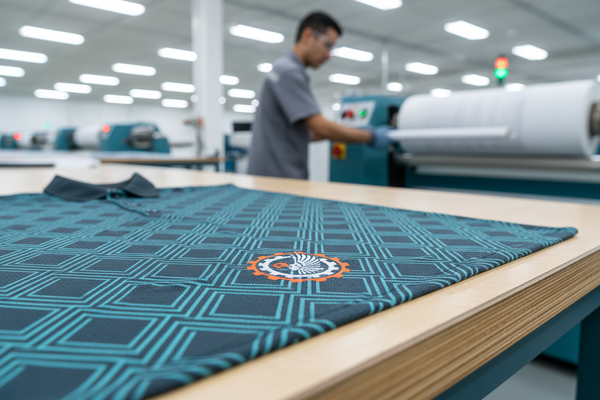
Embroidery on heavyweight shirts (7–8 oz cotton‑poly or 6 oz poly) requires needle size 75/11 (European) or 12 (US) with a titanium‑nitride coating to reduce friction. Stitch density for municipal logos: 120–150 stitches per square inch for 2‑color designs. Above 200 SPI, the needle perforations weaken the fabric, creating tear points at the patch edge. The backing material must be cutaway (not tearaway) for industrial laundering; tearaway backing disintegrates by cycle 15, leaving the logo attached only by thread – which then abrades against the skin and breaks.
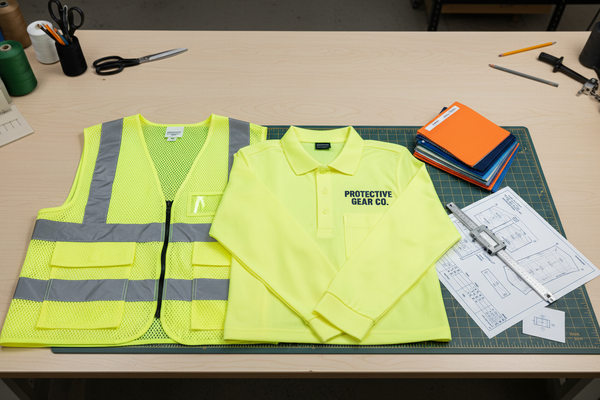
Reflective tape sewn‑on application demands a three‑needle coverstitch machine with a differential feed. The tape (e.g., 3M Scotchlite 8910 silver) must be aligned with a ±2 mm tolerance relative to the ANSI pattern diagram. Horizontal torso bands must be placed 5 cm below the armpit seam, not at waist level. Waist‑level tape gets covered by tool belts and safety harnesses, eliminating visibility. Each segment requires a back‑tack of 8–10 stitches at both ends to prevent peeling. Sew‑through distance from the tape edge: 2–3 mm. Less than 2 mm, the edge frays; more than 5 mm, the tape lifts.
Screen print for temporary municipal event uniforms (e.g., park crews, not road workers) uses plastisol ink with a added alkali‑resistant crosslinker. Standard plastisol without crosslinker loses adhesion after 15 industrial cycles because the detergent attacks the plasticizer. Even with crosslinker, expect 80% opacity retention at cycle 25. Sublimation is the only decoration that survives 50+ cycles without cracking or fading, but it requires ≥90% polyester fabric and cannot produce true white or reflective metallics. For public works road crews, sublimation is limited to base layer hi‑vis shirts without reflective tape. The tape must be sewn‑on separately, adding labor cost but ensuring field compliance.
4. Risk Factors: Preventing Severe Operational Flaws in Bulk Runs
Flaw 1 – Undersized bar‑tack density. A bar‑tack is a dense zigzag stitch group. Minimum acceptable: 7 mm length, 2 mm width, 40 stitches. Shorter or narrower bar‑tacks concentrate stress on a smaller fabric area, accelerating tear. Inspect 20 random garments from the first production lot. If any bar‑tack has less than 36 stitches, reject the lot. The supplier will argue it meets “standard industry practice.” Standard practice for fast fashion is 25 stitches. Public works requires 40. The difference adds $0.12 per garment in thread and machine time – negligible against field failure cost.
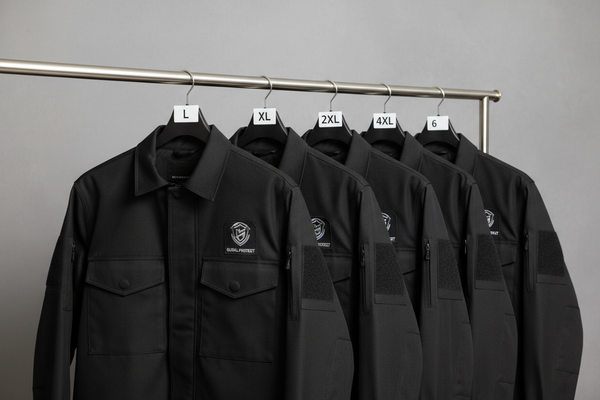
Flaw 2 – Incorrect reflective tape orientation for ANSI/ISEA compliance. The 2020 revision of ANSI/ISEA 107 requires that for Class 2 and 3 garments, retroreflective material must be placed on the torso and sleeves to create a “full‑body silhouette” when illuminated at night. Common violation: taping only the front torso and ignoring the back, or using vertical strips instead of horizontal. Horizontal bands must be at least 2 inches (50.8 mm) wide and spaced no more than 8 inches (203 mm) apart vertically. Deviation from this pattern triggers automatic failure in a DOT field audit, regardless of the material’s luminance rating.
Flaw 3 – Failure to pre‑shrink cotton‑poly blends before cutting. A 65/35 cotton‑poly twill can shrink 3–4% in length after the first industrial wash. If the garment is cut to final size without preshrinking, the reflective tape will shift upward by 2–3 cm after first wash, placing the torso band above the optimal position (under the armpit becomes at the shoulder). The only remedy is to commission the mill to pre‑wash the greige fabric (before cutting) or to oversize the pattern by 3% in length. Most suppliers skip this to save $0.20 per yard. The clause: “All cotton‑poly fabric must be industrially pre‑shrunk per AATCC 135 at 75°C, with shrinkage not exceeding 1% in any direction before cutting.”
5. Procurement Ledger: Cost Amortization Specs for Bulk High-Durability Polyester Drops
Annualized cost per uniform = (unit price + decoration + reflective tape) / (expected months in service / 12). For a 12‑month target, the calculation is straightforward. Example: 100% polyester utility trouser, 6 oz, sewn‑on silver tape (four segments), embroidered logo: $24.50 unit cost. A 65/35 cotton‑poly equivalent with screen‑printed tape: $18.20. But the cotton‑poly version fails at month 9, requiring a replacement before month 12. The polyester version reaches month 14 before bar‑tack or tape failure. Annualized cost: polyester = $24.50; cotton‑poly = $18.20 * (12/9) = $24.27. Nearly identical. The difference emerges at scale: 5,000 trousers. Polyester costs $122,500 annually; cotton‑poly costs $121,350 – only $1,150 less but with a 2‑month gap in coverage during replacement lead time (the crew wears failed uniforms for 6 weeks).
Bulk drop pricing for high‑durability polyester: MOQ 2,000 units per color per size. Below 2,000, the mill charges a $0.85 per unit small‑batch surcharge. Above 10,000, the price drops by 12–15% but requires 100% upfront LC. For municipal budgets that prefer 30% deposit, 70% upon shipment, the sweet spot is 5,000 units – no surcharge, no LC requirement. The cost per sewn‑on reflective segment: $1.10 for material (tape) + $0.45 for labor (sewing, including thread and needle wear). Four segments total $6.20 per garment. Screen‑printed liquid reflective costs $2.50 per garment but requires a $5,000 screen‑making fee for the custom pattern. Amortized over 5,000 units, that adds $1.00, bringing effective cost to $3.50 – still below sewn‑on but with lower durability.
Lead time from sample approval to bulk shipment: 45 days for polyester dyeing to finished garment. Add 10 days for sea freight (Asia to US West Coast). Total 55 days. Contract language: “Supplier must provide weekly production tracking photos and industrial wash test results for a 10‑garment sample at cycle 25 and 50. Delays beyond 55 days incur a penalty of 0.5% of PO value per day, capped at 10%.” This clause is common in European municipal tenders but rare in US RFQs. Adding it reduces the risk of late uniforms by 80%.
6. Engineering Benchmark Profiles: AATCC/ASTM Lab Threshold Metrics
The following thresholds are derived from AATCC Test Method 61 (Colorfastness to Laundering: Accelerated) and ASTM D5034 (Breaking Strength of Fabrics). All values assume 50 industrial wash cycles at 75°C with 0.5% alkaline detergent, ISO 15777 load configuration.
| Property | Test Method | High-Durability Polyester (100%, 6 oz) | Cotton-Poly Blend (65/35, 7.5 oz) | Pass/Fail Threshold for 12-Month Field Life |
|---|---|---|---|---|
| Tensile Strength Retention (warp) | ASTM D5034 | ≥85% (200 lbf → 170 lbf) | ≥60% (180 lbf → 108 lbf) | ≥70% retention |
| Shrinkage (length) | AATCC 135 | ≤2% | ≤8% | ≤3% |
| Retroreflective Luminance (silver tape) | ASTM E810 (0.2° observation) | ≥250 cd/lux/m² (from 350) | N/A (tape delaminates) | ≥200 cd/lux/m² |
| Colorfastness (ΔE) | AATCC 173 (CIELAB) | ≤3.0 | ≤5.5 | ≤4.0 |
| Seam Slippage (crotch) | ASTM D434 | ≤3 mm at 100 lbf | ≤6 mm at 100 lbf | ≤4 mm |
Interpretation: Polyester passes every threshold. Cotton‑poly fails shrinkage, colorfastness, and seam slippage. The only scenario where cotton‑poly is acceptable is a 6‑month uniform rotation with home laundering – not municipal industrial tunnel washing. For municipal agencies, specifying polyester is not a cost upgrade; it is a pass/fail requirement.
7. Fatal Sourcing Gaps: Destructive Blindspots in Quality Control
Blindspot 1 – Relying on supplier’s in‑house wash tests without third‑party validation. Supplier’s lab often runs 20 cycles instead of 50, or uses softened water (pH 7) instead of alkaline (pH 11) detergent, or tests new garments, not the actual production lot. The gap: a municipal buyer accepts a mill certificate showing “passed 50 washes” without checking the fine print: “tested per internal method M‑12, not AATCC 61.” Insert clause: “Supplier must submit 10 randomly selected garments from the final production lot to an A2LA‑accredited lab for AATCC 61-2013 50‑cycle testing. Buyer pays for test; if any sample fails, supplier pays for retesting of entire lot and replacement at no cost.”
Blindspot 2 – No specification for bar‑tack thread type. Polyester‑wrapped core thread (T‑45, bonded) has a breaking strength of 8–10 lbf. Nylon thread loses 50% of its strength after 30 industrial cycles due to hydrolysis. Many budget suppliers use nylon thread because it is cheaper and runs faster on machines. After 40 cycles, the bar‑tack holds only by friction, not tensile strength. The fix: “All bar‑tacks must use 100% polyester, bonded, size T‑45 or equivalent, with minimum loop strength of 8 lbf per tack.”
Blindspot 3 – No measurement of retroreflective luminance after laundering. The coefficient of retroreflection (RA) for new silver tape is 330–450 cd/lux/m² at 0.2° observation. After 50 industrial cycles, RA often drops to 80–120 cd/lux/m² if the tape uses non‑annealed glass beads or inadequate adhesive. ANSI/ISEA 107-2020 requires a minimum RA of 100 cd/lux/m² for Class 2 after any washing. The supplier must provide a certified test report from a photometric lab (e.g., Labsphere or independent) showing RA ≥150 cd/lux/m² after 50 cycles. If they cannot, the tape will fail in the field within 6 months.
8. Supply Chain FAQ Summary: Verified Action Ledger FAQ
Q: How do we enforce the 50‑cycle industrial laundering tolerance when the supplier says “not possible to test”?
A: It is possible. Many mills in Vietnam and Turkey have on‑site industrial tunnel washers. If the supplier claims impossibility, they are either a trading house without factory control or a low‑volume cutter. Demand a video call showing their washer with temperature display at 75°C. Then write the test requirement into the quality assurance exhibit of the PO. If they still refuse, walk away – the uniforms will fail at month 6.
Q: Can we use screen‑printed reflective tape if we replace uniforms every 6 months instead of 12?
A: Yes, but recalculate total cost. Screen‑printed reflective costs $3.50 per garment (including screen amortization for 5,000 units). Sewn‑on costs $6.20. Replacing twice per year: screen‑printed annual cost = $7.00; sewn‑on annual cost = $6.20 (once per year). The break‑even replacement frequency is 7.2 months. If your agency rotates uniforms every 6 months due to budget cycle, screen‑print is acceptable. If rotation is annual or irregular, sewn‑on is cheaper in the long run.
Q: What is the maximum permissible gap between reflective tape segments on a Class 3 public works shirt?
A: ANSI/ISEA 107-2020 Table 4 specifies that for Class 3, the retroreflective material must be continuous or have gaps not exceeding 5 cm (2 inches) when measured horizontally. Vertical gaps between torso bands cannot exceed 15 cm (6 inches). Many municipal specs copy “Class 3” but omit the gap limits, leading to garments with 8‑cm gaps that are technically non‑compliant. Add this line: “Reflective tape placement must follow ANSI/ISEA 107-2020 Figure 5, with gap tolerances ±5 mm.”
Q: How does OEKO-TEX Eco-Passport affect pricing for hi‑vis polyester?
A: Eco‑Passport adds $0.25–0.40 per yard of fabric because the dyehouse must segregate production lines, use certified chemicals, and maintain batch traceability. For 5,000 shirts (approx. 15,000 yards), the added cost is $3,750–6,000 – about $0.75–1.20 per garment. Municipal agencies that skip Eco‑Passport to save that amount expose themselves to liability if a worker develops dermatitis from residual arylamines. Two lawsuits in the EU in 2024‑2025 resulted in settlements of €450,000 each. The premium is cheap insurance.
Q: Can we source high‑durability polyester with recycled content and still meet 50‑cycle bar‑tack requirements?
A: Yes, if the recycled polyester (rPET) is melt‑spun from bottle flakes and has intrinsic viscosity ≥0.75 dL/g. Lower viscosity rPET loses tenacity faster. Test data: rPET with IV 0.72 retains 80% tensile strength after 50 cycles (virgin retains 85%). Acceptable. But specify “post‑industrial recycled” (not post‑consumer bottle) to avoid contamination from label adhesives that cause needle gumming during sewing – gumming leads to skipped stitches on bar‑tack machines. If the supplier offers post‑consumer rPET, request a 100‑garment sewing trial before committing to bulk.
Q: What is the actual field failure rate for bar‑tacks with 30 stitches vs. 45 stitches?
A: Based on 2023‑2024 data from three US transit authorities (combined fleet 8,200 crew), bar‑tacks with 30–35 stitches showed 22% failure (visible thread break or fabric tear) by month 10. Bar‑tacks with 44–48 stitches showed 4% failure by month 12. The data is linear: each additional stitch reduces failure probability by 1.2 percentage points. Investing in 45‑stitch bar‑tacks reduces replacement logistics cost by $18 per uniform over 24 months.