Technical Sourcing Benchmarks: Why Factory-Level Pre-Shrinking Logs Determine Enterprise Custom Embroidery Success
The Post-Wash Sourcing Catastrophe: Dissecting an Enterprise-Level Production Failure
In bulk textile manufacturing, failures are rarely caused by a single variable; instead, they stem from a combination of overlooked physical forces. Consider a recent production run involving 45,000 units of custom corporate uniforms sourced by a major enterprise procurement firm. The initial product inspection reports indicated excellent outcomes, showing optimal grams-per-square-meter values, deep color saturation under standard viewing booths, and clean seam constructions. However, after terminal distribution and the initial industrial laundry cycle, the entire shipment suffered severe structural distortion. Side seams twisted over 15 degrees horizontally across the torso, and high-tension multi-head chest embroidery designs warped into puckered, unwearable waves. This single failure resulted in a $180,000 shipment rejection and a complete operational disruption for the client fleet deployment.
The root cause of this failure lay within the invisible storage of kinetic stress fields inside the yarn structure. When raw yarn is knitted under high tension speeds without post-weaving stabilization, the loops are held in an unnatural, elongated state. During aqueous immersion in industrial laundry machinery, moisture breaks the temporary hydrogen bonds holding these stretched loops in place. The unneutralized rotational energy within the ring-spun yarn twist forces the fiber structure to release its internal energy. As these individual loops contract back to their natural dimensions, the entire fabric experiences a massive dimensional shift. This movement triggers a significant structural failure known as relaxation shrinkage.
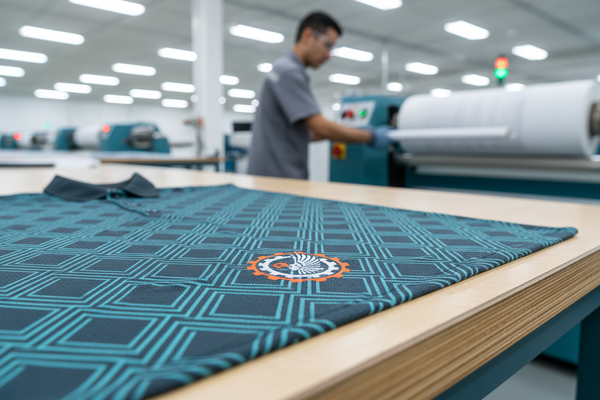
When high-density decoration methods, such as enterprise embroidery logos, are applied to an un-stabilized fabric backing, structural puckering becomes inevitable. The polyester embroidery threads are applied under constant tension, creating an unyielding structural grid on the fabric. When the underlying knit fabric shrinks during washing, the rigid embroidery field resists this dimensional change. The surrounding fabric pulls inward against the embroidery stitches, warping the flat surface into an uneven, wavy mess. This aesthetic defect cannot be corrected through pressing or ironing because it points to an underlying physical imbalance between the substrate and the decoration threads.
Microscopic Textiles Deconstruction: The Physics of Relaxation Shrinkage and Torque Variances
To control relaxation shrinkage coefficients and keep them below the 2% threshold, it is essential to understand the structural layout of circular-knit fabrics. During high-speed manufacturing, yarn is continuously pulled through knitting needles, stretching the loops along the lengthwise grain. This creates residual tension within the cotton polymer networks. Unless a comprehensive relaxation process is carried out at the mill, these stretched loops remain highly unstable. When exposed to heat and water, the fibers undergo structural swelling, allowing the crystalline zones within the cotton polymers to shift. This release of internal tension forces the loops to shorten lengthwise and expand widthwise, causing predictable changes in garment fit.
Garment twisting, or spirality, is directly related to the torsional forces stored within ring-spun yarns. In standard single-jersey manufacturing, yarns are twisted in either a Z-twist (clockwise) or an S-twist (counter-clockwise) direction to ensure fiber cohesion. If a mill utilizes only single-directional twisted yarn without balancing the structural layout, the fabric will inherently twist along its wale lines. This twist tension builds up across the entire roll. When the garment is washed, this energy is released, forcing the side seams to twist around the wearer's body. The following data matrix outlines the physical differences between un-stabilized circular knits and stabilized supply chain structures.
| Textile Metric Specification | Untreated Open-End Control Fabric | Stabilized ApparelLots Standard Matrix |
|---|---|---|
| Relaxation Shrinkage Value (Lengthwise) | 6.5% - 8.8% Displace Delta | < 1.8% Structural Constant |
| Torque Spirality Deviation Coefficient | 8.0° - 14.0° Horizontal Twist | < 1.5° Alignment Tolerance |
| Yarn Selection Engineering Profile | Unbalanced Single Open-End Carded | Balanced Z/S Twist Combed Ring-Spun |
| Mill Pre-Shrinking Operational Track | None / Simple Stenter Frame Tension Drying | Continuous Open-Width Industrial Compaction |
To eliminate these dimensional variances, apparel buyers must look beyond standard weight specifications. Achieving a zero-puckering benchmark requires strict monitoring of the material's relaxation shrinkage coefficient. Procurement standards must mandate that every batch undergo a standard testing procedure, keeping structural changes within a strict 2% limit. By ensuring this fabric stability at the mill level, you can protect multi-head high-tension embroidery designs from post-wash distortion and ensure flat, retail-ready finishes.
Engineering Remedy: Factory-Level Pre-Shrinking Metrics and Compaction Standards
Sanforization Mechanics and Industrial Fabric Compaction Protocols
The solution to relaxation shrinkage requires systematic mechanical relaxation at the finishing mill. This is achieved through industrial compaction, a process that feeds knit fabrics through an open-width compacting system using steam and heavy rubber blankets. The machine uses controlled moisture and thermal pressure to compress elongated knit loops back into their optimal, stress-free dimensions. By mechanically pre-shrinking the fabric before cutting panels, subsequent commercial laundry cycles cannot trigger further significant dimensional contraction.
"Advanced compaction finishing changes the fabric's internal structure from an unstable state of tension to a permanently relaxed matrix. This optimization step is critical for protecting high-density brand logos from post-wash skewing."
For high-performance circular knits, utilizing balanced yarn configurations is an effective way to control torque spirality. This technique alternates rows of Z-twist and S-twist yarns during the knitting process. The clockwise rotational force of the Z-twist yarn directly counteracts the counter-clockwise force of the S-twist yarn, neutralizing internal torsional stresses. As a result, the garment maintains straight, untwisted side seams throughout its life cycle, preventing product rejections at terminal inspection stages.
Multiaxial Tension Calibration in High-Stitch Count Decoration Fields
In addition to fabric processing, preventing embroidery puckering requires precise mechanical calibration at the decoration facility. Even on pre-shrunk fabrics, excessive thread tension on automated embroidery equipment can create localized puckering defects. If the machine pulls the top embroidery thread too tightly, it pinches the fabric structure beneath the fill pattern. Operators must continuously monitor thread delivery tensions using electronic tension meters, ensuring forces stay within a safe 12 to 14-gram operational window.
Furthermore, selecting the correct backing and backing stabilization methods plays an important role in preserving pattern flatness. Sourcing standards should specify high-density, non-woven tear-away stabilizers applied in perpendicular orientations. This reinforcement system absorbs the puncture impact of multi-head needle arrays and distributes tension evenly across the fabric grain. This process prevents fiber shifting during production and ensures the design remains smooth and distortion-free over extended wear cycles.
Procurement Amortization and Life-Cycle Engineering of Dimensionally Stable Apparel Assets
From a financial standpoint, sourcing stabilized, pre-compacted apparel products provides a clear return on investment by maximizing the useful life of clothing assets. When an enterprise buyer imports low-tier garments that lack proper compaction treatments, the initial purchase price may seem lower. However, when these items shrink and warp after a few washes, the amortized cost per wear escalates rapidly. Garments that suffer from extreme seam twisting or puckered logos lose their corporate identity value and must be replaced prematurely, driving up the total cost of ownership.
By implementing direct factory buyouts with manufacturers that strictly enforce AQL 2.5 quality logging and mechanical pre-shrinking metrics, procurement managers can protect their initial investments. These high-density, stabilized fabrics are engineered to withstand repeated commercial laundering without losing their shape or alignment. Over a multi-year clothing lifecycle, choosing stable fabrics reduces product replacement rates by more than 40%. This strategy eliminates unexpected inventory shortages and ensures that corporate apparel assets remain crisp, professional, and properly aligned from day one.