Optimizing Thread Count and Embroidery Calibration for Design Teams
1. Sourcing Realities: What Design Teams Overlook Regarding Bulk Apparel Procurement
Design teams routinely execute intricate vector illustrations within sterile digital workspaces, entirely detached from the mechanical stress variables of the factory floor. When drafting private label fashion streetwear capsule drops or high-end digital boutique releases, creative directors focus heavily on aesthetic scale and complex pantone arrangements. They mistakenly assume that any digital file can be flawlessly mapped onto any physical textile canvas without structural pushback. This fundamental disconnect creates severe supply chain friction when bulk production lines attempt to execute complex artwork on mismatched substrates. Enterprise procurement operations require a hard shift away from visual idealism toward rigorous material engineering protocols. Exploring the technical parameters at Custom Apparel Sourcing & Technical provides a baseline understanding of how these mechanical realities dictate cost and quality. Forcing creative teams to validate fabric stabilization limits prior to purchase eliminates systemic downstream yield loss.
The primary breakdown occurs when high-density decoration methods are forced onto lightweight, low-thread-count knit or woven surfaces. A digital vector file does not possess physical mass, but an industrial ink deposit or multi-layered embroidery pattern does. When specialized procurement buyers fail to audit the mechanical layout of inbound blanks, the interaction between needle penetration, thermal heat, and chemical ink placement can ruin entire production runs. Understanding the relationship between fabric construction and mechanical modification is the only repeatable way to maintain a line's profitability. Buyers must transition from evaluating raw visual mockups to actively calculating substrate capacities under high-stress processing states.
2. Textile Physics: The Structural Science Behind Thread Count and Substrate Weights
Thread count parameters dictate the physical stability, surface continuity, and ultimate tensile resilience of any woven or knitted fabric. In high-end apparel production, yarn construction is determined by the warp and weft intersection density per square inch or the circular knit gauge matrix. Selecting long-staple combed cotton ring-spun configurations yields a smooth, uniform surface canvas. This geometry minimizes protruding micro-fibers that would otherwise interfere with direct adhesive bonds or clean ink layer leveling. Conversely, low-tier open-end yarn spinning mills produce uneven thread structures containing localized thick and thin spots. These structural variances react unpredictably when subjected to mechanical decoration loads or elevated drying temperatures.
When a fabric presents structural irregularities, it causes an immediate Stitch Density Panel Weight Disproportion. This physical flaw occurs when the total weight of the applied decorative thread or cured plastic ink significantly exceeds the holding capacity of the substrate's local yarn web. For example, placing a high-density, multi-layer fills pattern on a loose 30-single single-jersey knit causes the fabric structure to collapse inward toward the vector epicenter. Furthermore, forcing a chemical print process onto an unvetted fiber structure can lead to an Organic Substrate Ink Non-Compatibility failure. Without a dense, uniform weave to support the chemical application, liquid plastisol or water-based pigments sink straight through the fiber interstitial gaps. This drops your visual opacity, ruins clean line definitions, and leaves you with an irregular, mottled surface finish.
3. Workshop Execution: Calibrating Embroidery and Industrial Print Output Lines
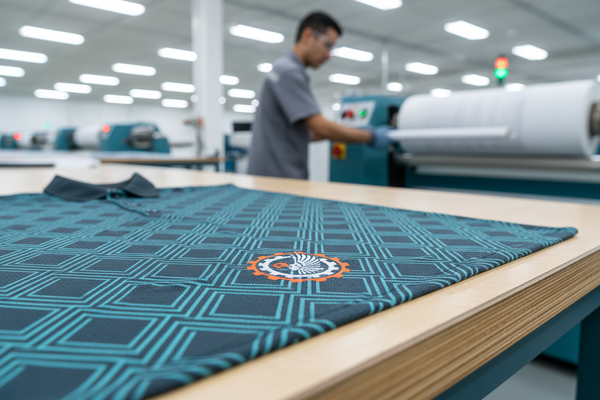
Industrial multi-head automated embroidery setups require precise mechanical tuning to maintain structural stability across high-volume production lines. Machinists must calibrate the active needle stroke velocity, the underlay stabilization pathing, and the active thread pull-compensation percentages within the digitization software. Using a standard 75/11 or 80/12 ballpoint needle ensures the tool slips between the knit yarn loops rather than slicing through the structural spinning filaments. If the digital file lacks precise Vector Node Tensile Modulation adjustments, the automated embroidery heads will apply excessive mechanical pulling force along a single axis. This localized directional tension pulls the warp and weft yarns out of their true 90-degree alignment, causing permanent fabric distortion that cannot be corrected by post-production steam pressing.
On high-speed automated screen printing presses and modern direct transfer lines, machine calibration centers entirely on controlling ink deposit depth and thermal exposure curves. Squeegee durometer values must be monitored closely using a Shore A hardness tester, maintaining a strict 65-to-75 range depending on the required ink rheology. If the mechanical pressure is set too low, the ink film sits unevenly on top of the fabric fuzz, which degrades the sharpness of fine lines. If the pressure is set too high, the ink is forced completely through the textile sheet, ruining the clarity on the back of the garment. Curing conveyor belts must be checked continuously using digital donut probes to ensure the internal chamber temperature stays uniform across the entire belt width. This level of control guarantees complete polymer cross-linking without scorched panels or under-cured print layers.
4. Risk Factors: Preventing Severe Operational Flaws in Bulk Runs
The most severe financial losses in mass manufacturing happen when technical production teams fail to check physical material limits before starting a high-volume run. A primary risk factor is DTF Shear Peel-Off Degradation, which typically shows up during the first few commercial laundering cycles. This issue stems from a breakdown in the thermal cross-linking phase between the direct transfer film's polyurethane adhesive powder and the underlying textile fibers. If the heating element's temperature drops even slightly during production, or if the press duration varies by just two seconds, the mechanical bond will fail, causing the graphic element to crack and peel away when stretched.
This structural failure is deeply tied to poor Dimensional Fabric Texture Adhesion. When trying to press a rigid direct-to-film transfer onto a highly textured, dimensionally complex surface—like heavy carded French terry loops, high-pile fleece, or wide-ribbed knits—the adhesive face cannot establish uniform surface contact. The transfer film spans across the peaks of the fabric texture like a bridge, leaving microscopic air pockets in the valleys underneath. Under ordinary wear-and-tear and washing agitation, these hollow spaces allow moisture to creep in, causing the edges of the print to release and split apart. To prevent these failures, production engineers must match highly flexible, thin-layer water-based ink systems to textured fabrics, while saving rigid film transfers exclusively for flat, high-density woven panels.
5. Procurement Ledger: Cost Amortization Specs for Bulk Thread Count Drops
Procurement directors must look past generic per-unit quotes and instead analyze a completely itemized cost amortization sheet. High-volume manufacturing pricing is driven by two main factors: initial machine setup configurations and ongoing mechanical run times. In automated multi-head embroidery production, pricing scales based on total stitch count blocks rather than design color counts. A complex, full-back streetwear graphic requiring 35,000 individual needle penetrations keeps an expensive multi-head machine occupied for significant blocks of time. This requires substantial hourly operational fees, regardless of the factory's local labor rates.
For automated screen printing runs, the fiscal math shifts entirely to upfront setup amortization. Preparing a separate screen for each spot color—including digital film imaging, emulsion coating, UV exposure, and press registration adjustments—demands a significant initial investment. When running a small 50-piece boutique drop, a complex 6-color design carries a heavy screen prep cost per garment. Scaling that identical design up to a 5,000-unit enterprise run spreads those setup costs across a massive production volume, dropping the per-unit screen fee to pennies. Procurement teams must use these scaling models to force factories into dropping flat production surcharges as volume thresholds are met.
| Production Volume (Units) | 6-Color Screen Print Setup Amortization (Per Unit) | 35,000-Stitch Embroidery Machine Runtime Fee (Per Unit) | Substrate Rejection Margin Target (AQL 1.5) |
|---|---|---|---|
| 100 | $4.50 | $8.50 | 3.0% Max Allowance |
| 500 | $0.90 | $7.20 | 1.5% Standard Target |
| 1,000 | $0.45 | $6.10 | 1.2% Controlled Target |
| 5,000 | $0.09 | $4.80 | 0.8% Hard Ceiling |
6. Engineering Benchmark Profiles: AATCC/ASTM Lab Threshold Metrics
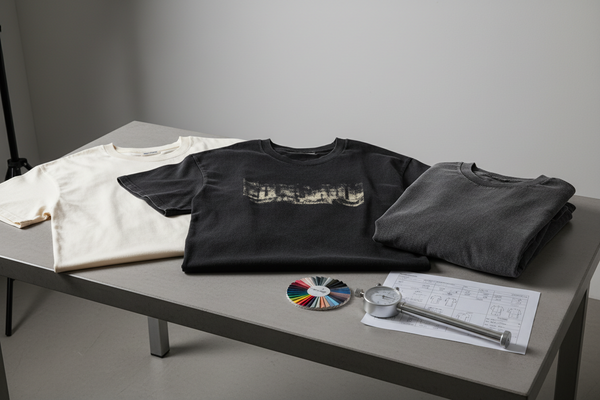
To eliminate personal bias and supplier disputes at the receiving dock, all master sourcing agreements must include objective, quantifiable lab thresholds. Factories must provide certified proof of compliance from independent testing facilities (such as SGS or Intertek) using standardized AATCC and ASTM testing protocols. Any batch that fails to meet these specific physical performance metrics must be automatically flagged for complete credit reclamation or mandatory manufacturer reprocessing.
| Testing Standard Reference | Physical Performance Parameter Evaluated | Minimum Acceptable Sourcing Threshold Value | Required Sourcing Failure Remedy Action |
|---|---|---|---|
| ASTM D3776 | Fabric Mass Per Unit Area (True GSM Verification) | Target Value minus 3% Maximum Deviation Allowed | Full Batch Financial Rejection or Automatic Cost Re-negotiation |
| AATCC 61 (2A) | Colorfastness to Laundering (Ink Fixation / Bleeding) | Minimum Grade 4.0 Grey Scale Rating | Mandatory Production Stop; Re-cure or Strip Inbound Lot |
| ASTM D2261 | Tearing Strength of Woven Fabrics by Tongue Procedure | Minimum 25 Newtons Material Resistance Force | Immediate Rejection of Raw Substrate Lot Shipments |
| AATCC 135 | Dimensional Changes in Automatic Home Laundering | Maximum 4.0% Warp / 3.0% Weft Structural Shrinkage | Compulsory Pre-Shrinking Processing or Complete Product Line Rejection |
| AATCC 8 | Colorfastness to Crocking (Dry and Wet Friction Transfer) | Dry Grade 4.5 / Wet Grade 3.5 Minimum Standard | Mandatory Application of Post-Wash Chemical Fixing Agents |
7. Fatal Sourcing Gaps: Destructive Blindspots in Quality Control
The most common blindspot for custom decoration specialists is overlooking the complex chemistry variations that occur during post-print thermal curing. For example, failing to regulate Polyester Sublimation Cross-Linking Chemistry limits when running multi-layered graphics on synthetic polyester fabrics can ruin an entire production batch. When synthetic fibers are exposed to temperatures above 310 degrees Fahrenheit in a curing dryer, the solid disperse dye particles trapped inside the polyester filaments shift back into a highly volatile gaseous state. These gas molecules travel upward through the freshly applied ink layers, permanently changing the color of your white graphics into a muddy, irregular pink or charcoal hue. This problem, known as dye migration, can be avoided if procurement teams require factories to use specialized low-temperature curing inks and heavy bleed-blocking carbon barrier base coats.
Another common quality control failure happens right at the dock gate: receiving teams often fail to run basic mechanical stress tests on incoming apparel boxes. Technicians should use a standardized cross-hatch tape pull test across random print samples to catch brittle, poorly cured ink layers before they ever reach a distribution center. Similarly, checking the back of embroidered panels with a high-magnification loop is essential to verify that the factory didn't swap out specified permanent cutaway stabilizers for cheap, water-soluble tear-away backings to save money. If the backing material is incorrect, the crisp embroidery work will distort and pucker after a single wash cycle, destroying the product's retail value.
8. Supply Chain FAQ Summary: Verified Action Ledger FAQ
Q: Why does high-density embroidery cause severe fabric puckering along the edges of complex vector logos?
A: Puckering happens when the digital design's stitch density overwhelms the physical weave structure of the fabric. As the automated machine heads punch thousands of polyester threads into a concentrated area, they pull the fabric's warp and weft yarns out of alignment. If the factory cuts corners by using a cheap tear-away stabilizer instead of a heavy-duty, multi-layered cutaway backing, the fabric will warp and buckle under the tension. To fix this, you must adjust your digital files to use open lattice underlay patterns, increase pull-compensation settings, and reduce total satin stitch counts.
Q: How do you identify under-cured plastisol print runs before shipping finished garments to retail customers?
A: An under-cured print run can be quickly identified using two reliable on-site quality control checks: a mechanical stretch test and a chemical wash test. First, firmly pull the printed graphic panel to about 80% of the fabric's total stretch limit; if the ink layer immediately cracks and splits apart, the oven dryer's belt speed was moving too fast or the heating temperature was too low. You can verify this by rubbing the printed surface with a white cotton swab dipped in acetone. If the ink transfer color bleeds onto the swab, the plastisol layer failed to reach its required 320-degree Fahrenheit internal fusion point, making the batch unfit for shipping.
Q: What causes direct-to-film transfers to crack and peel away from heavy loopback cotton fleece after short periods of wear?
A: This peeling is caused by poor surface adhesion across uneven, textured fabrics. Heavy loopback cotton fleece is multi-dimensional and filled with microscopic air pockets. When a flat heat-press attempts to fuse a rigid direct-to-film transfer onto this type of surface, the adhesive backing only binds to the highest points of the fabric texture. The film is left suspended over the micro-valleys underneath. As the garment flexes and stretches during normal wear, these unbonded areas collect moisture and dust, causing the print to split, break, and peel away from the fabric.
Q: How does dye migration happen on synthetic athletic gear, and how can procurement buyers stop it?
A: Dye migration is caused by unstable thermal chemistry in synthetic polyester fabrics. When printed garments travel through a high-temperature conveyor oven to set the surface inks, the heat causes the disperse dyes inside the polyester fibers to sublimate into a gas. This gas bleeds upward through the wet ink layers, permanently staining light-colored graphics with the base fabric color. Procurement buyers can eliminate this issue by adding two strict requirements to their tech packs: the use of low-cure temperature ink systems (which set below 290 degrees Fahrenheit) and a mandatory high-density black barrier ink base layer designed to trap sublimated gas molecules before they reach the surface graphic.