Corporate Apparel Budget Planning: Procurement Strategy Guide
1. Industry Opinion: The Real Cost of "Cheap" Corporate Apparel
Corporate apparel is an investment in your brand's perception. A $10 t-shirt might seem like a good deal, but if it pills, shrinks, or fades after a few washes, it projects a low-quality image. The real issue here is that many procurement teams optimize for the initial purchase price and ignore the total cost of ownership. A $15 shirt that lasts two years is cheaper than a $10 shirt that needs replacing every six months.
One team we worked with was proud of sourcing a "cheap" polo for their sales team. The unit cost was $8. The team ordered 500. Within three months, the polos had shrunk, pilled, and the logos had cracked. The sales team stopped wearing them. The brand's presentation suffered. The team had to re-order with a better spec. The total cost was triple what they would have paid for a quality garment upfront. The initial savings were an illusion.
What actually determines the ROI of a corporate apparel program is not the unit cost, but the garment's lifespan and its impact on the brand. A quality garment is an asset. A cheap one is a liability. The budget should reflect this reality. Allocate more for the garment itself and less for the inevitable reorders that come from poor quality.
2. Factory Observation: The Quality-Cost Connection
We were in a factory in Vietnam overseeing a corporate apparel order. The buyer had specified a ring-spun long-staple integrity fabric for the face yarn. The factory tried to substitute a cheaper carded yarn. The buyer caught it during a random fabric check. The difference in the fabric's surface was visible. The carded yarn was fuzzier and more prone to pilling. The buyer insisted on the spec. The order was delayed by two days, but the garment's quality was protected.
A common outcome when fabric substitution occurs is a shipment of garments that look cheap and wear poorly. The carded yarn will pill rapidly, making the garment look old and tired after a few washes. This is a classic example of a factory trying to cut costs at the buyer's expense. The buyer's insistence on the pre-production physical master sample and a fabric check prevented this.
Another buyer we worked with ordered a poly-cotton blend for their corporate polos. They didn't specify a low-bleed ink for the screen printing. The factory used a standard ink. The thermoplastic dye migration occurred during curing. The navy blue dye from the poly fibers migrated into the white part of the logo. The entire 1,000-piece order was rejected. The cost of the reprint was $8,000. The cost of specifying the correct ink was zero. This was a preventable quality failure.
3. Testing / Sampling: The Non-Negotiable Budget Item
A pre-production physical master sample is the single most important quality control measure in a corporate apparel program. It is the definitive benchmark for color, print placement, and construction. It costs $100-$300 to produce. The cost of an error in bulk production is often ten times that amount. Budgeting for a sample is not an expense; it's an investment.
During sampling for a similar program, a buyer approved a design based on a digital mockup. The factory went straight to bulk production. When the order arrived, the logo was 2 inches higher than expected. The buyer had to reject the entire 500-piece order. The cost of the reprint was $4,500. The cost of a pre-production physical master sample would have been $150. The buyer learned a hard lesson about the importance of sampling.
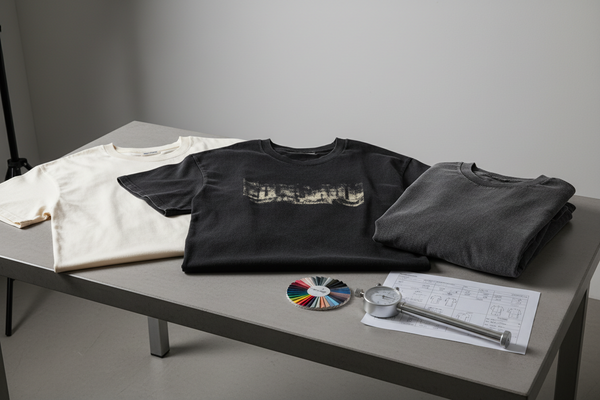
In most cases, a pre-production physical master sample should be produced on the exact production substrate and with the exact decoration method. The sample should be measured with a spectrophotometer to ensure the color is within an acceptable delta-E tolerance. A visual match under one light source might look different under another. The sample is the final, binding document. It establishes the standard for every single subsequent garment.
Testing is another critical budget item. A simple wash test on a sample can reveal shrinkage, skewing, or print failure. A crock test can reveal colorfastness issues. These tests cost a few dollars and a few days. They save thousands of dollars in rework and returns. Budget for testing. It's the insurance policy on your program.
4. Comparison: Cost Drivers Across Decoration Methods
The choice of decoration method has a significant impact on the budget. Screen printing is cost-effective for high volumes, but it has a high setup cost. Embroidery offers a premium look but is more expensive and slower. DTG has no setup cost but has a high per-unit cost. The table below outlines the trade-offs.
| Option | Best For | MOQ Range | Key Trade-Off | Typical Lead Time |
|---|---|---|---|---|
| Screen Print on T-Shirt | High volume, cost-effective, simple logos. | 100–500 pcs | Low per-unit cost but high setup fees. Durable. | 3–5 weeks |
| Embroidery on Polo | Professional, 3D branding, premium feel. | 50–200 pcs | Looks expensive but has a high setup cost. | 2–3 weeks |
| Embroidery on Jacket | Outerwear, high visibility, long-lasting branding. | 50–200 pcs | Adds weight to the garment. High setup cost. | 3–4 weeks |
| DTG Printing on Cotton | Low quantity, complex, full-color designs. | 1–100 pcs | No setup cost, but per-unit cost is high. | 1–2 weeks |
| Heat Transfer on Poly-Blend | Low quantity, quick turnaround. | 1–100 pcs | Cheap but less durable. Can crack or peel. | 1–2 weeks |
| Sublimation on Performance | Athletic wear, all-over prints, no "hand" feel. | 50–200 pcs | Excellent for polyester. Fabric must be white or light. | 3–4 weeks |
If you are budgeting for a 500-piece order of polos, screen printing is the most cost-effective option. The setup cost is amortized over 500 units, reducing the per-unit cost. If you are budgeting for a 50-piece order of jackets, embroidery is a better choice. The setup cost is higher, but the premium look and durability justify the investment.
5. FAQ: Your Budget Questions Answered
Q: What is a reasonable budget per employee for a corporate apparel program?
A: A quality program with a polo or t-shirt and a jacket typically costs $80-$150 per employee, depending on fabric choice and decoration method. This includes the garment, decoration, and fulfillment. A premium program can cost $150-$250 per employee.
Q: How much should I budget for sampling and QC?
A: Budget $100-$300 per colorway for a pre-production physical master sample. Budget an additional $100-$200 for wash testing and spectrophotometric color measurement. This is 2-5% of the total order cost and is the most important budget item you have.
Q: How do I budget for color matching across different suppliers?
A: You need to allocate budget for a physical Pantone swatch for each color and a spectrophotometric delta-E variance tracking protocol. This typically adds $100-$300 per colorway to your upfront costs. It's the price of consistency.
Q: What is the cost of a quality failure?
A: A 500-piece order with a print failure could cost $5,000-$10,000 to reprint, plus the cost of brand damage and lost employee goodwill. A quality failure is significantly more expensive than quality assurance. Budget for QC and sampling. It's an insurance policy.
Q: Should I prioritize unit cost or total cost?
A: Always prioritize total cost. A cheaper garment that needs replacing more often is more expensive over time. Factor in shipping, duties, storage, and the cost of reorders. The lowest unit cost is rarely the lowest total cost.
6. Ending Insight: The Three-Bucket Budget Strategy
A successful corporate apparel budget is built on three pillars: quality, consistency, and process. Allocate your budget into three buckets: Garment Quality, Color Management, and Process Control.
Bucket 1: Garment Quality (60-70% of budget). This is the fabric, the construction, and the decoration. Choose a ring-spun long-staple integrity fabric for a professional appearance. Specify a minimum GSM of 180 for polos and t-shirts. Choose screen printing for high-volume programs or embroidery for premium programs. This is where your brand's quality is most visible.
Bucket 2: Color Management (10-15% of budget). This is the cost of spectrophotometric testing and physical Pantone swatches. It ensures your corporate blue on a polo matches the blue on a jacket. This prevents the brand-damaging effect of inconsistent color. It's a non-negotiable cost.
Bucket 3: Process Control (15-20% of budget). This is the cost of the pre-production physical master sample, wash testing, and QC inspections. It prevents the costly errors that come from skipping these steps. It's the insurance policy on your program.
One team we worked with used this three-bucket strategy for their 500-employee program. They allocated 65% to garment quality, 15% to color management, and 20% to process control. The program came in on budget, the quality was consistent, and the brand was reinforced. The employees wore the apparel with pride. The program was a success. The strategy works. Corporate apparel is an investment. Budget for it accordingly.