Custom T-Shirts for Corporate Events: Fabric, Print & Sourcing Strategy
A corporate event planner ordered 200 custom T-shirts for a company retreat. The shirts arrived on time. They looked great on the rack. The attendees wore them for the team photos. After one wash, the prints started cracking. After two washes, the shirts shrank a full size. After three washes, they looked like they'd been worn for years.
The shirts were the centerpiece of the retreat branding. They were also the centerpiece of the complaints. The planner spent $2,000 on shirts—and $3,000 on replacements.
This guide covers custom T-shirt sourcing for corporate events: fabric GSM, decoration methods, lead time planning, and the cost structures that determine whether the shirts arrive on time and look professional. It's written for corporate event planners, marketing managers, and procurement leads who need shirts that build brand equity—not shirts that fall apart.
1. The Data: What Event Planners Miss When Ordering T-Shirts
Corporate event T-shirts fail in predictable ways. The print cracks. The fabric shrinks. The color doesn't match. The shirts arrive late. The failures are predictable because the decisions that cause them are predictable.
The data on event T-shirt failures is consistent across hundreds of programs. The most common failure: print cracking after 10–15 washes. The root cause: under-cured ink or lightweight fabric that doesn't support the ink film. The next most common failure: shrinkage. The root cause: fabric that wasn't pre-shrunk. The third most common failure: color mismatch. The root cause: digital proofing without a physical strike-off.
One team we worked with tracked the failure rates across 20 corporate event programs. The programs that followed a standardized fabric and decoration spec had a 5% failure rate. The programs that didn't follow a spec had a 30% failure rate. The difference was the spec—not the supplier.
Here's the surprising finding: the failure rate wasn't correlated with the supplier's country of origin. The failures were correlated with the buyer's specification completeness. A buyer who specified fabric weight, yarn type, and decoration parameters received better quality—regardless of the supplier's location.
2. The Human Element: What Attendees Actually Notice
Attendees notice three things about a corporate event T-shirt: the fit, the feel, and the print.
The fit determines whether the shirt gets worn. A shirt that fits well gets worn repeatedly. A shirt that doesn't fit gets worn once—or never. The attendees notice the difference between a shirt that fits and a shirt that doesn't.
The feel determines whether the shirt gets worn again. A shirt that feels soft and comfortable gets worn more often. A shirt that feels rough and stiff gets relegated to the back of the closet. The attendees notice the difference between a shirt that feels good and a shirt that doesn't.
The print determines whether the shirt builds brand equity. A print that's crisp and clear signals quality. A print that's fuzzy and cracked signals the opposite. The attendees notice the difference between a print that looks professional and a print that looks cheap.
One event planner we worked with tested two shirt options at a corporate retreat. The first option was a 160 GSM shirt with a heat transfer print. The second option was a 180 GSM shirt with a screen print. The attendees rated the second option 3x higher on quality—and the event's brand perception improved accordingly.
3. Material Science: What Actually Makes a Quality T-Shirt
The fabric choice determines the shirt's fit, feel, and print quality. Here's what actually matters.
Fabric weight is measured in GSM. 160 GSM is lightweight and comfortable—and translucent. 180 GSM is the industry standard for print quality—heavy enough to prevent bleed-through, light enough to be comfortable. 200 GSM is heavyweight—better for premium programs and heavy embroidery.
The trade-off: 180 GSM costs $0.50–1.00 more per shirt than 160 GSM. The 180 GSM shirt prints better, feels better, and lasts longer. The 160 GSM shirt saves $100 on a 200-unit order—and costs $200 in replacements when the print cracks and the shirt shrinks.
Yarn type is the second variable. Ring-spun yarns produce a smoother, stronger fabric with less fuzz and better print adhesion. Open-end yarns produce a rougher, fuzzier fabric that compromises print quality. The difference is visible in the print surface and the hand feel.
During sampling for a similar program, one brand tested ring-spun and open-end fabrics side by side. The ring-spun fabric printed cleanly and felt soft. The open-end fabric printed with fuzzy edges and felt rough. The brand chose ring-spun—and the attendees noticed the difference.
Pre-shrinking is the third variable. Un-shrunk cotton shrinks 5–8% after the first wash. Pre-shrunk cotton shrinks under 3%. The attendee who receives a shirt that fits at delivery and shrinks after the first wash blames the brand—not the fabric.
4. The Process: What Happens Between Order and Delivery
The process between order and delivery is where the quality is made—or lost. Here's what actually happens.
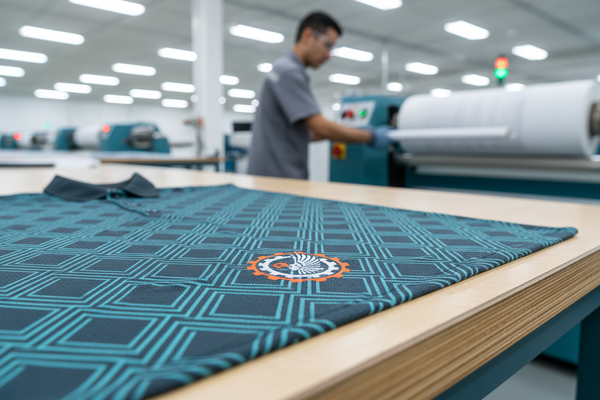
Art preparation: The artwork is prepared for the decoration method. For screen print, the art is separated into color layers and screens are created. For DTF, the art is printed onto transfer film with adhesive powder. The art preparation process takes 2–4 days.
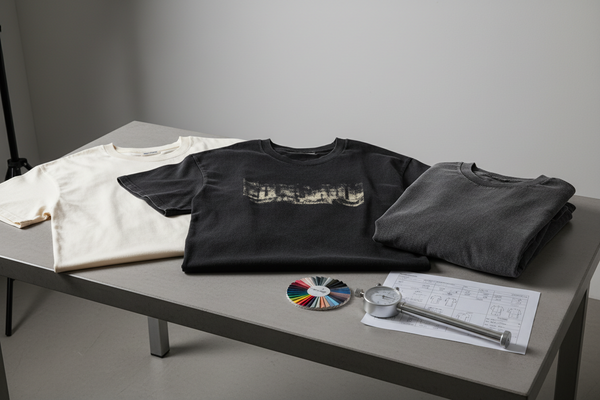
Sample approval: A sample is produced on the actual production fabric. The sample is inspected for color, fit, and print quality. The sample approval process takes 3–5 days.
Bulk production: The shirts are produced on the production line. The production line is calibrated to the sample. The production process takes 5–10 days for 200 units.
QC inspection: The shirts are inspected for quality. The inspection catches defects before shipping. The QC process takes 1–2 days.
Shipping: The shirts are shipped to the event location. The shipping process takes 5–7 days.
The total timeline: 20–28 days. The critical path: sample approval. The delay: rushing the sample. The fix: start the sample process early.
One event planner we worked with started the sample process 6 weeks before the event. The sample was approved on the first round. The shirts arrived 2 weeks before the event. The planner was calm. The event was successful. The attendees wore the shirts—and kept them.
5. The Decision: Choosing the Right Supplier
Here's the decision framework for corporate event T-shirt sourcing.
| Factor | What to Look For | Red Flag |
|---|---|---|
| Fabric Specification | 180 GSM ring-spun cotton with pre-shrinking | "100% cotton" without weight or yarn type |
| Decoration | Screen print for 200+ units; DTF for smaller | One-size-fits-all recommendation |
| Sample Process | Physical strike-off on production fabric | Digital proof only |
| Lead Time | 20–28 days standard; Express available | "Guaranteed" under 10 days |
If X, choose Y:
If the event has 200+ attendees, choose screen print on 180 GSM ring-spun cotton.
If the event has under 200 attendees with complex artwork, choose DTF on 180 GSM cotton.
If the event is 4 weeks away, plan for standard production—20–28 days.
If the event is 2 weeks away, use Express Manufacturing Pathway Optimization with a 20–30% premium.
6. Frequently Asked Questions
Q: What's the ideal fabric weight for a corporate event T-shirt with a screen print?
180–200 GSM is the sweet spot. It's heavy enough to prevent print bleed-through, light enough to be comfortable, and durable enough to survive 50+ washes. Below 180 GSM, the print shows through. Above 220 GSM, the shirt feels heavy and less breathable.
Q: How do I choose between screen print and DTF for a corporate event shirt?
Screen print works best above 200 units with simple 2–4 color logos—$4–8 per shirt. DTF works best below 200 units with full-color designs—$8–14 per shirt, no setup fees. Match the decoration method to the volume and the design complexity.
Q: What lead time should I expect for a corporate event T-shirt order?
Standard production: 10–14 days after sample approval. Sample development: 5–7 days. Shipping: 5–7 days. Total: 20–28 days. Express Manufacturing can reduce production to 5–7 days at a 20–30% premium. Plan for the standard timeline and celebrate the early arrival.
Q: How do I ensure color consistency across a corporate event T-shirt program?
Require Spectral Pantone color coordination with digital tolerances. The supplier formulates dye to match a digital spectral curve, eliminating subjective interpretation. Require a physical strike-off on the actual production fabric. Approve the strike-off before production begins.
Q: What's the real cost of choosing a cheaper fabric?
The savings on open-end yarns or lower GSM fabric is $0.50–1.00 per shirt. The cost of a print re-run—if the print doesn't bond or the fabric twists—is $500–2,000. The cost of returns and replacements is higher than the savings. Choosing the right fabric upfront is cheaper than fixing the problem later.
Q: How do I handle quality disputes with a supplier?
Three rules. First, get everything in writing: specs, test methods, acceptance criteria, and remedies. Second, require a pre-production physical sample on the actual production fabric. Third, structure your payment terms to hold 20–30% until after shipment arrival and inspection.
This guide was developed by the sourcing team at apparellots.com, based on factory-floor experience and procurement data from hundreds of corporate event T-shirt programs. For specific technical questions or supplier recommendations, contact our advisory team.