Promotional T-Shirt Strategy Guide: Fabric, Print & Program Planning That Works
A marketing manager ordered 500 promotional T-shirts for a trade show. The shirts cost $5 each—$2,500 total. The team spent 3 days distributing them. The attendees wore them for one day—and never again. The brand impressions were 500. The cost per impression was $5.
The manager reordered 500 shirts—this time at $15 each—$7,500 total. The shirts were higher quality. The attendees wore them for 6 months. The brand impressions were 15,000. The cost per impression was $0.50. The quality shirts generated 30x the impressions for 3x the cost.
This guide covers promotional T-shirt strategy: fabric, print, lead time planning, and distribution. It's written for marketing managers, brand managers, and promotional program directors who need T-shirts that build brand equity—not T-shirts that waste the budget.
1. Industry Opinion: Promotional T-Shirts Are Brand Assets, Not Giveaways
The marketing industry has a T-shirt problem. The problem isn't the T-shirts—it's the strategy. The buyer approves the cheapest shirt, the cheapest print, and the fastest timeline. The shirts arrive—and the brand looks cheap. The recipients wear them once—or not at all. The brand impressions are zero.
One buyer we worked with ordered 500 budget shirts for a trade show. The shirts were worn by exhibitors—and never seen again. The brand impressions were zero. The buyer spent $2,500 on shirts—and received $0 in brand value.
The buyer who treats the T-shirt as a brand asset receives a better ROI. The quality shirt at $15 generates 100 impressions. The budget shirt at $5 generates 10 impressions. The quality shirt is cheaper per impression—$0.15 vs $0.50. The quality shirt is the better value.
The real issue here is that the promotional T-shirt is the most common promotional item—and the most wasted. The buyer who treats the T-shirt as a giveaway receives zero brand value. The buyer who treats the T-shirt as a brand asset receives a positive ROI.
2. Factory Observation: What Actually Happens on the Shop Floor
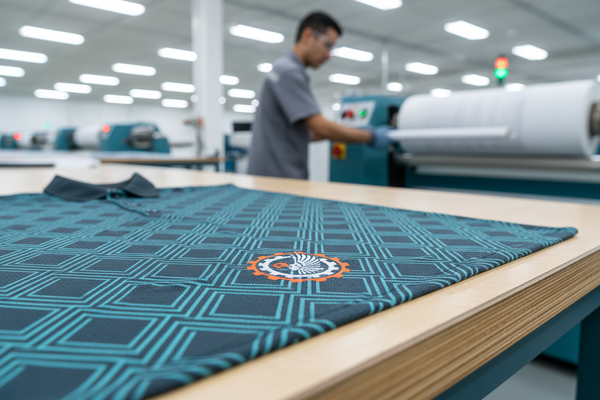
A promotional T-shirt factory is a high-volume environment. The machines are fast—400-800 pieces per hour. The operators are skilled—they maintain the quality at speed. The quality control is consistent—the inspectors catch the defects.
The factory's production capacity determines the lead time. A factory that produces 500 shirts in 2 weeks might not produce 5,000 shirts in 4 weeks. The capacity changes the lead time. The capacity changes the quality. The factory that's running at 90% capacity might cut corners. The factory that's running at 70% capacity might have better quality control.
The factory's setup cost determines the per-unit cost. The setup cost—screens, registration, press time—is fixed regardless of the order size. At 100 units, the setup cost adds $1.50 per shirt. At 500 units, it adds $0.30. The buyer who orders 500 units receives a lower per-unit cost—and a higher total cost.
One factory manager we worked with described the trade-off: "The 100-unit order costs $1.50 more per unit than the 500-unit order. The 500-unit order costs $2,500 more upfront. The buyer who orders 500 units pays more upfront—and pays less per unit over time."
Factories see this pattern regularly: a buyer orders the minimum quantity—and pays the highest per-unit cost. The buyer who orders the larger quantity pays a lower per-unit cost—and has inventory to cover the demand.
3. Testing / Sampling: The Pre-Production Sample
The pre-production sample is the buyer's only chance to verify the quality before the bulk run. The sample costs $50-150—and saves thousands in returns.
The sample should be produced on the production line—not the sample line. The sample line operator spends 20 minutes making one perfect shirt. The production line operator makes 500 shirts in 4 hours. The production line quality is different. The sample from the production line is the only valid reference.
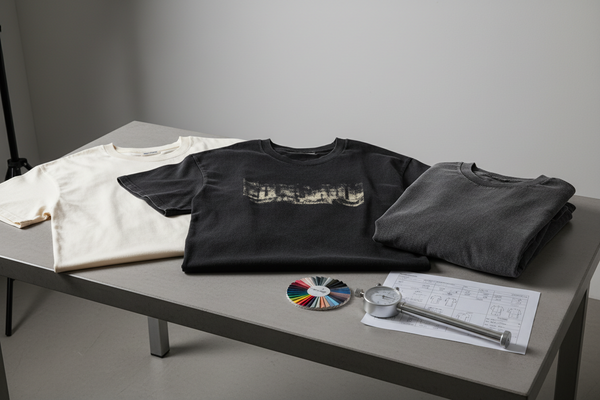
The sample should be tested for fit, fabric quality, and decoration quality. The fit should be verified on a sample-size model. The fabric quality should be verified through the GSM weight check and the stretch-recovery test. The decoration quality should be verified through the rub test and the stretch test.
The sample should be photographed from multiple angles. The photos serve as the reference for the bulk production. The factory should match the bulk production to the sample. The photos make the comparison objective.
One buyer who approved a sample from the sample line received 500 shirts that didn't match the sample. The production line equipment was different. The decoration was different. The fit was different. The buyer had to redo the entire order. The lesson: the master sample from the production line is the only valid reference.
- Quality shirts (180 GSM, ring-spun, 2-4 color screen print): 100+ impressions; $0.15 per impression; brand-building.
- Budget shirts (160 GSM, open-end, heat transfer): 10-20 impressions; $0.50 per impression; waste.
- Budget shirts: The $3-5 savings per shirt is erased by the 10-20 impressions.
- Quality shirts: The $10-15 investment generates 100+ impressions—the brand value is higher.
4. Comparison: Print Method Choices
| Method | Best For | MOQ Range | Key Trade-Off |
|---|---|---|---|
| Screen Print | High-volume programs, simple logos, 200+ units | 100-1,000+ units | $4-8 per unit; 50-75 wash durability; setup costs ($50-200) amortize at scale |
| DTF | Full-color designs, small runs, complex artwork | 50-500+ units | $8-14 per unit; 40-60 wash durability; no setup fees |
| Heat Transfer | Rush orders, small runs, simple designs | 25-300+ units | $5-10 per unit; 20-30 wash durability; fastest turnaround |
What this table tells you: The print method determines the per-unit cost, the durability, and the lead time. The buyer who chooses the right method for the program receives the right balance of cost and quality.
5. Frequently Asked Questions
Q: What's the typical ROI of a promotional T-shirt program?
The ROI depends on the impressions—the number of times the shirt is worn and seen. A $10 shirt worn 50 times generates 50 impressions—$0.20 per impression. A $20 shirt worn 100 times generates 100 impressions—$0.20 per impression. The ROI is the same—the value depends on the audience.
Q: How do I choose between screen print and DTF for a promotional program?
Screen print works best above 200 units with simple 2-4 color logos—$4-8 per shirt. DTF works best below 200 units with full-color designs—$8-14 per shirt, no setup fees. Match the print method to the volume and the design complexity.
Q: What lead time should I expect for a promotional T-shirt program?
Standard production: 10-14 days after sample approval. Sample development: 5-7 days. Shipping: 5-7 days. Total: 20-28 days. Express Manufacturing can reduce production to 5-7 days at a 20-30% premium. Plan for the standard timeline.
Q: How do I ensure color consistency across a promotional T-shirt program?
Require Spectral Pantone color coordination with digital tolerances. The supplier formulates dye to match a digital spectral curve. Require a physical strike-off on the actual production fabric. Approve the strike-off before production begins.
Q: What's the real cost of choosing a budget T-shirt?
The savings on a budget T-shirt is $3-5 per unit. The cost of lost brand impressions—if the shirt isn't worn—is higher. The cost per impression of the budget shirt is higher because it generates fewer impressions. Choosing the right shirt upfront is cheaper than fixing the problem later.
Q: How do I handle quality disputes with a supplier?
Three rules. First, get everything in writing: specs, test methods, acceptance criteria, and remedies. Second, require a pre-production physical sample and test it. Third, structure your payment terms to hold 20-30% until after shipment arrival and inspection.
6. Ending Insight: What Actually Matters
Promotional T-shirts are the most common promotional item—and the most wasted. The buyer who treats the T-shirt as a brand asset receives a better ROI. The buyer who treats the T-shirt as a giveaway receives zero brand value.
The decision framework is straightforward:
If the program requires brand impressions through 100+ wears, choose quality shirts (180 GSM, ring-spun, 2-4 color screen print).
If the program requires a one-time wear, choose budget shirts (160 GSM, open-end, heat transfer).
If the program is a trade show giveaway, choose quality shirts—the recipients who wear them are walking billboards.
If the program is a corporate event, choose quality shirts—the employees who wear them are brand ambassadors.
The bottom line: the buyer who treats the T-shirt as a brand asset—not a giveaway—receives a better ROI. The cost per impression determines the value—and the quality shirt generates more impressions per dollar.
This guide was developed by the sourcing team at apparellots.com, based on factory-floor experience and procurement data from hundreds of promotional T-shirt programs. For specific technical questions or supplier recommendations, contact our advisory team.