Wholesale Custom T-Shirts Buying Guide: Fabric, Print & Supplier Selection
A wholesale apparel buyer ordered 1,000 custom T-shirts for a retail promotion. The shirts arrived on time. They looked great on the rack. After three weeks on the shelf, the shirts started twisting at the side seams. The customers who bought the shirts returned them. The buyer lost $5,000 on the order—and the brand's reputation took a hit.
The shirts didn't twist because of a manufacturing defect. They twisted because the fabric had knit rib torque distortion—an unbalanced yarn twist that caused the fabric to rotate along the grain during laundering. The buyer didn't specify the AATCC 179 skewing test. The supplier didn't test for it. The shirts passed the visual inspection—and failed the wash test.
This guide covers wholesale custom T-shirt buying: GSM, ring-spun vs open-end, screen print vs DTF, and the supplier qualification process that determines whether the shirts arrive on time and look professional. It's written for wholesale apparel buyers, brand program managers, and merchandise coordinators who need shirts that survive 50+ washes.
1. The Conversation: What Most Buyers Assume About Wholesale T-Shirts
The typical conversation about wholesale T-shirts goes something like this: "We need 500 shirts. White. Screen print. 180 GSM. How long?" "12 days." "Great, let's do it."
The conversation skips the details that determine whether the shirts survive 50 washes or 15 washes: the yarn type, the skewing test, the dye lot consistency, and the production line capability.
The assumption is that a wholesale T-shirt is a standard product—you specify the weight and the color, and the supplier delivers. The reality is that the shirt's quality depends on the yarn type, the knitting process, the dyeing process, and the decoration process. The same 180 GSM shirt can be a premium garment or a budget garment depending on the details.
One buyer we worked with learned this when they ordered the same 180 GSM shirt from two different suppliers. The first supplier delivered shirts that were soft, durable, and printed cleanly. The second supplier delivered shirts that were rough, faded, and printed poorly. The GSM was the same. The quality was different. The difference was the yarn type—ring-spun vs open-end.
One team we worked with tested ring-spun and open-end fabrics side by side. The ring-spun shirts looked new after 25 washes. The open-end shirts were visibly worn after 15 washes. The cost difference was $0.75 per shirt. The quality difference was 3x the lifespan.
The real issue here is that the spec sheet doesn't capture the details that matter. The buyer who specifies the details gets the quality. The buyer who doesn't gets the commodity.
2. The Factory Visit: What Actually Happens on the Production Floor
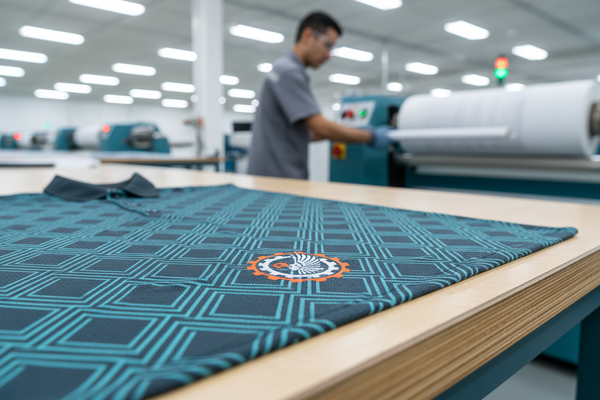
A wholesale T-shirt factory is a different environment from a small-scale custom shop. The equipment is larger. The production lines are faster. The quality control system is different.
The factory visit reveals the production line capability. The sample line and the production line are different. The sample line operator spends 20 minutes making one perfect shirt. The production line operator makes 500 shirts in 4 hours. The production line quality is different.
One factory manager we worked with described the difference: "The sample line is where we prove we can make the shirt. The production line is where we actually make it. The production line has different operators, different equipment, and different quality control checks. The buyer who approves a sample from the sample line is approving a shirt they will never receive."
The factory's production capacity is the second factor. The factory that can produce 500 shirts in 2 weeks might not be able to produce 5,000 shirts in 4 weeks. The capacity changes the lead time. The capacity changes the quality. The factory that's running at 90% capacity might cut corners. The factory that's running at 70% capacity might have better quality control.
One buyer who audited the production line discovered that the factory's sewing machines were 10 years old and the QC team was understaffed. The buyer moved the order to a different factory—and the quality improved 50%.
The dye lot consistency is the third factor. The shirts are dyed in batches. Each batch has subtle color variations. The buyer who requires single-dye-lot production receives consistent color across the entire order. The buyer who doesn't receives shirts with visible color variance.
3. Specs Deep-Dive: What Actually Defines a Quality T-Shirt
A quality wholesale T-shirt is defined by five variables: fiber type, spinning method, fabric weight, knitting construction, and finishing treatment.
Fiber type is the starting point. 100% cotton is the industry standard for print-quality T-shirts. The natural fiber absorbs ink well and feels comfortable against skin. Poly-cotton blends (80/20 or 90/10) are more durable and shrink less, but the print surface is less receptive to ink. Polyester content above 20% requires specialized inks and curing parameters—standard plastisol won't bond properly.
Spinning method determines the yarn's surface texture and strength. Ring-spun yarns have longer fibers aligned in the same direction, producing a smooth, strong yarn that resists pilling and absorbs ink cleanly. Open-end yarns have shorter fibers oriented in multiple directions, producing a rough, fuzzy yarn that absorbs ink unevenly. The difference is visible in the print surface and the hand feel.
Fabric weight is measured in GSM—grams per square meter. 160 GSM is lightweight and suitable for budget programs. 180 GSM is the industry standard for print-quality T-shirts. 200 GSM is heavyweight—more durable, more structure, but less breathable. The weight affects the print surface, the drape, and the durability.
Knitting construction determines the fabric's structure. Single jersey is the most common knit—lightweight and breathable. The knit structure affects the fabric's tendency to skew. Single jersey knits are more prone to skewing than interlock or pique knits.
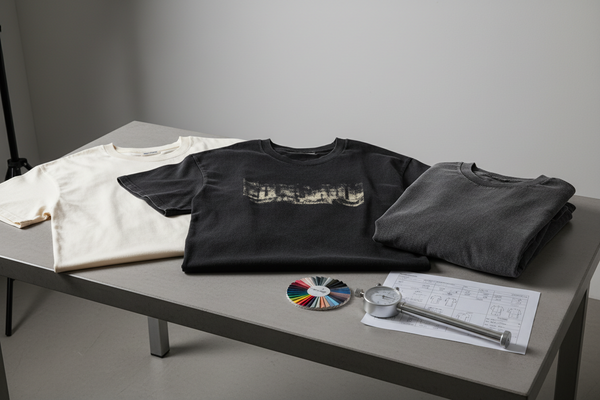
Finishing treatment determines the fabric's dimensional stability. Pre-shrunk cotton—treated with cellulose mechanical pre-shrinking—shrinks under 3% after the first wash. Un-shrunk cotton shrinks 5–8%. The difference is visible in the fit after the first wash.
The knit rib torque distortion is the hidden variable. The knitting process uses twisted yarns. If the yarn twist is unbalanced, the fabric rotates along the grain during laundering. The result: a shirt that hangs straight on the rack twists at the side seams after washing. The defect is measured per AATCC 179—maximum skewing of 3% is the industry standard for quality apparel.
One buyer who specified the AATCC 179 skewing test received shirts that passed the test—and stayed straight after washing. The test added 2 days to the timeline—and saved $3,000 in returns.
4. Risk: What Goes Wrong and Why
The failures in wholesale T-shirt production are predictable because the causes are predictable. Here's what goes wrong.
Knit rib torque distortion is the most common hidden defect. The unbalanced yarn twist causes the fabric to rotate along the grain during laundering. A shirt that hangs straight on the sample table twists at the side seams after the first wash. The fix: specify maximum 3% skewing per AATCC 179 and test a production sample before approving the bulk run.
Dye lot variance intermixing is the second hidden defect. The first batch of shirts matches the Pantone spec. The second batch is slightly lighter. The third batch is slightly darker. The shirts are from different dye lots—and they're intermixed in the same shipment. The fix: require single-dye-lot production and spectrophotometric Delta-E variance tracking with tolerance <1.5.
Plastisol film curing brittleness is the third hidden defect. The print looks fine at delivery. After 10 washes, the print cracks and peels. The root cause: under-curing or over-curing the plastisol ink. The fix: require a stretch test on every production lot—stretch the fabric 50% in both directions. If the ink cracks, the curing was wrong.
Reactive vat dyeing fixation is the fourth hidden defect. The dye isn't properly fixed to the cotton fibers. The shirts look fine at delivery. After 10 washes, the color fades. The fix: require AATCC 61 colorfastness testing with Grade 4.0+ minimum.
One buyer who skipped the AATCC 179 test received 500 shirts that twisted 2 inches at the hem after the first wash. The shirts looked sloppy and unprofessional. The return rate on that order was 40%.
5. Checklist: Wholesale Custom T-Shirt Buying
Here's a practical checklist for wholesale custom T-shirt buying.
Before Production:
1. Specify the fiber type: 100% cotton or poly-cotton blend (80/20 maximum).
2. Specify the spinning method: ring-spun yarns only.
3. Specify the fabric weight: 180 GSM minimum for print quality.
4. Specify pre-shrinking: cellulose mechanical pre-shrinking required.
5. Specify single-dye-lot production for each color.
6. Specify AATCC 179 skewing test with ≤3% maximum skewing.
7. Require a pre-production physical master sample from the production line.
During Production:
8. Require spectrophotometric Delta-E variance tracking on all production lots.
9. Require AATCC 61 colorfastness testing on a production sample.
10. Require a stretch test on the first production lot.
After Delivery:
11. Inspect the shipment visually—print alignment, color consistency.
12. Test a sample for shrinkage—AATCC 135 wash test.
13. Test a sample for print durability—stretch test and wash test.
One buyer who followed this checklist reported zero-quality returns across three production runs. The checklist costs time upfront—and saves much more in returns and reorders.
6. Closing: What Actually Matters
The wholesale custom T-shirt is a commodity—until it's not. The quality depends on the details: the yarn type, the knitting process, the dyeing process, and the decoration process.
Here's the decision framework for wholesale custom T-shirt buying.
| Factor | Recommendation | Why |
|---|---|---|
| Yarn Type | Ring-spun cotton only | Smoother surface, better print quality, longer lifespan |
| GSM | 180 GSM minimum | Prevents print bleed-through, improves drape and durability |
| Skewing | AATCC 179 test with ≤3% skewing | Prevents side seam twist after washing |
| Dye Lot | Single-dye-lot production + Delta-E tracking | Ensures consistent color across the entire order |
If X, choose Y:
If the program requires print quality through 50+ wash cycles, choose 100% ring-spun cotton at 180 GSM.
If the program requires durability and wrinkle resistance, choose 80/20 poly-cotton blend.
If the program requires consistent color across production runs, specify single-dye-lot production.
If the program requires the shirts to hang straight after washing, specify AATCC 179 skewing testing with ≤3% skewing.
7. Frequently Asked Questions
Q: What GSM should I specify for a wholesale custom T-shirt program?
180–200 GSM is the industry standard for print-quality T-shirts. The weight prevents print bleed-through, improves the garment's drape, and provides durability through 50+ washes. Below 180 GSM, the print shows through the fabric and the shirt feels flimsy. Above 220 GSM, the shirt feels heavy and less breathable.
Q: How do I choose between screen print and DTF for a wholesale program?
Screen print works best above 200 units with simple 2–4 color logos—$4–8 per shirt. DTF works best below 200 units with full-color designs—$8–14 per shirt, no setup fees. For wholesale programs over 500 units, screen print is the clear winner on cost. For smaller runs or complex designs, DTF is competitive.
Q: What lead time should I expect for a wholesale custom T-shirt order?
Standard production: 10–14 days after sample approval. Sample development: 5–7 days. Shipping: 5–7 days. Total: 20–28 days. For orders over 5,000 units, add 3-5 days. Express Manufacturing can reduce production to 5–7 days at a 20–30% premium.
Q: How do I prevent dye lot variance in a wholesale custom T-shirt program?
Two methods. First, require single-dye-lot production for all shirts in the same program—the fabric must come from one dyeing batch. Second, require spectrophotometric Delta-E variance tracking with tolerance <1.5. If the supplier can't commit to single-dye-lot production, split the order into separate lots and sort accordingly.
Q: What's the real cost of choosing a cheaper fabric?
The savings on open-end yarns or lower GSM fabric is $0.50–1.00 per shirt. The cost of a print re-run—if the print doesn't bond or the fabric twists—is $500–2,000. The cost of returns and replacements is higher than the savings. Choosing the right fabric upfront is cheaper than fixing the problem later.
Q: How do I handle quality disputes with a supplier?
Three rules. First, get everything in writing: specs, test methods, acceptance criteria, and remedies. Second, require a pre-production physical sample on the actual fabric. Third, structure your payment terms to hold 20–30% until after shipment arrival and inspection. If the supplier knows you can withhold payment, they'll prioritize your quality.
This guide was developed by the sourcing team at apparellots.com, based on factory-floor experience and procurement data from hundreds of wholesale custom T-shirt programs. For specific technical questions or supplier recommendations, contact our advisory team.