Public Sector Workwear Standards Compliance & Sourcing Manual
1. Industry History: From Stock Purchasing to Binding Standards
The evolution of public sector workwear procurement reflects a decades-long transition from fragmented, catalog-based purchasing to heavily regulated safety engineering. Thirty years ago, municipal agencies regularly allowed individual department heads to procure work attire from local commercial distributors, prioritizing immediate price per unit over long-term structural durability. These decentralized purchases lacked technical material specifications, leaving road maintenance crews, sanitation workers, and utility teams equipped with basic cotton-poly garments that offered minimal visibility and rapid physical degradation under real-world weather exposure.
A mid-sized transit authority in 2018 provided a stark example of the risks inherent in loose procurement controls when they ordered 4,000 safety vests from a generic catalog importer without requiring laboratory test documentation. During a routine state transportation department safety audit six months later, inspectors discovered that the fluorescent yellow background fabric had faded past mandatory chromaticity boundaries after just twelve outdoor shifts. The state regulatory body issued an immediate non-compliance citation, forcing the transit authority to pull the entire lot from service and spend $68,000 on emergency replacements, illustrating the financial hazard of skipping formal specification vetting.
Today, public sector workwear is governed by strict federal, state, and international regulatory frameworks designed to protect field personnel while ensuring responsible expenditure of public funds. The introduction of standards like ANSI/ISEA 107 and NFPA 2112 transformed public tenders from simple commercial negotiations into technical compliance evaluations. What actually determines whether a public sector contract succeeds isn't the initial catalog discount — it's the rigor of the technical brief used to govern the manufacturing floor before a single bolt of fabric is cut.
Understanding this historical context is essential for modern procurement leads tasked with drafting public tenders. When an agency issues a request for proposal (RFP) for thousands of field crew garments, the specification document must function as a legally binding engineering blueprint. Bypassing clear performance criteria in favor of broad promotional descriptions invites low-tier suppliers to cut corners on fabric weight, dye quality, and retroreflective performance, setting the stage for premature product failure on the job site.
2. Material Evolution: Tensile Integrity and High-Visibility Physics
The physics of high-visibility workwear requires a delicate balance between light absorption, fluorescent emission, and mechanical fiber strength. Fluorescent background fabrics function by converting invisible ultraviolet light into visible light, creating an intense glowing effect that makes workers stand out against complex ambient backgrounds. Achieving this optic performance requires specialized dye formulations applied to synthetic fibers like polyester or modified acrylics, as natural fibers like cotton cannot hold fluorescent pigments with acceptable wash-fastness metrics.
A municipal public works department encountered the limitations of unreinforced materials when they specified a 100% cotton canvas 300 GSM pant for winter road maintenance crews, deliberately omitting synthetic fiber content to maximize natural breathability. After just thirty days of winter service, constant friction against road salt spreaders and equipment cabs caused 18% of the pants to suffer severe seam blowouts at the crotch and knees. The natural cotton yarns lacked the abrasion resistance needed for heavy industrial service, forcing an emergency procurement pass to re-engineer the garments with a 65% polyester / 35% cotton twill weave reinforced with high-tenacity filament nylon along high-wear zones.
To ensure high-visibility performance remains intact throughout the Field Crew Safety Uniform Lifecycle, technical briefs must mandate specific background fabric weights and retroreflective tape construction. Standard high-vis shirts utilize a 150 GSM to 180 GSM polyester mesh or interlock knit engineered for high moisture-wicking capability, while heavy duty jackets require a 280 GSM to 320 GSM solid woven polyester shell backed by a waterproof polyurethane membrane. The retroreflective bands must utilize micro-prismatic technology or high-index glass beads embedded in a durable polymer matrix, delivering a Retroreflective Luminance Coefficient ($R_A$) that exceeds $500 cd/(lx \cdot m^2)$ at a 0.2-degree observation angle.
Factories see this pattern regularly: when contractors attempt to lower their material acquisition costs, they substitute lower-tier retroreflective tapes that utilize thin glass-bead coatings on paper-backed carriers. These cheap transfers perform acceptably on a dry inspection table, but they degrade rapidly when exposed to rain, mechanical abrasion, or laundry friction. Specifying heavy duty heat-applied segmented reflective tape or double-stitched fabric-backed retroreflective bands ensures the garment maintains full nighttime visibility through 50 or more industrial wash cycles, keeping field crews safe and compliant.
3. Innovation: Smart Textiles, Recycled Yarns, and Eco-Passports
Modern public sector procurement mandates increasingly intersect with corporate social responsibility goals and environmental sustainability directives. Municipalities and state agencies worldwide are enacting green purchasing policies that require workwear contracts to integrate recycled fibers, lower carbon footprints, and eliminate hazardous processing chemicals. However, integrating sustainable materials into heavy duty safety garments requires strict verification to ensure eco-friendly components do not compromise worker safety or garment lifespans.
During sampling for a county environmental services department, the procurement team mandated the use of Global Recycled Standard (GRS) certified recycled polyester for a 3,000-unit high-visibility vest contract. The winning contractor sourced an unvetted recycled yarn lot produced from low-grade post-consumer PET bottle flake. When the yarn entered high-speed circular knitting machines at the mill, the inconsistent tensile strength of the recycled filaments caused frequent yarn breakage, delaying production by three weeks and resulting in a finished fabric with a rough surface texture that failed initial tear strength tests under ASTM D2261 standards.
- Pros (Certified GRS Recycled Polyester): Satisfies municipal green procurement mandates; reduces crude oil consumption; provides full supply chain traceability from bottle flake to finished yarn.
- Cons (Certified GRS Recycled Polyester): Requires rigorous lot-by-lot tensile testing; carries a 5% to 8% cost premium [IR]; vulnerable to color shade variation if melt-filtering processes are uncalibrated.
The solution to sustainable workwear sourcing lies in requiring OEKO-TEX Strict Eco-Passport Validation alongside GRS material certification. The OEKO-TEX Eco-Passport standard verifies that every chemical inputs used in textile dyeing, finishing, and retroreflective tape manufacturing — including liquid dyes, water-repellent coatings, and heat-transfer adhesives — has been independently tested for harmful substances. This certification prevents toxic chemicals like per- and polyfluoroalkyl substances (PFAS), heavy metals, and phthalates from entering public sector supply chains, protecting both garment workers and municipal field staff.
Furthermore, advances in yarn manufacturing now allow mills to produce recycled polyester filaments that match the tensile strength and dye uptake of virgin synthetic fibers. By specifying premium mechanical recycling processes that utilize fine melt-filtration and continuous filament drawing, public procurement teams can deploy eco-friendly workwear that clears ANSI/ISEA Class 3 requirements without sacrificing durability or colorfastness. This technical balance satisfies environmental directives while ensuring public sector workwear performs reliably under daily industrial strain.
4. Quality Control Protocols on the Factory Floor
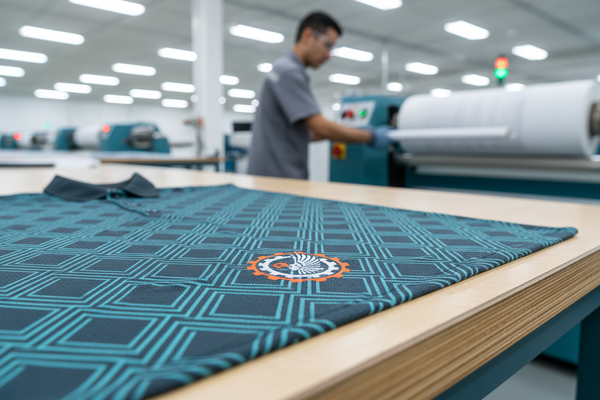
Establishing binding quality control protocols requires moving past visual end-of-line sorting and enforcing quantitative physical audits directly on the manufacturing floor. In public sector workwear contracts, a minor manufacturing defect is not merely a cosmetic issue — a loose seam on a high-visibility parka or an unbonded section of reflective tape represents a safety hazard that can lead to regulatory non-compliance or field accidents. Ensuring total batch compliance demands a multi-stage inspection framework built into the core purchasing agreement.
An on-site technical facility floor audit executed at a contractor's facility in Fujian revealed a common industry shortcut that cost-driven manufacturers use to boost daily throughput. The quality auditor discovered that while the factory used certified 3M retroreflective tape on the chest and back panels of high-visibility jackets, the sewing operators were substituting an uncertified, non-compliant glass-bead tape on the lower sleeve bands to shave $0.35 per unit off manufacturing costs. Because the visual appearance of the two tapes was nearly identical under ambient room light, the substitution would have escaped basic visual inspection, only to fail retroreflectometer testing on the loading dock.
In most cases, the difference between a compliant delivery and a rejected shipment comes down to whether the contract enforces an Acceptable Quality Limit (AQL) 1.5 Major / 4.0 Minor threshold under ISO 2859-1 statistical sampling tables [DS]. Under this framework, an auditor inspecting a 5,000-unit municipal garment shipment pulls a random sample of 200 items. The entire lot is rejected if auditors find more than 7 major defects (such as out-of-spec dimensions, unbonded reflective tape, or seam stitching failures) or more than 10 minor defects (such as untrimmed thread ends or misaligned care labels) across the checked sample.
Industrial thermal laundering resilience must be verified through rigorous laboratory stress testing before mass production garments clear factory gates. Public sector workwear frequently undergoes intensive commercial laundering to remove oil, road tar, grease, and biological contaminants. The technical specification must require production strike-offs to clear 50 consecutive industrial wash cycles under ISO 15797 parameters at 75°C wash temperatures, followed by tunnel drying at 140°C. If the background fabric loses its fluorescent chromaticity or the retroreflective tape delaminates during testing, the production line must be halted immediately for re-engineering.
- Verify retroreflective luminance ($R_A$) using a handheld retroreflectometer to confirm values exceed $500 cd/(lx \cdot m^2)$ across all garment bands.
- Perform a manual 90-degree cross-hatch tape adhesion check over heat-applied reflective transfers to test adhesive cross-linking.
- Examine background fabric under a calibrated 6000K daylight light box to verify chromaticity coordinates match ANSI/ISEA 107-2020 master charts.
- Measure chest circumference, torso length, and sleeve dimensions across ten random units per size tier against approved tech-pack blueprints.
- Review certified ISO 15797 wash test reports confirming background fabric and retroreflective trim survive 50 industrial wash passes [DS].
- Confirm 100% of finished garments pass automated inline mechanical needle detection sweeps before final poly-bagging.
5. Decision Framework: Navigating Tenders and Lifecycle Costs
Evaluating public sector workwear bids requires replacing low-bid procurement logic with a total cost of ownership (TCO) evaluation model. In municipal procurement, awarding a contract strictly to the lowest initial unit quote frequently generates higher cumulative costs over a multi-year budget cycle. A low-tier high-visibility vest priced at $8.50 per unit that degrades after three months of field service carries an effective annual cost of $34.00 per worker, whereas a heavy duty $18.00 vest engineered for 50 industrial wash cycles lasts two full years, reducing the annual per-worker cost to $9.00.
A city tender provided a clear demonstration of this principle when a low-bid broker won a 10,000-unit municipal workwear contract by offering $14.50 per high-visibility waterproof parka, undercutting established industrial apparel manufacturers by 25%. Three months after delivery, municipal road crews reported widespread water leakage along shoulder seams during heavy rain events. Technical analysis revealed that the low-bid contractor had used cheap PVC seam-sealing tape applied at incorrect temperatures, causing the tape to delaminate under normal wear. The city was forced to spend $80,000 on early replacement garments, demonstrating why lifecycle performance metrics must be weighted heavily in bid evaluations.
What actually determines contract value is structuring public tenders with enforceable Contract Compliance Audit Clauses. These provisions authorize the public agency to conduct unannounced factory audits, pull random production samples for independent laboratory testing, and assess financial penalties if delivered goods deviate from technical specs. Furthermore, embedding clauses that require contractors to hold standing greige fabric reserves ensures rapid 10-day reorder fulfillment for new municipal hires, eliminating the multi-month lead times that disrupt agency operations.
The table below provides a decision matrix comparing primary workwear specification tiers to guide public sector procurement directors in structuring bid requirements.
| Workwear Specification Tier | Primary Safety Standard | Target Wash Lifespan | Key Sourcing Trade-Off | Primary Municipal Match |
|---|---|---|---|---|
| ANSI Class 3 Weather Parka | ANSI/ISEA 107-2020 Class 3 | 50+ Industrial Cycles [DS] | Higher unit cost; extended manufacturing lead time | DOT road crews, transit authorities, night operations |
| ANSI Class 2 Field Vest | ANSI/ISEA 107-2020 Class 2 | 25+ Commercial Cycles [IR] | Limited body coverage; not compliant for high-speed roadways | Parks & recreation, parking enforcement, surveyors |
| Dual-Compliant FR Work Shirt | NFPA 2112 + ANSI Class 2 | 50+ Industrial Wash Loops [DS] | High material cost; requires specialized aramid trims | Municipal gas utilities, electrical maintenance crews |
6. Future Outlook: Regulatory Mandates and Circular Workwear Pipelines
The future of public sector workwear procurement is being shaped by emerging extended producer responsibility (EPR) legislation, circular economy mandates, and advanced smart textile technologies. Governments across North America and Europe are introducing regulations that require public institutions to establish closed-loop recycling pathways for decommissioned uniforms and safety wear. These mandates aim to eliminate landfill disposal of industrial textiles while ensuring that retired high-visibility workwear — which carries official agency insignia — is securely shredded and reprocessed to prevent unauthorized civilian use.
A regional sanitation authority experimenting with a closed-loop recycling pilot discovered a significant engineering barrier common to complex workwear products. When the authority attempted to recycle 2,000 retired high-visibility jackets, the textile recycling facility reported that the garments could not be processed through standard mechanical shredders without manually removing all metal zippers, plastic snaps, and retroreflective glass-bead tapes first. This manual disassembly requirement added $3.20 per garment in labor costs, doubling the total cost of recycling and highlighting the need for "design for recyclability" principles in future workwear specifications.
In response to these challenges, textile manufacturers are developing mono-material safety garments engineered for simplified end-of-life recycling. Future public sector workwear specs will increasingly incorporate bio-based synthetic fibers, fully recyclable polyester retroreflective tapes, and depolymerizable zippers that dissolve during chemical recycling processes. Furthermore, smart workwear integrating woven RFID tags and heat-resistant micro-chips will allow municipal inventory systems to track individual garment wash counts, monitor retroreflective degradation, and automate circular recycling loops upon retirement.
By establishing forward-looking technical standards today, public sector procurement executives can build resilient, compliant, and sustainable workwear supply chains that protect field personnel, fulfill environmental mandates, and optimize public capital expenditure for years to come.
What Sourcing Teams Ask Next
How can municipal procurement teams verify retroreflective tape compliance on inbound shipments without expensive third-party lab testing?
Sourcing teams perform rapid dockside verification by using handheld optical retroreflectometers to measure the Retroreflective Luminance Coefficient ($R_A$) directly on incoming garments. Compliant ANSI Class 2 and Class 3 safety wear must yield an $R_A$ value exceeding $500 cd/(lx \cdot m^2)$ at a 0.2-degree observation angle. Additionally, inspectors execute a manual 90-degree cross-hatch tape adhesion test over heat-applied reflective bands to confirm complete polymer cross-linking, ensuring the tape will not peel or delaminate during active field use.
Why do fluorescent yellow-green safety garments maintain visibility longer than fluorescent orange-red garments in urban environments?
This visibility variance relates directly to human eye spectral sensitivity under daylight conditions, which peaks near 555 nanometers within the green-yellow light spectrum. Fluorescent yellow-green fabrics stimulate human visual receptors more effectively against dark urban asphalt, concrete, and foliage backgrounds. Fluorescent orange-red background fabric remains highly effective in wooded environments or road construction zones marked by clay and soil, making location-specific environment audits essential when selecting garment colorways.
Can public sector agencies utilize high-speed automated machine embroidery to apply municipal crests directly onto ANSI Class 3 waterproof jackets?
Automated machine embroidery operates by forcing high-frequency needles and dense thread clusters directly through the fabric, which creates thousands of microscopic perforations through internal waterproof polyurethane membranes. Attempting to embroider directly onto waterproof outerwear destroys the garment's weather barrier, creating a leaking zone along the chest or sleeve. To preserve waterproof performance, procurement briefs must require flame-bonded, heat-sealed emblems applied with waterproof seam tape behind the decoration zone, or specify specialized digital heat transfers instead.