Moisture Wicking Polo Fabric Explained: Piqué, CoolDry & 65/35 Blends for Uniforms
Let's talk about what actually happens when a moisture-wicking polo program goes wrong. The difference between a polo that keeps staff comfortable through a double shift and one that's soaked through by lunch comes down to three decisions: knit structure, fiber composition, and finishing treatments. This guide breaks down moisture-wicking polo fabric selection from a procurement standpoint—piqué double-knit geometry, CoolDry polyester performance, 65/35 poly-cotton blend economics, and the decoration compatibility requirements that separate successful uniform programs from expensive failures.
1. Sourcing Realities: What Corporate Uniform Buyers and Hospitality Managers Overlook Regarding Moisture-Wicking Polo Fabric
The typical moisture-wicking polo brief looks like this: "Polo shirts with moisture-wicking fabric, embroidered logo, 200 units, need them in 6 weeks." That's not a spec—it's a gamble. The actual technical decisions that determine outcome happen in the knit structure, the fiber blend, and the finishing treatments—and most buyers never get past the "moisture-wicking" checkbox.
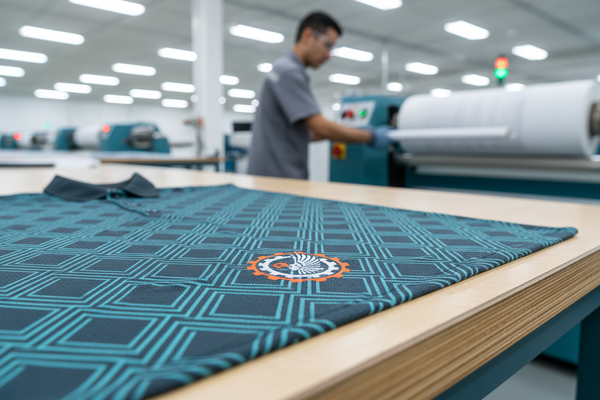
Knit structure is the first variable that matters. Piqué fabric is a double-knit textile with a raised geometric texture—typically diamonds, hexagons, or waffle patterns—that creates air pockets between the fabric and skin[reference:27]. This three-dimensional structure delivers 20–30% better breathability than flat jersey while maintaining a professional, structured appearance[reference:28]. The raised texture physically lifts fabric away from skin, creating micro-channels for air circulation[reference:29]. Jersey knits sit flat against skin, trapping heat and moisture during activity[reference:30]. The procurement trap is specifying "piqué" without understanding the construction difference—and receiving a flat knit that doesn't deliver the breathability piqué is known for.
Fiber composition is the hidden variable that determines moisture management performance. 100% polyester fabrics like CoolDry use micro-capillary wicking: micro-denier filaments create capillary channels and micro-grooves along the fiber surface, significantly increasing surface area and enabling rapid moisture absorption[reference:31]. The moisture moves through these channels via capillary action, spreading across the fabric surface for rapid evaporation. The 65/35 poly-cotton blend offers a different value proposition: the breathability and softness of cotton combined with the durability, color retention, and easy-care performance of polyester[reference:32]. The procurement error is choosing the blend without validating the moisture-wicking performance against the actual use case.
Then there's the finishing question. Moisture-wicking performance isn't just about fiber type—it's about how the fabric is engineered. Polyester is inherently hydrophobic—it repels water at the molecular level[reference:33]. To make it wick moisture, the fibers are chemically treated with hydrophilic polymers or engineered with cross-sectional shapes that create capillary channels[reference:34]. The treatment can degrade over time. The question isn't whether the fabric wicks moisture at delivery—it's whether it still wicks moisture after 20 industrial launderings.
2. Textile Physics: The Structural Science Behind Moisture-Wicking Polo Fabrics
Let's talk about what actually happens inside a moisture-wicking polo fabric. The knit structure, fiber composition, and finishing treatments work together to transport moisture away from the skin—and each component must be specified correctly for the system to function.
Piqué Double-Knit Geometry is the foundation of most structured polo fabrics. Circular knitting machines with dedicated cam arrangements create the double-knit structure: face needles form the raised geometric pattern while back needles create the smooth underside[reference:35]. The tuck-stitch surface provides more structure than single jersey, supporting collar stability around the placket and collar area[reference:36]. The raised honeycomb or waffle texture supports airflow and reduces embroidery puckering compared with flatter knit surfaces[reference:37]. For corporate, hospitality, and uniform polos, piqué is the practical first choice when collar posture and logo decoration matter[reference:38].
Micro-Capillary Moisture Wicking is the physical mechanism that transports moisture. Micro-denier polyester filament yarns are so fine that many fibers can be packed together very tightly[reference:39]. The space between yarns creates capillary channels that wick moisture away from the body[reference:40]. The initial wicking rate from 5 seconds to 1 minute is higher in micro-denier polyester than in standard polyester—it pulls moisture away from skin to the outer surface of the fabric quickly[reference:41]. Between polyester fabrics, filament polyesters show higher wicking than spun polyester because continuous filaments allow capillary rise unhindered[reference:42].
Polyester Disperse Molecular Binding affects both color performance and decoration compatibility. Disperse dyes are physically trapped within the polyester polymer matrix rather than chemically bonded[reference:43]. This means the dye can migrate under high heat—a critical consideration for sublimation decoration, which requires 180–200°C to convert dye to gas. On cotton or poly-cotton blends, sublimation dye doesn't bond—the dye passes through the fabric and produces almost no result. The procurement implication: sublimation requires minimum 65% polyester content—preferably 100%[reference:44].
GSM (grams per square meter) is the fabric's density. For polo shirt programs, piqué typically runs in the 180–240 GSM range depending on construction and finishing[reference:45]. Corporate uniform and hospitality applications generally call for weights toward the higher end of this range, where additional fabric density supports shape retention across commercial laundering cycles[reference:46]. Warm-climate retail or hospitality programs may target lighter constructions within the same range[reference:47]. Lightweight piqué (170–190 GSM) with wicking treatments provides optimal comfort in tropical conditions[reference:48]. Heavy fabrics above 220 GSM trap heat and restrict airflow in hot environments[reference:49].
3. Workshop Execution: Calibrating Decoration Output Lines for Moisture-Wicking Polo Fabrics
Moisture-wicking polo fabrics require specific decoration parameters. The knit structure, fiber composition, and finishing treatments all affect how decoration bonds with the substrate.
Embroidery on piqué requires different parameters than embroidery on woven fabrics or flat knits. The raised texture provides a more stable surface than jersey, reducing embroidery puckering[reference:50]. But heavy embroidery on lightweight piqué (160–190 GSM) can still cause distortion. The fix: use cut-away backing (2.5–3.0 oz) rather than tear-away. For large chest designs or dense fills, double layering—one strong cut-away plus one light secondary stabilizer—dramatically reduces fabric movement. Reduce fill density by 5–10% and use edge-run plus zigzag underlay. The smooth piqué knit offers an excellent surface for embroidery when properly stabilized[reference:51].
Sublimation on polyester piqué requires careful attention to fabric composition. The dye gas needs polyester polymer chains to bond with—minimum 65% polyester content, preferably 100%[reference:52]. On 65/35 poly-cotton blends, only the polyester fibers accept dye, producing a washed-out, faded result. The fix: verify the polyester content before specifying sublimation. Test a small sample first to verify color saturation and wash fastness. Sublimation delivers permanent, wash-fast color on 100% polyester piqué—but it fails on cotton-rich blends.
DTF (Direct-to-Film) works on virtually all piqué substrates—cotton, blends, and polyester. The adhesive bonds with the fabric surface, creating a durable transfer. On piqué's textured surface, the raised knit pattern can reduce contact area between the transfer and the fabric. The fix: use a heat press with a soft silicone pad or add a Teflon sheet and press for 2–3 additional seconds to allow the adhesive to penetrate the knit structure.
Laser Engraving is a newer decoration method for synthetic polo fabrics. The laser vaporizes the surface of polyester fabrics, creating permanent marks without ink or adhesive. The technique works best on 100% polyester piqué and produces clean, durable branding. The trade-off: the engraved area can feel slightly different from the surrounding fabric, and the technique doesn't work on cotton or cotton-rich blends.
One universal rule for polo decoration: test on production fabric, not on the supplier's test swatch. The test swatch is usually a different lot, sometimes a different weight entirely. Run adhesion, wash, and stretch tests on samples cut from the actual production roll. If the supplier won't provide a production roll sample for testing, that's a red flag.
4. Risk Factors: Preventing Severe Operational Flaws in Bulk Runs
Bulk production amplifies every small variance. A 5% difference in polyester content changes moisture-wicking performance. A 2°C difference in heat-set temperature changes dimensional stability. Here are the operational failures I see most often in moisture-wicking polo programs—and how to prevent them.
Dual-contrast trim color bleeding is a frequent failure in corporate uniform programs. The contrast trim on collars and cuffs looks clean at delivery. After 10 commercial launderings, the trim color bleeds into the body fabric. The root cause: different dye affinities between the trim fabric and the body fabric—especially across cotton and polyester components. The fix: specify AATCC Grade 4+ color fastness on all contrast components and test the full assembled garment, not just the individual fabrics[reference:53].
Embroidery puckering on lightweight mesh makes otherwise premium polos look cheap. The needle compresses the open knit structure, creating perimeter distortion. The root cause: insufficient stabilization for the fabric weight. The fix: match embroidery density to fabric weight. Heavy emblems belong on 220+ GSM piqué with high-elasticity backing shields, not on lightweight summer mesh. For lightweight piqué, reduce fill density and use cut-away backing.
Moisture-wicking performance degradation is the invisible failure. The fabric wicks moisture at delivery. After 20 launderings, the performance drops by 30–50%. The root cause: the hydrophilic finish degrades over time, or the fabric wasn't properly heat-set to lock in the capillary structure. The fix: require AATCC moisture management testing on production samples—specifically AATCC TM195 for liquid moisture management properties and AATCC TM197 for vertical wicking[reference:54][reference:55]. The test method produces objective measurements of liquid moisture management properties of knitted fabrics[reference:56].
Dense synthetic fiber heat trapping is the self-inflicted wound that kills tropical uniform programs. Heavyweight piqué above 220 GSM traps heat and restricts airflow, creating the "clammy" sensation that moisture-wicking fabrics are supposed to eliminate[reference:57]. The root cause: choosing fabric weight based on durability alone without considering the operating environment's heat and humidity profile. The fix: lightweight piqué (170–190 GSM) with wicking treatments for tropical conditions[reference:58]. Match the weight to the climate, not to the perceived premium of heavier fabric.
5. Procurement Ledger: Cost Amortization Specs for Bulk Moisture-Wicking Polo Drops
Let's talk about the actual cost structure. The per-unit price of a moisture-wicking polo breaks down into materials, labor, decoration, and overhead—but the proportions shift dramatically with fabric choice and volume.
Materials run $4–8 per polo for 200 GSM piqué, depending on fiber composition and finishing. 100% cotton piqué sits at the higher end of this range. 65/35 poly-cotton blends offer cost savings while maintaining durability[reference:59]. 100% polyester CoolDry piqué sits in the mid-range. Moisture-wicking finishes add $0.50–1.00 per garment. Antimicrobial or UV-protection finishes add additional cost. The material cost is the largest variable, and it's also the most negotiable—if you're willing to compromise on fiber quality or finishing.
Labor runs $3–6 per polo for cutting, sewing, and finishing. This is where the MOQ math matters. A factory's setup cost for a production run is fixed—pattern grading, cutting table setup, sewing line configuration. At 200 units, you're paying $2–3 per polo in setup amortization. At 500 units, it drops to $1–2. At 1,000 units, it drops to $0.50–1.00. The MOQ isn't arbitrary—it's the point where the factory's setup cost becomes economically viable for them and cost-effective for you.
Decoration varies by method. Embroidery: $8–18 per polo depending on stitch count, plus $45–95 digitizing fee. DTF: $8–14 per polo for full-color designs. Sublimation: $10–18 per polo for all-over prints on polyester. Screen print: $4–8 per polo for 2–3 colors at 200+ units. The decoration cost often exceeds the garment cost on small runs.
Overhead includes shipping, duties, packaging, and quality control. Budget $2–4 per polo for freight from Asia to a US warehouse. Add $0.50–1.00 for polybagging and cartoning. QC inspection adds $0.50–1.00 per polo. Total landed cost for a 200 GSM 65/35 poly-cotton piqué polo with 2-color screen print at 200 units: roughly $16–22 per unit. At 500 units: $14–18. At 1,000 units: $12–16. The curve flattens after 500 units.
One cost trap for hospitality programs: rush fees. If you need polos in under 4 weeks, expect to pay a 20–30% premium for expedited production. The factory prioritizes your order on the production line, which means bumping other customers. That premium is avoidable if you plan 8–10 weeks ahead.
6. Engineering Benchmark Profiles: AATCC/ASTM Lab Threshold Metrics
| Test Method | Parameter | Acceptance Threshold | Failure Mode |
|---|---|---|---|
| AATCC TM195 | Liquid Moisture Management | Grade 3+ wicking rate[reference:60] | Poor sweat evaporation; garment cling |
| AATCC TM197 | Vertical Wicking | ≥ 5 cm in 10 minutes[reference:61] | Moisture pooling; slow drying time |
| AATCC TM61 | Colorfastness to Laundering | ≥ 4.0 (Gray Scale)[reference:62] | Logo fading; contrast trim bleeding |
| AATCC TM135 | Dimensional Stability (shrinkage) | ≤ 3% after 5 cycles[reference:63] | Fit distortion; collar misalignment |
| ASTM D3512 | Pilling Resistance | Grade 4+[reference:64] | Surface fuzz; professional appearance degradation |
| ISO 3801 | Fabric Weight (GSM) | Tolerance: -2.5% to +5% of spec | Inconsistent weight; wrong hand feel |
These thresholds represent the minimum standards for quality moisture-wicking polo programs. If your supplier can't commit to these numbers in writing, or won't provide independent lab results, you're buying on faith. And faith doesn't survive the first commercial laundry cycle.
7. Fatal Sourcing Gaps: Destructive Blindspots in Quality Control
Most moisture-wicking polo quality control plans focus on what you can see: print alignment, seam straightness, collar shape. But the failures that kill uniform programs are invisible at the inspection table. They show up in the laundry room, on the employee's body, or in the returns pile six months later.
The piqué substitution. The buyer specifies piqué double-knit. The factory substitutes a single jersey knit—cheaper, faster to produce. The fabric passes the weight inspection—200 GSM is 200 GSM. But the knit structure is wrong. The jersey sits flat against skin, trapping heat and moisture[reference:65]. The piqué's 20–30% breathability advantage is gone[reference:66]. The fix: inspect the fabric surface. Piqué has a distinct raised geometric texture—diamonds, hexagons, or waffle patterns[reference:67]. If the surface feels flat like jersey, reject the lot.
The finish degradation. The moisture-wicking finish is an extra step. The factory skips it or under-applies it to save time and cost. The fabric passes the weight and color inspection. But the first sweat test—the employee works a double shift—reveals the failure. The fabric doesn't wick. The fix: the water droplet test on every production lot. Place a drop of water on the fabric surface from 12 inches. On a properly engineered moisture-wicking fabric, the droplet spreads rapidly across the surface within 2–3 seconds. If the droplet beads up or sits on the surface without spreading, the wicking treatment is absent or degraded.
The blend ratio drift. The mill specs 65/35 poly-cotton. But cotton prices fluctuate. Mid-production, the mill increases the polyester content to 70/30—cheaper, more available—to protect their margin. The fabric weight stays the same. But the moisture-wicking performance changes: higher polyester content means faster drying, but lower cotton content means reduced breathability and comfort. The fix: require AATCC fiber composition analysis (AATCC 20) with every shipment. Test it. Reject deviations beyond ±3%.
The heat-set omission. The fabric hasn't been properly heat-set to lock in dimensional stability. The polos look perfect at delivery. After one commercial wash at 60°C, they shrink 5–8%[reference:68]. The collars curl. The placket misaligns. The fix: require AATCC TM135 dimensional stability testing on every production lot, not just the sample. Quality mills achieve <2% shrinkage at the heat-setting stage[reference:69]. If the shrinkage exceeds 3%, reject the lot.
8. Supply Chain FAQ Summary: Verified Action Ledger FAQ
Q: What GSM should I specify for a moisture-wicking polo that needs to perform in both air-conditioned and outdoor environments?
Specify 200–220 GSM piqué[reference:70]. This midweight range delivers the structure needed for professional appearance while maintaining breathability through the piqué double-knit geometry[reference:71]. For tropical environments, lightweight piqué (170–190 GSM) with wicking treatments provides optimal comfort[reference:72]. Heavy fabrics above 220 GSM trap heat and restrict airflow[reference:73].
Q: Can I sublimate on a 65/35 poly-cotton piqué polo?
No. Sublimation dye only bonds with polyester fibers through disperse molecular binding. On 65/35 poly-cotton blends, only the polyester fibers accept dye, producing a washed-out, faded result that's not commercially viable[reference:74]. Sublimation requires minimum 65% polyester content—preferably 100%.
Q: What's the typical lead time for a custom moisture-wicking polo program?
Assuming a 200-unit run with custom-dyed 200 GSM piqué and 2-color screen print: 7–10 days for sample development, 3–5 days for sample approval, 15–20 days for production, 5–7 days for QC and packaging, and 12–18 days for sea freight. Total: 42–60 days. Express Manufacturing Lane can reduce production to 5–7 days with a 20–30% premium. Plan for the longer timeline.
Q: How do I verify that the piqué fabric actually delivers the specified moisture-wicking performance?
Require AATCC moisture management testing—specifically AATCC TM195 for liquid moisture management properties[reference:75] and AATCC TM197 for vertical wicking[reference:76]. The test method measures both vertical and horizontal wicking to ascertain a lifelike representation of moisture management as worn[reference:77]. Require certified lab reports for each production lot, not just the sample.
Q: What's the real cost difference between 100% cotton piqué and 65/35 poly-cotton piqué at 200 units?
100% cotton piqué: landed cost roughly $18–24 per unit with 2-color screen print. 65/35 poly-cotton piqué: landed cost roughly $16–22 per unit. The 65/35 blend offers superior durability, color retention, and easy-care performance—withstanding 60°C laundering while maintaining shape[reference:78]. For a hospitality or corporate program where uniforms go through frequent commercial laundering, the 65/35 blend delivers better lifecycle value.
Q: How do I handle quality disputes with an overseas supplier?
Three rules. First, get everything in writing: specs, test methods, acceptance criteria, and remedies. Second, use a third-party inspection service (e.g., SGS, Bureau Veritas) for pre-shipment inspection—this gives you independent leverage. Third, structure your payment terms to hold 20–30% until after shipment arrival, inspection, and moisture management testing. If the supplier knows you can withhold payment, they'll prioritize your quality. If you pay 100% upfront, you're buying their problems.
This guide was developed by the sourcing team at apparellots.com, based on factory-floor experience and procurement data from hundreds of moisture-wicking polo programs. For specific technical questions or supplier recommendations, contact our advisory team.