Corporate Uniform Program Guide: Fabric Specs, Decoration & Procurement Strategy
Let's talk about what actually happens when a corporate uniform program goes from a procurement spreadsheet to a warehouse full of garments that don't perform. The difference between a uniform program that delivers 50+ industrial wash cycles and one that's threadbare after 15 shifts comes down to about six specification decisions made before the factory ever cuts fabric. This guide walks through those decisions from a procurement standpoint—fabric engineering, decoration durability, and the testing protocols that separate successful programs from expensive failures.
1. Sourcing Realities: What Corporate Procurement Managers Overlook Regarding Fabric Specification
The typical corporate uniform brief reads like this: "Poly-cotton blend, embroidered logo, 200 units, need it in 6 weeks." That's not a spec—it's a gamble. The actual technical decisions that determine outcome happen in the fabric weight, the blend ratio, the yarn type, and the finish treatments—and most buyers never get past the "poly-cotton" checkbox.
Fabric weight is the first variable that matters. Corporate uniforms span a wide range of use cases, and the weight must match the actual wear conditions[reference:21]. A 180 GSM poplin works for office-only roles in climate-controlled environments. A 200–220 GSM pique delivers balanced performance for mixed indoor-outdoor use[reference:22]. A 230–260 GSM twill provides the industrial tensile endurance required for field crews, warehouse staff, and maintenance teams[reference:23]. The procurement trap is choosing one weight for all roles—and ending up with uniforms that either overheat or wear out prematurely.
The blend ratio matters just as much. A 65/35 polyester-cotton blend delivers the optimal balance for most corporate applications: the polyester provides strength, wrinkle resistance, and dimensional stability; the cotton contributes moisture balance and comfort[reference:24]. Higher polyester content (80/20) improves durability further but reduces breathability. Lower polyester content (50/50) feels softer but lacks the industrial tensile endurance for field use. The procurement error is specifying "poly-cotton" without the ratio—and receiving whatever the mill has on hand[reference:25].
Then there's the yarn quality. Long-staple combed ring-spun yarns produce fabrics with significantly lower hairiness, higher tensile strength, and superior dye uptake compared to carded or open-end alternatives. The difference shows up in decoration quality: smoother surfaces hold embroidery and screen print more cleanly. The difference shows up in durability: stronger yarns resist abrasion and pilling longer. The cost premium is real—typically $1–2 per yard—but the lifecycle value is substantially higher.
2. Textile Physics: The Structural Science Behind Poly-Cotton Blend Workwear
Let's talk about what actually happens inside a poly-cotton twill under industrial laundering conditions. The polyester fibers provide the structural backbone—they have higher tensile strength than cotton and better elastic recovery. The cotton fibers provide the moisture management and comfort against skin. The combination works because the two fiber types complement each other's weaknesses.
In a 65/35 blend, the polyester content is high enough to significantly improve the fabric's breaking strength. ASTM D5034 grab tests on 230 GSM poly-cotton twill typically show breaking forces of 35–45 lbf in the warp direction and 30–40 lbf in the weft. Compare that to a 100% cotton twill of similar weight at 25–35 lbf—the poly-cotton blend delivers 20–30% higher industrial tensile endurance[reference:26].
The weave structure matters too. Twill fabrics have a diagonal rib pattern that distributes abrasion across multiple yarns. When a seat belt or tool belt rubs against a twill uniform, the friction is spread across the diagonal floats rather than concentrated on individual yarns. Plain weave fabrics lack this distribution mechanism—they abrade faster and fail sooner. That's why corporate uniforms for field roles specify twill, not plain weave.
Dimensional stability under laundering is another critical parameter. AATCC 135 testing measures shrinkage in both warp and weft directions. Quality poly-cotton twill maintains ≤3% shrinkage in warp and ≤5% in weft after 5 industrial wash cycles. Fabrics with inadequate finishing or improper blend ratios can shrink 5–8%, changing the fit and compromising decoration placement. The finishing line's tension settings determine shrinkage performance—and those settings must be calibrated to each fabric weight and blend[reference:27].
One more physics point: thermoplastic dye migration. In polyester blends, the disperse dyes used to color the synthetic fibers are not chemically bonded to the polymer—they're physically trapped within the fiber structure. Under high heat—above 180°C during decoration curing or industrial drying—these dyes can sublime and migrate[reference:28]. The result: color transfer from dark areas to light areas, white logos turning pink, and uniform programs that look like manufacturing defects. The fix is specifying low-migration dyes and testing substrate polymer cross-linking stability before production.
3. Workshop Execution: Calibrating Decoration Output Lines for Corporate Uniforms
Corporate uniforms require decoration methods that survive industrial laundering—not just look good at the initial rollout. The substrate is heavier, the wash cycles are more aggressive, and the abrasion is relentless. Choosing the wrong method is expensive[reference:29].
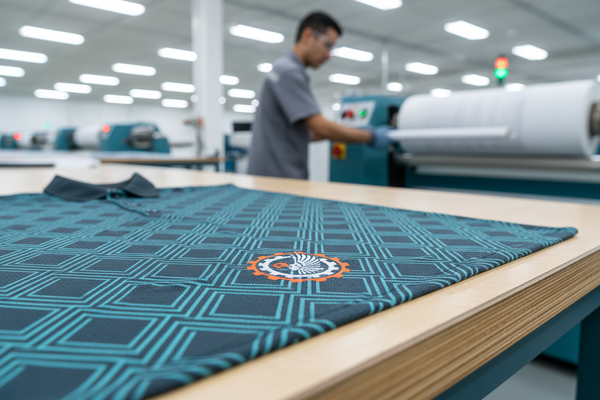
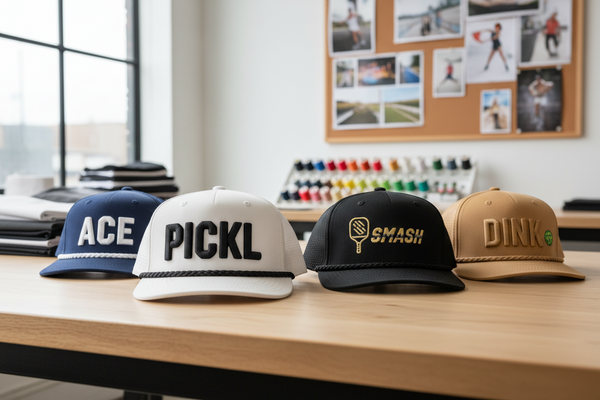
Embroidery is the premium choice for corporate uniforms, delivering 5–7 years of durability through regular washing[reference:30]. The process uses industrial multi-head machines to stitch thread directly into the fabric, creating a raised, dimensional finish that signals quality[reference:31]. Embroidery requires professional digitizing—converting artwork into machine-readable stitch patterns—which adds $45–95 per design[reference:32]. Per-garment costs run $8–15 depending on stitch count and colors[reference:33]. Embroidery works best for logos, text, and simple shapes on structured garments like polo shirts, jackets, and caps[reference:34].
Screen printing is the most cost-effective method for volume uniform programs, running $4–8 per garment with setup costs amortizing across large orders[reference:35]. The process involves creating separate mesh screens for each color in the design, then pressing ink through those screens onto the garment. Screen print survives 50–75 washes typical and works best for simple 2–4 color designs[reference:36]. The trade-off: setup costs make small runs uneconomical, and color gradients are limited compared to digital methods[reference:37].
DTF (Direct-to-Film) has become the go-to for full-color, complex designs in corporate uniform programs. The design is printed onto a transfer film with specialized adhesion polymers, then heat-pressed onto the garment[reference:38]. DTF enables unlimited colors and photo-realistic detail at $8–14 per garment[reference:39]. The durability is 40–60 washes when pressed correctly[reference:40]. The trade-off: slight texture on the finished garment, and the adhesion polymers must be matched to the specific fabric substrate—polyester requires different chemistry than cotton[reference:41].
Heat Transfer is the fastest option for rush orders or small runs, with 3–5 day turnaround at $5–10 per garment[reference:42]. The process uses pre-cut vinyl or printed transfers heat-pressed onto the fabric. Heat transfer suits names, numbers, and simple graphics[reference:43]. The trade-off: lower durability than screen print or embroidery, with potential peeling or cracking over time[reference:44].
One universal rule for corporate uniform decoration: test on production fabric, not on the supplier's test swatch. The test swatch is usually a different lot, sometimes a different weight entirely. Run adhesion, wash, and stretch tests on samples cut from the actual production roll[reference:45]. If the supplier won't provide a production roll sample for testing, that's a red flag.
4. Risk Factors: Preventing Severe Operational Flaws in Bulk Runs
Bulk production amplifies every small variance. A 1% difference in polyester content changes the dye uptake and the shrinkage behavior. A 2% variation in finishing tension alters the fabric weight and the hand feel. Here are the operational failures I see most often in corporate uniform programs—and how to prevent them.
Thermoplastic dye migration is the most insidious failure in polyester-blend uniform programs. When the fabric is subjected to high heat—during decoration curing, industrial drying, or even hot-press finishing—the disperse dyes in the polyester fibers can re-gas and migrate[reference:46]. The visible result: color bleeding into adjacent areas, white prints turning pink or grey, and uniforms that look like they've been dyed incorrectly. The root cause is using standard disperse dyes instead of low-migration formulations. The fix: require low-migration dye certification from the mill and test substrate polymer cross-linking stability at 180°C before approving the fabric batch.
Fabric weight grammage variance shows up as inconsistent hand feel and performance across a single production run. A 230 GSM fabric that measures 218 GSM on some rolls and 242 GSM on others indicates either yarn substitution or finishing tension problems. The root cause is inadequate quality control at the finishing stage. The fix: ISO 3801 fabric weight testing on every production roll, with tolerance of -2.5% to +5% of spec. If a roll falls outside tolerance, reject it.
Decoration delamination occurs when the adhesion between the decoration and the fabric fails. Screen print ink peels, DTF film lifts, heat transfer cracks. The root cause is inadequate curing temperature or incompatible adhesion polymers for the substrate. The fix: run a stretch test on every production lot—stretch the fabric 50% in both directions. If the decoration cracks or separates, the curing or polymer selection was wrong. Reject the lot[reference:47].
Inaccurate seasonal weight selection is the self-inflicted wound that kills more corporate uniform programs than any quality issue. A uniform that looks professional in a catalog becomes unusable in the actual work environment. The root cause is specifying fabric weight without validating it against the operating environment. The fix: map your uniform usage across all locations and seasons before finalizing the spec[reference:48]. Field crews in warm climates need 150–180 GSM performance fabrics. Office staff need 200–220 GSM pique. Industrial staff need 230–260 GSM twill. One weight does not fit all.
5. Procurement Ledger: Cost Amortization Specs for Bulk Corporate Uniform Drops
Let's talk about the actual cost structure. The per-unit price of a corporate uniform breaks down into materials, labor, decoration, and overhead—but the proportions shift dramatically with volume and specification tier.
Materials run $4–8 per uniform for 200–230 GSM poly-cotton fabrics, depending on blend ratio, yarn quality, and finish. Long-staple combed ring-spun yarns add $1–2 per yard. Soil-release or moisture-wicking finishes add $0.50–1.00 per garment. Higher GSM fabrics cost more—a 260 GSM twill typically costs $1–2 more than a 200 GSM pique in the same style[reference:49]. The material cost is the largest variable, and it's also the most negotiable—if you're willing to compromise on weight or finish.
Labor runs $3–6 per uniform for cutting, sewing, and finishing. This is where the MOQ math matters. A factory's setup cost for a production run is fixed—pattern grading, cutting table setup, sewing line configuration[reference:50]. At 200 units, you're paying $2–3 per uniform in setup amortization. At 500 units, it drops to $1–2. At 1,000 units, it drops to $0.50–1.00. The MOQ isn't arbitrary—it's the point where the factory's setup cost becomes economically viable for them and cost-effective for you[reference:51].
Decoration varies by method. Embroidery: $8–15 per uniform depending on stitch count, plus $45–95 digitizing fee[reference:52]. Screen print: $4–8 per uniform for 2–3 colors at 200+ units[reference:53]. DTF: $8–14 per uniform for full-color designs[reference:54]. Heat transfer: $5–10 per uniform for simple designs[reference:55]. The decoration cost often exceeds the garment cost on small runs. If your program is under 200 units, consider simplifying the decoration—fewer colors, smaller design, or single embroidery placement—to keep the per-unit cost under control.
Overhead includes shipping, duties, packaging, and quality control. Budget $2–4 per uniform for freight from Asia to a US warehouse. Add $0.50–1.00 for polybagging and cartoning. QC inspection—if you're using a third-party service—adds $0.50–1.00 per uniform[reference:56]. Total landed cost for a 220 GSM poly-cotton pique uniform with 2-color screen print at 200 units: roughly $18–24 per unit. At 500 units: $15–20. At 1,000 units: $12–17. The curve flattens after 500 units.
One cost trap for corporate programs: rush fees. If you need uniforms in under 4 weeks, expect to pay a 20–30% premium for expedited production[reference:57]. The factory prioritizes your order on the production line, which means bumping other customers. That premium is avoidable if you plan 8–10 weeks ahead.
6. Engineering Benchmark Profiles: AATCC/ASTM Lab Threshold Metrics
| Test Method | Parameter | Acceptance Threshold | Failure Mode |
|---|---|---|---|
| AATCC 61 | Colorfastness to Laundering | ≥ 4.0 (Gray Scale) after 20 cycles | Logo fading; color transfer to other garments |
| AATCC 8 | Colorfastness to Crocking | ≥ 4.0 (dry) / ≥ 3.5 (wet) | Color transfer to vehicle interiors; equipment staining |
| AATCC 135 | Dimensional Stability (shrinkage) | ≤ 3% warp / ≤ 5% weft after 5 cycles | Fit distortion; decoration misalignment |
| ASTM D5034 | Breaking Strength (Grab Test) | ≥ 35 lbf (warp) / ≥ 30 lbf (weft) | Seam failure; fabric tearing under stress |
| AATCC 20 | Fiber Composition Analysis | ± 3% of stated blend ratio | Misrepresented fabric content; performance variance |
| ISO 3801 | Fabric Weight (GSM) | Tolerance: -2.5% to +5% of spec | Inconsistent weight; wrong hand feel |
These thresholds represent the minimum standards for quality corporate uniform programs. If your supplier can't commit to these numbers in writing, or won't provide independent lab results, you're buying on faith[reference:58]. And faith doesn't survive the first industrial wash cycle[reference:59].
7. Fatal Sourcing Gaps: Destructive Blindspots in Quality Control
Most corporate uniform quality control plans focus on what you can see: print alignment, seam straightness, loose threads. But the failures that kill uniform programs are invisible at the inspection table[reference:60]. They show up in the laundry room, in the field, or in the employee's closet six months later.
The blend ratio substitution. The mill specs 65/35 poly-cotton. But polyester prices fluctuate. Mid-production, the mill increases the polyester content to 70/30—cheaper, more available—to protect their margin. The fabric weight stays the same because they adjust the yarn count. But the dye uptake changes: higher polyester content means lighter color, different hand feel, and reduced breathability[reference:61]. You won't see it in the inspection. You'll see it when the employees complain that the uniforms feel "stiffer" and "don't breathe." The fix: require AATCC 20 fiber composition analysis with every shipment. Test it. Reject deviations.
The finish skip. The soil-release or moisture-wicking finish is an extra step. The factory skips it to save time and money. The fabric passes your incoming inspection—the weight is right, the color matches. But the first oil stain or sweat mark sets permanently. The uniform never comes clean. The fix: the water bead test on every production lot. Drip water from 12 inches onto the fabric surface[reference:62]. If it doesn't bead and roll off, the finish is absent or degraded. Reject the lot.
The pre-production physical master sample omission. You approved the design on a digital proof and a small swatch. The factory runs 200 units. The collar rolls differently than expected. The pocket sits 2 cm lower than the sample. The fabric drapes heavier than the swatch suggested. The root cause: no pre-production physical master sample on actual production fabric[reference:63]. The fix: require a full pre-production sample on the actual production fabric with all decorations applied. Inspect it under the lighting conditions where the uniform will be worn. Cut it, stretch it, wash it, dry it. If it doesn't perform, don't approve the production run.
The low-migration dye omission. You specified standard disperse dyes for the polyester blend. The factory used them. The uniforms look perfect at delivery. After the first industrial wash at 75°C, the dark blue areas bleed into the white stripes. The logo—white on navy—turns pink. The root cause: thermoplastic dye migration under heat[reference:64]. The fix: require low-migration dye certification from the mill and test substrate polymer cross-linking stability at 180°C before approving the fabric batch. If the dye migrates at 180°C, it will migrate in the dryer.
8. Supply Chain FAQ Summary: Verified Action Ledger FAQ
Q: What's the minimum order quantity for a corporate uniform program with custom fabric?
Most full-service manufacturers set MOQ at 200–300 units per color for custom fabric production[reference:65]. If you're using stock fabric (blanks that the factory already produces), MOQ can drop to 50–100 units. Embroidery programs typically start at 50–150 units. Screen print programs typically start at 100+ units for optimal economics[reference:66].
Q: How do I verify that the factory is actually using the specified blend ratio and fabric weight?
Three methods. First, request yarn and fabric certification from the mill—this should specify blend ratio, yarn count, and GSM[reference:67]. Second, run AATCC 20 fiber composition analysis on a production sample—this identifies fiber content within ±3% accuracy[reference:68]. Third, run ISO 3801 fabric weight testing on every production roll—cut a 10cm x 10cm square, weigh it, multiply by 100. If the GSM deviates more than 5% from spec, reject the roll.
Q: What's the typical timeline from tech pack submission to delivery for a corporate uniform program?
Assuming a 200-unit run with custom-dyed 220 GSM poly-cotton pique and 2-color screen print: 7–10 days for sample development, 3–5 days for sample approval, 15–20 days for production, 5–7 days for QC and packaging, and 12–18 days for sea freight. Total: 42–60 days[reference:69]. Express Manufacturing Lane can reduce production to 5–7 days with a 20–30% premium. Plan for the longer timeline and celebrate the early arrival.
Q: How do I protect my corporate uniform program against color variance between production runs?
Require Spectral Pantone coordinated matching with digital tolerances[reference:70]. The supplier formulates dye to match a digital spectral curve, eliminating subjective interpretation. Require that all fabric comes from a single dye lot[reference:71]. For reorders, request that the mill retain a physical color standard from your initial production. Digital matching is helpful but not sufficient—fabric texture affects perceived color. A physical standard is the only reliable reference.
Q: What's the real cost difference between a premium corporate uniform and a budget corporate uniform at 200 units?
Premium: 230 GSM poly-cotton twill with long-staple combed ring-spun yarns, soil-release finish, and 2-color screen print. Landed cost: roughly $22–28 per unit. Budget: 180 GSM poly-cotton poplin with carded yarns, no finish, and 1-color heat transfer. Landed cost: roughly $14–18 per unit[reference:72]. The premium uniform lasts 2–3x longer—50+ industrial wash cycles vs. 20–25. For a corporate program where the uniform is a brand and safety asset, the premium option is cheaper per wear. For a short-term program, budget might win. Match the spec to the operational requirement.
Q: How do I handle quality disputes with an overseas supplier?
Three rules. First, get everything in writing: specs, test methods, acceptance criteria, and remedies[reference:73]. Second, use a third-party inspection service (e.g., SGS, Bureau Veritas) for pre-shipment inspection—this gives you independent leverage[reference:74]. Third, structure your payment terms to hold 20–30% until after shipment arrival and inspection[reference:75]. If the supplier knows you can withhold payment, they'll prioritize your quality. If you pay 100% upfront, you're buying their problems.
This guide was developed by the sourcing team at apparellots.com, based on factory-floor experience and procurement data from hundreds of corporate uniform programs. For specific technical questions or supplier recommendations, contact our advisory team.