Corporate Fleet Uniform Sourcing: Engineering Durability for Heavy Transport Crews
Let's talk about what actually happens when a fleet uniform program goes from a procurement spreadsheet to a crew locker room. The difference between a uniform that holds up through 50 industrial wash cycles and one that's threadbare after 15 shifts comes down to about five specification decisions made before the factory ever cuts fabric. This guide walks through those decisions from a procurement standpoint—fabric engineering, decoration durability, and the logistical realities that separate successful rollouts from operational headaches.
1. Sourcing Realities: What Fleet Managers and Logistics Coordinators Overlook Regarding Fabric Specification
The typical fleet uniform brief reads like this: "Poly-cotton blend, screen print logo, 500 units, need it in 6 weeks." That's not a spec—it's a prayer. The actual technical decisions that determine outcome happen in the fabric weight, the blend ratio, and the finish treatments—and most buyers never get past the "poly-cotton" checkbox.
Fabric weight is the first variable that matters. Retail-weight shirts at 140–160 GSM lack the industrial tensile endurance required for 12-hour shifts against seat belts, tool belts, and equipment edges. Fleet crews need minimum 200 GSM substrates, with 240 GSM twill being the standard for heavy transport applications[reference:13]. The difference in cost is $1–2 per yard. The difference in lifespan is 30–40 additional wash cycles[reference:14].
The blend ratio matters just as much. A 65/35 polyester-cotton blend delivers the optimal balance: the polyester provides strength, wrinkle resistance, and dimensional stability; the cotton contributes moisture balance and wearing comfort[reference:15]. Higher polyester content (80/20) improves durability further but reduces breathability[reference:16]. Lower polyester content (50/50) feels softer but lacks the industrial tensile endurance for fleet use. The procurement trap is specifying "poly-cotton" without the ratio—and receiving whatever the mill has on hand.
Then there's the finish. A fluorocarbon soil release treatment—applied during finishing—creates a low-surface-energy barrier that causes oil, grease, and dirt to bead and release during laundering[reference:17]. Without it, uniforms absorb contaminants on the first shift and never come clean. The treatment adds $0.50–1.00 per garment but extends the professional appearance window by 20–30 washes. For fleet mechanics and fuel handlers, it's not optional.
2. Textile Physics: The Structural Science Behind Poly-Cotton Blend Workwear
Let's talk about what actually happens inside a poly-cotton twill under industrial laundering conditions. The polyester fibers provide the structural backbone—they have higher tensile strength than cotton and better elastic recovery. The cotton fibers provide the moisture management and comfort against skin. The combination works because the two fiber types complement each other's weaknesses.
In a 65/35 blend, the polyester content is high enough to significantly improve the fabric's breaking strength. ASTM D5034 grab tests on 240 GSM poly-cotton twill typically show breaking forces of 35–45 lbf in the warp direction and 30–40 lbf in the weft[reference:18]. Compare that to a 100% cotton twill of similar weight at 25–35 lbf—the poly-cotton blend delivers 20–30% higher industrial tensile endurance.
The twill weave structure matters too. Twill fabrics have a diagonal rib pattern that distributes abrasion across multiple yarns. When a seat belt rubs against a twill uniform, the friction is spread across the diagonal floats rather than concentrated on individual yarns. Plain weave fabrics lack this distribution mechanism—they abrade faster and fail sooner. That's why fleet uniforms specify twill, not plain weave.
Dimensional stability under laundering is another critical parameter. AATCC 135 testing measures shrinkage in both warp and weft directions[reference:19]. Quality poly-cotton twill maintains ≤3% shrinkage in both directions after 5 industrial wash cycles. Fabrics with inadequate finishing or improper blend ratios can shrink 5–8%, changing the fit from "relaxed" to "boxy" and compromising the retroreflective tape placement[reference:20].
3. Workshop Execution: Calibrating Decoration Output Lines for Fleet Uniforms
Fleet uniforms require decoration methods that survive industrial laundering—not just look good at the initial rollout. The substrate is heavier, the wash cycles are more aggressive, and the abrasion is relentless.
Screen printing on poly-cotton twill requires different parameters than printing on lightweight jersey. The heavier fabric needs more squeegee pressure to push ink into the weave. The mesh count should be lower—110 to 156 threads per inch—to deposit sufficient ink film thickness. The cure temperature needs calibration: poly-cotton blends require 160–170°C for proper ink cross-linking, but the polyester content means you can't exceed 180°C without risking dye migration[reference:21]. The window is narrow—and the factory needs to know your exact blend ratio to set the dryer correctly.
Heat transfer has become more common for fleet programs because it eliminates screen setup costs and handles complex designs. But heat transfer on poly-cotton has a failure mode: the adhesive film doesn't penetrate the twill weave as deeply as screen print ink. On heavier fabrics, the film sits on the surface rather than bonding into the yarns. The result: peeling after 15–20 industrial launderings instead of 50+. The fix is a higher-pressure heat press and a longer press time—18 seconds at 165°C instead of the standard 12 seconds. But that extra heat can affect the fabric's soil release finish. Trade-offs everywhere.
Embroidery is the most durable decoration method for fleet uniforms—it survives industrial laundering when executed correctly. But embroidery on poly-cotton twill requires specific digitizing parameters. The needle compression is different from lightweight fabrics. Dense designs can create perimeter puckering if the digitizer doesn't account for the fabric's stretch recovery. The fix is pull-compensation vector digitizing with values calibrated to the specific GSM and weave structure. If your digitizer doesn't ask about your fabric weight and construction, find a new digitizer.
One universal rule for fleet decoration: test on production fabric, not on the supplier's test swatch. The test swatch is usually a different lot, sometimes a different weight entirely. Run adhesion, wash, and stretch tests on samples cut from the actual production roll. If the supplier won't provide a production roll sample for testing, that's a red flag.
4. Risk Factors: Preventing Severe Operational Flaws in Bulk Runs
Bulk production amplifies every small variance. A 1% difference in polyester content changes the dye uptake and the shrinkage behavior. A 2% variation in finishing tension alters the fabric weight and the hand feel. Here are the operational failures I see most often—and how to prevent them.
Laundering crocking failure is the silent killer of fleet uniform programs. When dyes aren't properly fixed to the fibers, they transfer during washing—blue logos onto white shirts, dark colors onto light trim. The root cause is inadequate dye fixation or improper after-treatment. The fix is AATCC 8 crocking testing on every production lot, with minimum Grade 4.0 on the Gray Scale for Staining[reference:22][reference:23]. But most buyers never test for crocking because they don't know to ask.
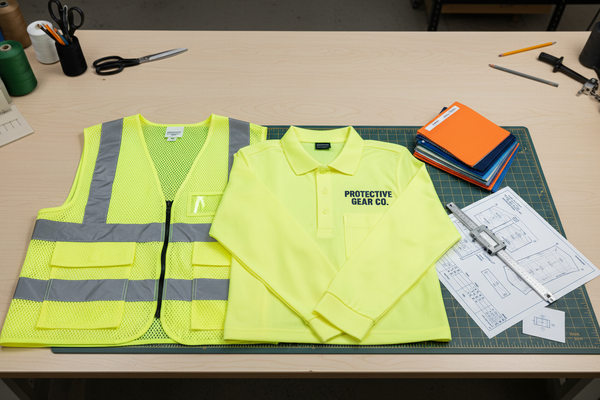
Retroreflective tape delamination shows up after the first industrial wash. The tape separates from the fabric, the reflective layer cracks, or the adhesive fails. The root cause is using tape that wasn't certified for the specific fabric substrate and wash protocol. The fix is specifying retroreflective materials with ANSI/ISEA 107 certification and requiring tape suppliers to provide wash test data for your specific fabric. Not all tape works on all substrates—and the factory's standard tape might not work on yours.
Soil release finish degradation is the most common invisible failure. The fluorocarbon treatment wears off after 10–15 washes, and suddenly the uniforms start absorbing oil and grease. The root cause is either inadequate application (the finish wasn't properly cured) or incompatible wash chemistry (alkaline detergents degrade fluorocarbons). The fix is the water bead test: drip water onto the fabric from 12 inches. If it beads and rolls off, the finish is intact. If it spreads or absorbs, the finish is gone.
Logistics routing buffer time neglect is the self-inflicted wound that kills more fleet rollouts than any quality issue. Procurement teams calculate delivery from factory gate to port and stop there. They forget the regional sort, the last-mile truck, the warehouse receiving backlog. The fix is the 14-day rule: add 10–14 days of logistics routing buffer time for multi-hub distribution. That covers the port delay, the regional sort, and the truck that breaks down.
5. Procurement Ledger: Cost Amortization Specs for Bulk Poly-Cotton Fleet Drops
Let's talk about the actual cost structure. The per-unit price of a fleet uniform breaks down into materials, labor, decoration, and overhead—but the proportions shift dramatically with volume and specification tier.
Materials run $4–8 per uniform for 240 GSM poly-cotton twill, depending on blend ratio and finish. Soil release fluorocarbon finish adds $0.50–1.00. Retroreflective tape adds $2–5 per garment depending on class and placement. High-visibility polyester substrates run $5–9 per uniform. The material cost is the largest variable, and it's also the most negotiable—if you're willing to compromise on weight or finish.
Labor runs $3–6 per uniform for cutting, sewing, and finishing. This is where the Bulk Contract MOQ Tier math matters. A factory's setup cost for a production run is fixed—pattern grading, cutting table setup, sewing line configuration. That cost is amortized across your unit count. At 300 units, you're paying $2–3 per uniform in setup amortization. At 1,000 units, it drops to $0.50–1.00. The MOQ isn't arbitrary—it's the point where the factory's setup cost becomes economically viable for them and cost-effective for you.
Decoration varies by method. Screen print: $3–6 per uniform for 2–3 colors at 500+ units. Heat transfer: $5–8 per uniform for full-color designs. Embroidery: $8–15 per uniform depending on stitch count. The decoration cost often exceeds the garment cost on small runs. If your program is under 300 units, consider simplifying the decoration—fewer colors, smaller design, or a single embroidery placement—to keep the per-unit cost under control.
Overhead includes shipping, duties, packaging, and quality control. Budget $2–4 per uniform for freight from Asia to a US warehouse. Add $0.50–1.00 for polybagging and cartoning. QC inspection—if you're using a third-party service—adds $0.50–1.00 per uniform. Total landed cost for a 240 GSM poly-cotton twill uniform with 2-color screen print at 500 units: roughly $18–24 per unit. At 1,000 units: $15–20. The curve flattens after 1,000 units.
One cost trap: multi-tier rolling buffer stocks. Instead of one massive production run, structure your contract for quarterly releases with 10–15% buffer stock held at the factory. This gives you coverage for unexpected attrition while keeping inventory carrying costs manageable. The buffer absorbs the logistics routing buffer time without leaving crews uncovered. The trade-off is slightly higher per-unit cost—the factory charges a holding fee for the buffer—but the operational insurance is worth the premium.
6. Engineering Benchmark Profiles: AATCC/ASTM Lab Threshold Metrics
| Test Method | Parameter | Acceptance Threshold | Failure Mode |
|---|---|---|---|
| AATCC 61 | Colorfastness to Laundering | ≥ 4.0 (Gray Scale) after 20 cycles | Logo fading; color transfer to other garments[reference:24] |
| AATCC 8 | Colorfastness to Crocking | ≥ 4.0 (dry) / ≥ 3.5 (wet) | Color transfer to vehicle interiors; equipment staining[reference:25] |
| AATCC 135 | Dimensional Stability (shrinkage) | ≤ 3% in warp and weft after 5 cycles | Fit distortion; retroreflective tape misalignment[reference:26] |
| ASTM D5034 | Breaking Strength (Grab Test) | ≥ 35 lbf (warp) / ≥ 30 lbf (weft) | Seam failure; fabric tearing under stress[reference:27] |
| AATCC 20 | Fiber Composition Analysis | ± 3% of stated blend ratio | Misrepresented fabric content; performance variance[reference:28] |
| ANSI/ISEA 107 | Retroreflective Performance | Class 2: ≥250 cd/lx/m²; Class 3: ≥330 cd/lx/m² | Reduced visibility in low-light conditions |
These thresholds represent the minimum standards for commercial-quality fleet uniform programs. If your supplier can't commit to these numbers in writing, or won't provide independent lab results, you're buying on faith. And faith doesn't survive the first industrial wash cycle.
7. Fatal Sourcing Gaps: Destructive Blindspots in Quality Control
Most quality control plans focus on what you can see: print alignment, seam straightness, loose threads. But the failures that kill fleet programs are invisible at the inspection table. They show up in the laundry room, in the vehicle cab, or on the crew member's body six months later.
The blend ratio substitution. The mill specs 65/35 poly-cotton. But polyester prices fluctuate. Mid-production, the mill increases the polyester content to 70/30—cheaper, more available—to protect their margin. The fabric weight stays the same because they adjust the yarn count. But the dye uptake changes: higher polyester content means lighter color, different hand feel, and reduced breathability. You won't see it in the inspection. You'll see it when the crew complains that the uniforms are "stiffer" and "don't breathe." The fix? Require AATCC 20 fiber composition analysis with every shipment. Test it. Reject deviations[reference:29].
The finish skip. The soil release fluorocarbon finish is an extra step. The factory skips it to save time and money. The fabric passes your incoming inspection—the weight is right, the color matches. But the first oil stain sets permanently. The uniform never comes clean. The fix? The water bead test on every production lot, not just the sample. Drip water from 12 inches. If it doesn't bead, reject the lot.
The tape substitution. You specified ANSI/ISEA 107 Class 2 retroreflective tape. The factory substitutes a non-certified tape that looks identical—until the first wash. The reflective layer cracks, the adhesive fails, and the tape delaminates. The fix? Require tape certification with every shipment. Test the tape's retroreflective coefficient with a portable reflectometer. Reject deviations.
The logistics buffer omission. The production timeline is tight—12 days to completion. But the factory's freight forwarder books standard ocean freight, not expedited. The container sits at the port for 5 days waiting for a vessel. Customs clearance takes another 4 days. Regional distribution adds 10 days. The uniforms arrive 3 weeks late. The fix? The 14-day rule: add logistics routing buffer time to every timeline. Not 5. Not 7. Fourteen. That covers the port delay, the regional sort, and the last-mile truck.
8. Supply Chain FAQ Summary: Verified Action Ledger FAQ
Q: What's the minimum order quantity for a fleet uniform program with custom fabric?
Most full-service manufacturers set MOQ at 300–500 units per color for custom fabric production. If you're using stock fabric (blanks that the factory already produces), MOQ can drop to 100–200 units. The Bulk Contract MOQ Tier structure allows for phased rollouts: Tier 1 (500+ units) at base pricing, Tier 2 (200–499) at 5–8% premium, Tier 3 (50–199) at 10–15% premium.
Q: How do I verify that the factory is actually using the specified poly-cotton blend ratio?
Two methods. First, request yarn certification from the mill—this should specify blend ratio, yarn count, and twist level. Second, run AATCC 20 fiber composition analysis on a production sample[reference:30]. The test identifies fiber content within ±3% accuracy. If the lab report shows higher polyester content than specified, you've got a substitution.
Q: What's the typical timeline from tech pack submission to crew locker for a fleet program?
Assuming a 500-unit run with custom-dyed 240 GSM poly-cotton twill and 2-color screen print: 7–10 days for sample development, 3–5 days for sample approval, 15–20 days for production, 5–7 days for QC and packaging, 12–18 days for sea freight to a US port, and 10–14 days for regional distribution. Total: 52–74 days. Express Manufacturing Lane can reduce production to 5–7 days with a 20–30% premium. Plan for the longer timeline and celebrate the early arrival.
Q: How do I protect my fleet program against color variance between production runs?
Require Spectral Pantone coordinated matching with digital tolerances. The supplier formulates dye to match a digital spectral curve, eliminating subjective interpretation. Require that all fabric comes from a single dye lot. For reorders, request that the mill retain a physical color standard from your initial production. Digital matching is helpful but not sufficient—fabric texture affects perceived color. A physical standard is the only reliable reference.
Q: What's the real cost difference between a premium fleet uniform and a budget fleet uniform at 500 units?
Premium: 240 GSM poly-cotton twill with soil release finish, 2-color screen print, and retroreflective tape. Landed cost: roughly $22–28 per unit. Budget: 180 GSM poly-cotton poplin with no finish, 1-color screen print, no reflective tape. Landed cost: roughly $14–18 per unit. The premium uniform lasts 2–3x longer—50+ industrial wash cycles vs. 20–25[reference:31]. For a fleet program where the uniform is a safety and branding asset, the premium option is cheaper per wear. For a short-term program where the uniform is disposable, budget might win. Match the spec to the operational requirement.
Q: How do I handle quality disputes with an overseas supplier?
Three rules. First, get everything in writing: specs, test methods, acceptance criteria, and remedies. Second, use a third-party inspection service (e.g., Bureau Veritas, SGS) for pre-shipment inspection—this gives you independent leverage. Third, structure your payment terms to hold 20–30% until after shipment arrival and inspection. If the supplier knows you can withhold payment, they'll prioritize your quality. If you pay 100% upfront, you're buying their problems.
This guide was developed by the sourcing team at apparellots.com, based on factory-floor experience and procurement data from hundreds of fleet uniform programs. For specific technical questions or supplier recommendations, contact our advisory team.