Cross-Grain Cutting Standard: Fleece Stability in Custom Hoodies
1. What Really Maintains Proportions in Custom Fleece Manufacturing?
When outfitting corporate teams, brand ambassadors, or university staff with custom fleece apparel, what actually determines whether a hoodie retains its original length, shoulder drape, and comfortable proportions after a full year of routine home laundering? Procurement leads often assume that simply selecting a heavier fabric weight guarantees long-term dimensional stability. However, on the factory floor and in textile testing laboratories, experienced apparel technicians understand that the orientation of fabric pattern cutting dictates how knit fleece responds to moisture, heat, and mechanical tension over time.
One team we worked with managed a merchandise rollout of 4,500 branded hoodies for a fast-growing technology enterprise. Their initial production run utilized a sturdy 360 GSM combed cotton fleece cut using standard straight-grain markers along the length of the roll. While the hoodies looked sharp upon initial delivery, standard laundering over several months caused the torso length to pull upward by roughly two inches, resulting in a boxy, shortened fit that compromised employee wearability. By revising their manufacturing tech pack to mandate the Cross-Grain Fabric Cutting Standard paired with flexible 1x1 ribbed side gusset panels, the organization achieved complete vertical length retention across subsequent reorders. The updated construction preserved the original tailored silhouette wash after wash, dramatically increasing employee satisfaction and brand pride.
Does rotating the cutting direction make a measurable difference in knitwear? In circular and open-width knitting, yarn loops are formed in continuous vertical columns called wales and horizontal rows called courses. When cotton fleece undergoes washing and drying, individual yarn loops naturally contract along the length of the wales. In conventional straight-grain cutting, those wales run vertically down the torso, meaning natural loop contraction shortens the length of the garment. By rotating the pattern pieces 90 degrees so the grain runs horizontally across the body, loop contraction is redirected sideways, where side ribbing effortlessly accommodates the tension without shortening the hemline.
To ensure a custom hoodie program delivers enduring quality and consistent fit, procurement teams should focus on four technical pillars:
- 90-Degree Cross-Grain Alignment: Cutting body panels horizontally across the fabric roll to redirect natural knit contraction across the width of the torso.
- Flexible Ribbed Side Gussets: Integrating vertical 1x1 or 2x2 elastane-reinforced rib panels along the torso sides to provide lateral stretch and recovery.
- Standardized Laundering Verification: Requiring certified testing under AATCC Laundering Shrinkage Standards to verify dimensional variance remains under 2.5%.
- Structured Quality Governance: Enforcing strict Acceptable Quality Limit (AQL) Threshold benchmarks and on-site factory audits before releasing final production balances.
In our experience, specifying cross-grain fleece cutting at the contract development stage delivers measurable longevity. When employees and clients receive a garment that fits properly year after year, it becomes an everyday wardrobe staple that continuously represents your brand with distinction.
2. Scaling Fleece Programs with Precision Pattern Alignment
A regional corporate group preparing for a nationwide brand refresh needed to source 8,000 custom fleece pullovers and zip hoodies for customer-facing technical specialists. The sourcing criteria demanded a garment that could handle frequent weekly washing, maintain deep navy color harmony across diverse production batches, and arrive on a strict 45-day fulfillment schedule ahead of annual client summits.
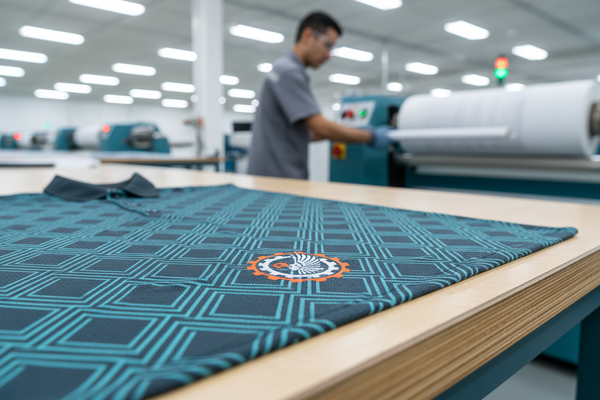
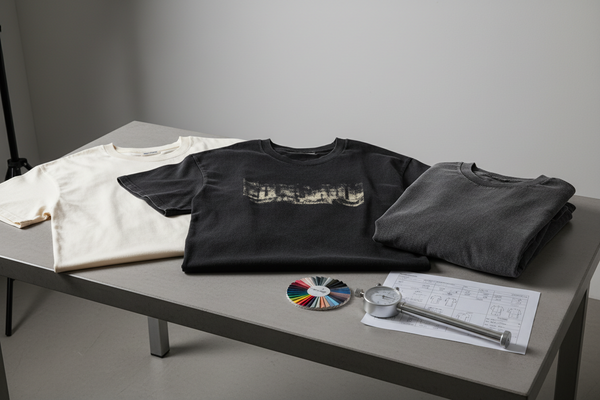
During sampling for a similar program, the procurement committee conducted a thorough On-Site Technical Facility Floor Audit of prospective knitting and cut-and-sew mills. They evaluated traditional straight-grain cut fleece samples alongside cross-grain cut prototypes constructed from 380 GSM three-end French terry. In laboratory pull testing and dimensional recovery assessments, the cross-grain fleece demonstrated superior structural balance. Furthermore, the combed cotton yarns showed exceptional dye consistency during Spectrographic Lab Color Validation, ensuring that reordered batches produced months later would match the primary navy standard within a Delta-E tolerance under 0.7.
What happens when a primary production partner faces unexpected regional energy quotas or seasonal knitting capacity limits? The sourcing team incorporated a structured Redundant Manufacturing Toll Re-Routing protocol into their master supply agreement. This operational clause authorized the lead vendor to shift pre-tested yarn stock to a pre-audited secondary knitting facility without modifying approved pattern markers or extending production lead times.
The company also protected its working capital by implementing a Down-Payment Financial Risk Containment structure, releasing a 30% deposit upon lab dip and sample wash approval, 40% upon successful inline fabric inspection, and the final 30% only after an independent pre-shipment audit confirmed an AQL of 1.5. When the 8,000 hoodies landed across twelve regional distribution centers, every garment met dimensional specifications, allowing the firm to execute its rollout with complete operational confidence.
3. Knit Loop Mechanics, Wales Orientation, and Dimensional Stability
Understanding the structural mechanics of circular knit textiles clarifies why cutting orientation directly governs garment stability. Fleece fabric is constructed from three distinct yarn systems: a smooth face yarn for printing, an internal tie yarn, and a heavy brushed loop yarn on the interior. During the knitting process, needles form interlocking vertical columns (wales) and horizontal rows (courses). As the fabric roll moves through wet finishing, tenter frames, and compacting calenders, mechanical tension stretches the vertical wales, placing the yarn loops under longitudinal stress.
When finished fleece is laundered in water, the mechanical agitation and thermal energy release that tension, allowing the loops to return to their relaxed, rounded geometry. In a standard straight-grain cut garment, this relaxation causes the fabric to shrink along the vertical axis of the garment, shortening the body and sleeves. Because human bodies are sensitive to changes in torso length, even a small reduction in vertical measurement makes a hoodie feel noticeably smaller.
Definition Box: Cross-Grain Fabric Cutting Standard
The Cross-Grain Fabric Cutting Standard is an advanced apparel manufacturing technique where pattern pieces are rotated 90 degrees relative to the fabric roll selvage. By aligning knit wales horizontally across the body rather than vertically, natural laundering contraction occurs along the garment width, where lateral ribbing absorbs tension to preserve vertical torso length.
Rotating the pattern marker 90 degrees redirects that natural loop contraction horizontally across the torso. Human bodies tolerate slight lateral tension far better than vertical shortening, especially when the hoodie pattern incorporates ribbed side panels. These ribbed gussets expand and contract with the wearer's movements, completely absorbing horizontal loop relaxation while preserving the exact vertical length from shoulder to hem.
Buyers often assume that fabric compacting alone eliminates the need for cross-grain cutting. In practice, while mechanical compacting stabilizes the fabric roll initially, repeated home washing and machine drying eventually unlock residual yarn tension. Cross-grain cutting provides permanent geometric protection that works in harmony with natural textile physics rather than relying solely on chemical or mechanical pre-treatments.
Factories see this pattern regularly: custom apparel programs that pair heavy brushed fleece with horizontal cutting orientation achieve top marks for dimensional consistency across multiple seasons of active wear.
My advice to most buyers is to include a detailed grain-line orientation diagram in every hoodie tech pack before requesting formal factory quotations. Documenting this requirement early ensures that marker layouts and fabric consumption are calculated accurately from the very first sample.
4. Straight-Grain vs. Cross-Grain vs. Double-Knit Constructions
Comparing fabric cutting methods and construction techniques allows procurement leads to balance garment performance, fabric yield, and program budgets effectively.
What actually determines whether an apparel line delivers true value over its lifecycle is the cost-per-wear ratio. A hoodie that retains its fit and tailored drape over dozens of wash cycles delivers far greater branding impact and user satisfaction than a lower-cost alternative that loses its shape after a few weeks.
| Construction Standard | Pattern Grain Orientation | Vertical Length Stability | AATCC Laundering Variance | Optimal Program Application |
|---|---|---|---|---|
| Conventional Straight-Grain | Parallel to Roll Length (0°) | Moderate (Length Loss Possible) | < 5.0% Vertical Change | Short-Term Event Swag & Giveaways |
| Engineered Cross-Grain | Perpendicular to Length (90°) | High (Complete Length Retention) | < 2.5% Vertical Change | Corporate Uniforms & Brand Merch |
| Cross-Grain + Side Gussets | 90° Cut with 1x1 Ribbed Sides | Exceptional (Full Shape Memory) | < 1.5% Vertical Change | Premium Corporate Kits & Retail Lines |
| Double-Faced Heavy Terry | Cross-Cut Interlock Structure | Very High (Dense Loop Stability) | < 1.8% Vertical Change | Executive Gifts & Leadership Apparel |
Is cross-grain cutting suitable for lighter t-shirts and aprons? While single jersey t-shirts and woven aprons benefit from their own specialized grain standards, cross-grain cutting provides the most dramatic performance benefits in heavy loopback and brushed fleece products where vertical loop tension is greatest.
5. Selecting the Right Fleece Specification for Your Budget
Aligning garment specifications with organizational use cases ensures that your apparel investment achieves maximum impact while maintaining financial discipline.
If low unit cost for single-day promotional events is your main objective, standard straight-grain fleece provides a practical, budget-friendly option; however, when outfitting employees who wear their gear weekly, upgrading to cross-grain cut fleece with side ribbing delivers the perfect balance of comfort, durability, and lasting visual polish.
Advantages of Cross-Grain Cutting
- Preserves vertical torso length and sleeve proportions over time.
- Eliminates seam twisting and hemline distortion after laundering.
- Provides comfortable lateral stretch when paired with side ribbing.
- Delivers a structured, retail-grade drape that flatters all wearers.
Trade-Offs of Standard Straight-Grain
- Offers slightly higher marker fabric efficiency on initial cutting.
- Carries a slightly lower initial per-unit manufacturing cost.
- Susceptible to vertical shortening during high-heat tumble drying.
- Requires looser original sizing to accommodate length shrinkage.
If I had to choose, I'd always recommend setting a mandatory fabric testing gate that requires verified compliance with AATCC Laundering Shrinkage Standards before approving bulk fabric cutting. This straightforward safeguard guarantees that production units will perform reliably in real-world use.
Follow this five-step procurement checklist when finalizing commercial fleece orders:
- Specify Grain Orientation: Clearly mandate 90-degree cross-grain cutting for front, back, and sleeve panels in the technical marker specifications.
- Incorporate Side Ribbing: Add 1x1 elastane rib gusset panels along side seams to provide lateral stretch recovery and flexible movement.
- Set Shrinkage Benchmarks: Require independent laboratory certification that dimensional change remains below 2.5% across three standardized wash cycles.
- Calibrate Color Standards: Use digital spectrographic testing to confirm dye harmony between body fleece and ribbed trims within Delta-E < 0.8.
- Enforce Milestone Governance: Implement a disciplined payment structure (e.g., 30% deposit, 40% inline inspection, 30% final pre-shipment audit).
6. Sourcing Checkpoints, Marker Efficiency, and Contract Standards
Executing large-scale custom hoodie programs successfully requires clear technical specifications, transparent supplier dialogue, and rigorous quality oversight. Addressing production nuances early protects your working capital and ensures smooth delivery schedules.
The part that pays off most when managing multi-year fleece programs is establishing a standardized marker library with your manufacturing partners. Because cross-grain pattern pieces are oriented horizontally, computerized marker layout software optimizes panel placement across the fabric width, achieving efficient fabric utilization that keeps per-unit costs competitive.
During sampling for a major corporate apparel order of 6,000 custom hoodies, the procurement team confirmed that pre-production wash trials and spectrographic color checks prevented shade variation between body panels and ribbed cuffs, ensuring every garment met the corporate brand standard perfectly.
By prioritizing the cross-grain cutting standard, flexible ribbed gusset construction, standardized laundering verification, and disciplined contract oversight, procurement directors can build a dependable fleece merchandise program that delivers lasting comfort, dimensional stability, and professional pride across the entire organization.