Ordering Custom Sublimation Polo Shirts: What to Confirm Before Production
Ordering custom polo shirts sounds straightforward: choose a shirt, send a logo, confirm the quantity, and place the order.
In practice, a bulk custom polo order usually involves several details that need to be confirmed before production starts.
The fabric, garment color, logo color, printing locations, artwork files, size breakdown, matching accessories, shipping method, and production schedule can all affect the final result. Small misunderstandings at the quotation stage can become much harder to fix once production has started.
This guide walks through the main points to confirm when ordering custom sublimation polo shirts for a company, team, event, promotional program, or organization.
1. Start With the Fabric, Not Just the Shirt Style
For performance-oriented custom polos, the fabric is one of the first specifications worth confirming.
A polyester/spandex or polyester/elastane blend can be used for custom sublimation polo shirts when stretch and performance characteristics are important.
One production specification commonly requested for this type of polo is:
-
Polyester/spandex (elastane) blend
-
Approximately 140–170 GSM
-
Four-way stretch
-
Moisture-wicking
-
Quick-drying
-
Sublimation printing
These specifications describe more than simply how the shirt looks.
A lightweight stretch fabric can be more appropriate when the shirts will be worn for outdoor work, events, golf, uniforms, company activities, or other situations where freedom of movement and moisture management matter.
However, buyers should avoid assuming that every polyester performance polo has exactly the same fabric composition or performance characteristics.
If a particular fabric percentage or weight is important to your project, specify it in the initial inquiry and ask the supplier to confirm the available production option.
2. Be Specific About the Base Color
Color confirmation can become surprisingly important when sublimation printing is involved.
For example, a buyer may describe the garment as black and provide reference photos where the lighting makes the fabric appear dark gray.
That can create confusion later.
The safest approach is to confirm the actual garment color in writing:
Base garment: Black
Then separately confirm the printing color.
This distinction matters because the garment color and the logo color are two different production specifications.
In one common scenario, the customer may send a black logo file while also requesting a black garment. If the logo is supposed to appear in light gray, white, or another contrasting color, the production team needs to know that before preparing the artwork.
Do not rely only on the appearance of an attached mockup.
Confirm the intended colors in text.
3. Send the Actual Logo File Separately
A mockup is useful for showing the overall design, but it should not necessarily be treated as the final production artwork.
When requesting a quotation or preparing an order, send the logo as a separate file whenever possible.
This gives the production team an opportunity to check:
-
Logo artwork
-
Color requirements
-
Image quality
-
Printing suitability
-
Artwork proportions
-
Placement requirements
It can also reveal problems that are easy to miss in a product mockup.
For example, a customer may send a black logo file but intend the finished printed logo to be light gray. That difference needs to be resolved before production rather than after the artwork has already been prepared.
A simple message such as:
"The garment will be black, and the logo should be light gray."
can prevent unnecessary back-and-forth.
4. Mark Every Logo Location on the Reference Image
"Add our logo to the shirt" is usually not specific enough for a custom apparel order.
A polo may have several possible branding areas, including:
-
Front chest
-
Back
-
Collar
-
Sleeve
-
Other designated areas depending on the garment construction
If you have a specific layout in mind, mark the locations directly on a reference image.
This is especially useful when the design contains multiple branding areas.
For example, a custom polo may be planned with branding on the collar, front chest, back, and sleeve area. The production team can then review each location individually rather than assuming where the logos should go.
Why this matters
A reference image can show the intended appearance, but not every part of a garment can necessarily be printed in the same way.
Certain construction areas, seams, stripes, bands, or other design elements may limit the printable area.
In the referenced production discussion, some diagonal and horizontal sleeve areas could not be printed, while other logo areas could be customized.
That is exactly the kind of issue that should be identified before production.
5. Do Not Assume Every Part of the Reference Design Can Be Sublimated
One of the most useful lessons when ordering custom apparel is that a visual mockup and a production-ready garment are not always identical.
A buyer may provide a reference shirt showing:
-
Decorative stripes
-
Sleeve bands
-
Multiple color blocks
-
Logos near seams
-
Graphics extending across different garment panels
Some areas may not be suitable for the requested printing process.
Instead of asking only:
"Can you copy this design?"
it is better to ask:
"Which areas of this design can actually be produced on the selected garment?"
The supplier can then identify any restricted areas and suggest a workable layout before the order is finalized.
This is much easier than discovering the limitation after production begins.
6. Confirm the Size Breakdown Before Production
For a bulk order, the total quantity is only one part of the specification.
If the order contains 250 polos, the supplier still needs to know how those 250 pieces should be divided by size.
For example:
| Size | Quantity |
|---|---|
| S | — |
| M | — |
| L | — |
| XL | — |
| 2XL | — |
| Total | 250 |
The actual size distribution should come from the buyer's expected wearer group rather than being guessed by the supplier.
This is particularly important for uniforms, company apparel, event staff shirts, and employee programs where the shirts will be distributed to different people.
If the size breakdown is not ready, ask for the available size chart early and use it to finalize the order.
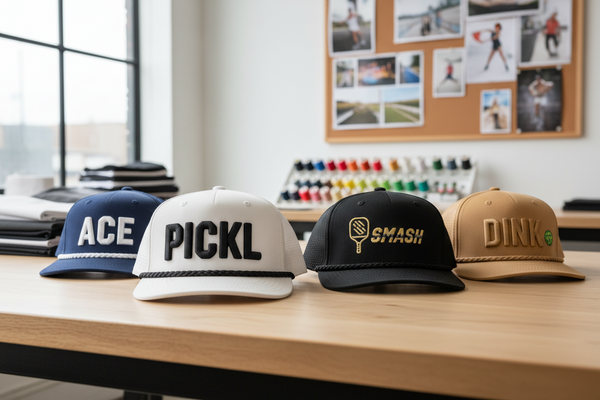
7. If You Are Ordering Matching Caps, Treat Them as a Separate Specification
A polo-and-cap program may look like one coordinated product package, but the two items still require separate production decisions.
For example, a cap order may need confirmation of:
-
Quantity
-
Cap style
-
Base color
-
Logo artwork
-
Logo color
-
Front logo
-
Side logo
-
Back logo
Some cap styles may look very similar while having different construction details.
If more than one suitable style is available, comparing the actual options before production is better than choosing based only on the product name.
Logo placement should also be stated clearly.
For example:
Cap logo locations:
-
Front
-
Side
-
Back
This is much clearer than simply saying "custom logo cap."
8. Keep the Polo and Cap Colors Consistent
When ordering polos and caps together, confirm that both products use the same intended base color.
A common source of confusion is photography.
Black garments can look gray in product photos because of:
-
Lighting
-
Reflections
-
Camera exposure
-
Background color
If the actual requirement is black, confirm it explicitly rather than judging the color only from photographs.
The same applies to the logo.
A black garment with a light-gray logo is a very different visual specification from a black garment with a white logo, even if the difference looks small in a quotation image.
9. Air Shipping Is Not Always the Fastest Practical Choice
Buyers often ask about air shipping because they want the order quickly.
That makes sense, but shipping method should be evaluated based on the entire shipment rather than production speed alone.
A combined order of several hundred polos and caps can become a relatively heavy shipment.
For larger apparel orders, air shipping may have:
-
Higher freight cost
-
Carton size limitations
-
Weight limitations
-
Additional package splitting requirements
For that reason, sea shipping can be considerably more economical for a larger combined apparel order.
The right question is not simply:
"Can you ship this by air?"
Instead, ask for both options when timing matters:
-
Air shipping cost and estimated transit time
-
Sea shipping cost and estimated transit time
Then compare the additional freight cost against the delivery deadline.
10. Ask for the Complete Timeline, Not Just Production Time
A supplier may quote a production time of a few days, but that is only one part of the schedule.
A more useful timeline separates:
Artwork confirmation → Production → Shipment → Transit → Final delivery
For example, the production communication in this order indicated approximately 3–5 days after payment for production.
Shipping then needs to be considered separately.
This distinction is important when the shirts are needed for a specific event or company deadline.
A five-day production time does not mean the entire order will arrive in five days.
11. Understand the Payment Requirement Before Production
Payment terms should also be confirmed before the order is approved.
For this type of custom bulk apparel production, the stated process was full payment before production, with payment available by wire transfer or an online payment link using PayPal or credit card.
This is worth confirming before finalizing the order because production generally begins only after the payment requirement has been completed.
A buyer should know:
-
Total product cost
-
Shipping cost
-
Payment method
-
When production begins
-
Whether artwork approval is required before production
-
Estimated production time
Having these points confirmed in writing makes the purchasing process much clearer.
12. A Practical RFQ Checklist for Custom Polo Shirts
If you are requesting a quotation for custom sublimation polos, sending the following information in the first message can make the process much faster.
Garment
-
Polo shirt style
-
Intended use
-
Fabric composition
-
Fabric weight/GSM
-
Stretch requirement
-
Moisture-wicking requirement
-
Quick-dry requirement
-
Base garment color
Customization
-
Logo/artwork file
-
Logo color
-
Printing method
-
Front logo location
-
Back logo location
-
Sleeve logo location
-
Collar or other logo location
-
Reference image or mockup
Quantity
-
Total quantity
-
Size breakdown
-
Any separate quantities for other products
Matching Accessories
If ordering caps or other accessories:
-
Quantity
-
Color
-
Style
-
Logo locations
-
Logo color
-
Artwork
Shipping
-
Destination ZIP code
-
Full delivery address when available
-
Required delivery date
-
Preferred shipping method
-
Whether you want an air and sea freight comparison
Production
-
Sample requirement
-
Artwork approval process
-
Production lead time
-
Payment terms
Providing these details upfront gives the production team enough information to evaluate the project instead of going back and forth over basic specifications.
13. What to Confirm Before You Approve Production
Before making the final payment or giving production approval, review the order one more time.
Your final confirmation should cover:
Garment:
Black performance polo
Fabric:
Confirmed polyester/spandex or polyester/elastane performance fabric
Printing:
Sublimation
Logo:
Approved artwork and confirmed light-gray logo color
Locations:
Approved printable locations on the polo and caps
Quantity:
Confirmed polo and cap quantities
Sizes:
Approved size breakdown for the polos
Cap:
Approved cap style and logo placement
Shipping:
Confirmed freight method and destination
Production:
Confirmed production timeline
This final check takes only a few minutes, but it can prevent expensive changes later.
Final Takeaway
Custom sublimation apparel is not simply a matter of sending a logo and choosing a quantity.
A successful bulk order depends on getting the small details right before production:
fabric → garment color → artwork → logo color → print locations → sizes → accessories → shipping → payment → production approval
The more specific the initial request is, the easier it is for a custom apparel supplier to determine what can actually be produced.
And when a reference image is involved, do not assume every visual detail can automatically be reproduced. Ask the production team to review the artwork, confirm the printable areas, and identify any limitations before the order moves into production.
That is usually the point where a simple quotation becomes a properly defined manufacturing order.