Reusable Bags Market Trends: Sourcing Strategy & Material Analysis
Aligning Volume Demands with Operational Realities
A corporate procurement team ordering 100,000 units for a nationwide promotional rollout operates under fundamentally different constraints than a boutique brand sourcing 2,000 retail-ready canvas totes. The real issue here is whether account managers are buying for single-event branding or multi-year structural utility. When an event agency orders low-cost promotional bags, their primary objective centers on meeting an unyielding trade show deadline at $0.45 per unit. Conversely, a regional grocery chain buying 500,000 reusable shopping totes every quarter must prioritize long-term durability, washability, and dynamic weight capacity to prevent costly floor failures in front of customers.
One team we worked with at a mid-sized grocery buyer switched supplier sources purely based on a $0.04 reduction in unit cost. Six weeks later, 18% of the incoming shipment suffered handle separation when loaded with standard 12 lb grocery orders. The factory had quietly removed the secondary reinforcement layer beneath the handle anchor points to achieve that lower price point. The resulting customer complaints, store-level refunds, and emergency repurchasing burned through $42,000 in margin—completely wiping out the initial $20,000 raw material savings. Sourcing teams must categorize their true buyer profile before signing off on material bills of materials.
Enterprise buyers typically fall into three distinct profiles: high-volume commodity purchasers, middle-market promotional agencies, and premium retail product developers. High-volume buyers focus on container optimization, raw material resin indices, and automated ultrasonic production speed. Promotional agencies balance crisp brand representation with fast 20-day production cycles and minimal MOQ barriers. Retail developers prioritize heavy fabric hands, intricate internal seam edge binding, and custom hardware accessories that justify $25+ retail price points. Defining these parameters up front prevents critical engineering misalignment between the buyer and the factory floor.
During sampling for a similar mid-tier retail program, a client assumed that specifying an 80 GSM non-woven fabric would automatically guarantee a 20 lb static load capacity. Factory stress tests proved otherwise. Without a reinforced top lip and proper cross-stitching, the handles detached at just 11 lbs of static force. Structural integrity stems from the interaction between fabric weight, stitch density, and seam architecture—not just the standalone material thickness listed on a spec sheet.
2. Need Analysis: Structural Demands vs. End-User Lifecycles
Every reusable bag serves a specific operational purpose, and matching structural specifications to realistic end-user lifecycles is essential for supply chain efficiency. What actually determines long-term bag survival is handle attachment geometry rather than raw fabric weight. A tote intended for trade show collateral carrying 3 lbs of lightweight brochures requires minimal seam binding. A heavy-duty grocery tote designed for 50 distinct store visits must withstand repeated dynamic dropping, liquid exposure, and total static loads exceeding 30 lbs without structural yarn shift or needle-hole tearing.
Increasing raw fabric GSM by 20% adds material cost without solving handle tearing. Dynamic load distribution depends entirely on anchor surface area. Replacing a single horizontal seam with a 1.5-inch cross-box stitch pattern increases handle load threshold by up to 140% at zero added material weight.
Factories see this pattern regularly: clients request a heavier fabric gauge to solve field durability issues, unaware that the actual point of failure is stitch density. Standard industrial production defaults to 6 stitches per inch using lightweight polyester thread. Under sustained load, these loose stitches act like a serrated knife, slicing directly through the synthetic fibers or cotton weave. Upgrading the specification to 8-10 stitches per inch alongside a continuous box-stitched structural gusset distributes weight evenly across the entire side panel, preventing premature tensile load-bearing failure.
A common outcome when this gets skipped involves seam edge fraying after minor consumer use. Unbound internal seams in woven cotton or recycled PET bags quickly unravel when exposed to friction or washing machine cycles. Incorporating internal seam edge binding with bias tape or bias-cut non-woven strip wraps the raw fabric edges completely, locking threads in place. This subtle construction detail adds less than $0.08 to production costs while extending product lifespans from weeks to years.
Volumetric geometry plays a crucial role in practical utility. Flat totes without side or bottom expansion gussets strain handle attachment points whenever bulky or square items are inserted. Adding a 4-inch side gusset transforms how internal weight shifts, lowering center-of-gravity stress on top seams. Procurement teams must map out precisely what their end-users will place inside these bags to select an appropriate shape, volume, and structural seam assembly.
3. Material Fit: Evaluating Non-Woven, Woven, and Synthetic Alternatives
Selecting the right base substrate requires evaluating unit economics against mechanical performance under real-world conditions. In most cases, non-woven polypropylene offers the lowest unit cost, but heavy woven canvas yields significantly higher repeat impressions. Non-woven polypropylene (NWPP) dominates high-volume distribution due to its low cost and lightweight nature. Formed by thermal bonding extruded polymer filaments into a web, NWPP delivers functional performance at 80 to 100 GSM. However, its low melting point and limited abrasion resistance make it unsuitable for high-friction industrial applications or heavy laundering.
| Material Substrate | Weight Standard | Tensile Strength | Target Unit Cost | Primary Applications |
|---|---|---|---|---|
| Non-Woven PP | 80 - 100 GSM | Moderate (15-20 lbs) | $0.35 - $0.75 | Grocery giveaways, events, promotional events |
| Laminated NWPP | 110 - 130 GSM | High (25-35 lbs) | $0.65 - $1.20 | Supermarket retail, full-color printed totes |
| Recycled PET (RPET) | 120 - 150 GSM | High (30-40 lbs) | $0.95 - $1.85 | Sustainability programs, apparel retail packaging |
| Woven Cotton Canvas | 10 - 14 oz/yd² | Very High (40-60 lbs) | $1.80 - $4.50 | Retail merchandise, corporate gifts, premium apparel |
Laminated non-woven PP introduces a biaxially oriented polypropylene (BOPP) film layer melted onto the non-woven base. This lamination step seals the porous surface, transforming polypropylene non-woven adhesion into a total liquid barrier capable of supporting vivid, edge-to-edge rotogravure printing. The operational trade-off appears in shipping density: laminated fabric stiffens considerably, reducing folding flexibility. As a result, master cartons hold 30% fewer units per cubic meter compared to soft non-woven bags, directly increasing ocean freight costs per unit.
Recycled Polyethylene Terephthalate (RPET) crafted from post-consumer plastic bottles offers an excellent balance between environmental messaging and technical strength. Utilizing high denier filament weight specification yarns, RPET fabric delivers higher tensile performance per GSM than standard polypropylene. It withstands repeated flex cycles without whitening or cracking along fold lines, making it an ideal substrate for structured, high-use retail bags. However, raw material supply fluctuations can cause unit pricing to shift up to 12% between purchasing quarters.
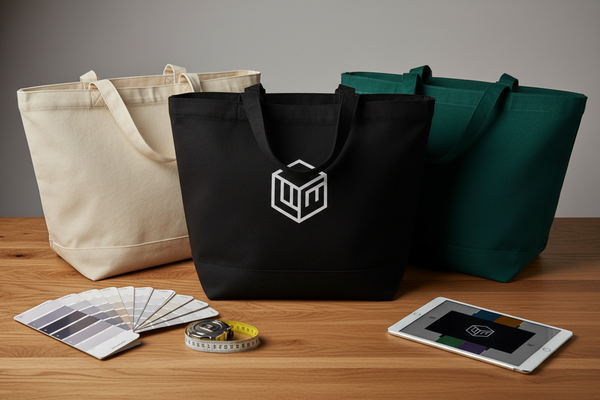
Woven cotton canvas remains the classic gold standard for premium retail totes. Ranging from 8 oz light duck cloth to 14 oz heavy duck canvas, woven cotton offers unmatched tactile appeal, excellent breathability, and exceptional tear resistance. Cotton fibers absorb dyes and inks deeply, producing rich visuals. However, cotton absorbs moisture easily, stains when exposed to liquids, and requires careful pre-shrinking treatments during mill production to prevent severe shrinkage during end-user washing cycles.
When selecting synthetic materials like 420D or 600D polyester, denier count directly governs performance under heavy cargo hardware stress. Lower denier fabrics tear easily around sharp corners like boxed goods, whereas higher denier weaves provide robust structural integrity. Buyers must weigh initial material procurement costs against total product lifecycles to ensure chosen substrates deliver optimum value over time.
4. Decoration and Printing Methodologies
Selecting artwork decoration methods requires balancing visual design complexity, production run size, and material compatibility. The difference between screen printing and rotogravure lamination comes down to surface roughness and ink absorption limits. Water-based screen printing on flat cotton canvas yields sharp line detail and vibrant colors at low MOQs. However, applying screen print inks directly to textured 80 GSM non-woven polypropylene often results in uneven ink coverage, pinholes, and poor opacity due to the rough surface profile of the non-woven web.
- If line artwork features 1-3 flat spot colors at low MOQs (1,000–3,000 units), choose Direct Screen Printing.
- If artwork requires photo-realistic gradients or full-bleed graphics at high MOQs (10,000+ units), choose Rotogravure BOPP Lamination.
- If decorating highly structured 600D synthetic fabrics in mid volumes, choose Heat Transfer Litho Transfers.
- If branding high-end heavy cotton canvas with subtle, long-lasting detail, choose Direct Embroidery or Woven Patch Appliqués.
One regional supermarket chain experienced severe print flaking across 80,000 laminated non-woven bags. The factory had skipped the corona discharge surface treatment step on the BOPP film prior to ink application. Without proper surface tension adjustments, the ink failed to bond with the polymer layer, causing full-color graphic designs to peel off after light surface abrasion. Sourcing teams must verify that suppliers utilize inline surface treatment equipment on all film-laminated bag production runs.
Rotogravure printing uses engraved copper cylinders to transfer quick-drying inks onto OPP film prior to fabric lamination. This technique offers flawless photo-realistic rendering, exact color matching, and complete edge-to-edge full-bleed graphic capabilities. The drawback sits in initial tooling costs: cylinder setup charges range from $250 to $400 per color channel. For a four-color process run across front, back, and gusset panels, initial tooling fees easily exceed $2,500. These setup expenses must be amortized over large order quantities—typically 15,000 units minimum—to keep unit economics sensible.
Flexographic printing offers a practical middle ground for medium-complexity designs on non-woven substrates. Utilizing flexible photopolymer plates, flexo printing applies water-based inks quickly at lower setup costs than rotogravure. While it cannot match the micro-detail or photographic depth of gravure lamination, flexo printing handles 1 to 4 color logos efficiently with minimal setup charges, making it ideal for regional retail packaging programs running 5,000 to 10,000 units.
Heat transfer printing and direct-to-film (DTF) technologies provide flexible solutions for short-run, multi-color customization on complex canvas or RPET bags. DTF transfers print vibrant, flexible graphics that withstand repeated stretch cycles without cracking. However, heat transfers add a localized layer on top of the fabric, slightly reducing breathability and soft hand feel across large print areas. Sourcing leads should reserve heat transfers for small-format logos or variable data runs where screen setup fees would be prohibitive.
5. Cost Structure and Supply Chain Logistics
Navigating reusable bag procurement economics requires analyzing complete landed cost structures rather than relying on factory-gate unit prices. The real risk in volume bag procurement sits in freight volume calculations rather than factory gate price. A baseline factory quote of $0.42 per unit for an 80 GSM non-woven tote sounds attractive until sea freight, customs duties, port handling, and inland trucking are added. Depending on pallet packing efficiency and ocean container space availability, landed logistics costs can add 20% to 45% to total unit expenditure.
Raw polymer resin prices directly drive unit costs for synthetic bags. Polypropylene resin prices fluctuate alongside petroleum indices, creating sudden cost shifts during production runs. During sampling for a similar program, an overseas supplier attempted to increase unit prices by 14% mid-run, citing raw polymer cost increases. Sourcing managers should build price-index adjustment clauses into long-term master service agreements, tying unit price fluctuations directly to public resin benchmarks to prevent arbitrary mid-run price increases.
| Cost Component | Typical % of Landed Cost | Primary Cost Drivers | Optimization Strategy |
|---|---|---|---|
| Raw Substrate / Fabric | 40% - 55% | Resin index, cotton crop yield, GSM/weight specification | Lock material index pricing; optimize fabric weight targets |
| Cut, Sew & Assembly | 15% - 25% | Labor costs, handle stitch complexity, edge binding detail | Automate non-woven welding; standardize stitching patterns |
| Printing & Tooling | 10% - 20% | Color count, plate/cylinder setup fees, coverage area | Amortize setup costs over 15,000+ unit order runs |
| Packaging & Freight | 15% - 30% | Volumetric packing density, ocean rates, drayage | Use heavy vacuum compression packing; optimize pallet counts |
Logistics planning must account for carton compression limits during container transit. Soft non-woven totes can be vacuum compressed into dense bales, doubling the unit count per master carton and maximizing 40-foot High-Cube container capacity. Conversely, rigid laminated totes or heavy canvas bags with thick handles cannot withstand extreme vacuum compression without suffering permanent surface creasing or delamination. Attempting to force heavy laminated bags into undersized cartons causes crushed gussets and seam splits before goods ever reach the warehouse.
Lead times vary significantly across manufacturing hubs. Domestic sourcing offers fast 10-to-14-day delivery turnarounds, but unit costs are typically 2.5 to 4 times higher due to elevated labor rates. Overseas production in Southeast Asia delivers favorable unit economics for orders exceeding 10,000 units, but standard lead times run 35 to 45 days for factory production, plus 20 to 30 days for ocean freight transit and customs clearance. Sourcing managers must plan inventory cycles 90 days out to avoid emergency air freight charges that instantly eradicate project margins.
6. Recommendation and Sourcing Execution Playbook
Executing an efficient reusable bag procurement program requires balancing technical material specifications with strict quality assurance standards. In most sourcing scenarios, specifying reinforced cross-stitching adds 3% to unit cost while reducing return rates by 80%. Sourcing leads must establish clear tech packs, sign off on verified pre-production golden samples, and enforce strict factory-floor quality inspection routines at every production stage.
Quality inspection routines should focus on critical mechanical failure points. During a incoming container audit at a distribution warehouse, an inspector discovered that handle stress testing caused tensile failure under just 18 lbs of force, far short of the contracted 35 lb requirement. The factory had substituted standard lightweight polyester thread in place of high-tenacity nylon thread to cut assembly costs. Establishing a mandatory AQL 2.5 inspection protocol with mandatory tensile pull-testing catches subtle material substitutions before goods ship overseas.
- Material GSM Verification: Cut 10cm x 10cm fabric swatches from 5 random cartons; weigh on digital scales to ensure compliance within ±3% of spec.
- Handle Pull-Test Audit: Apply a sustained 35 lb static load for 3 minutes to 10 randomly selected bag samples; verify zero thread slippage or seam tearing.
- Print Rub & Adhesion Test: Perform 10 firm passes with an isopropyl swab across printed areas; verify zero ink transfer or surface flaking.
- Seam & Stitching Inspection: Count stitches per inch using a loupe (8-10 SPI required); verify internal seam edge binding covers all raw edges cleanly.
- Carton Volumetric Audit: Measure master carton dimensions and weight against packing list specs to prevent unexpected drayage charges.
When structuring long-term supplier agreements, split production allocations across two verified manufacturing facilities. Maintaining a primary supplier handling 70% of volume alongside a secondary regional factory holding 30% mitigates risks from regional labor strikes, port congestion, or sudden material shortages. This dual-sourcing model preserves supply chain flexibility while maintaining strong volume leverage with the primary factory floor.
Future-proofing your bag sourcing strategy involves staying ahead of changing global compliance standards and plastic reduction mandates. As regional governments expand single-use plastic bans to include low-gauge synthetic bags, specifying higher durability materials ensures full regulatory compliance across all sales channels. By maintaining strict tech pack controls, locking in clear raw material benchmarks, and enforcing on-site quality testing, procurement teams consistently deliver long-lasting carrier products that protect both brand reputation and profit margins.