Print Durability Comparison Guide: B2B Sourcing Analysis
1. Industry Opinion: The Flaw in Visual Sample Sign-Offs
The commercial textile industry routinely conflates initial visual sharpness with long-term mechanical print durability. Brand owners and procurement directors regularly approve high-volume production runs based on pristine pre-production physical samples inspected on an office table. These samples look vibrant, sharp, and perfectly registered. However, visual evaluation at room temperature reveals almost nothing about how an ink system behaves after exposure to heat, agitation, detergent chemistry, and mechanical elongation. Sourcing teams that treat decoration sign-off as a cosmetic visual check invariably face high customer return rates, localized print cracking, and complete film delamination once inventory hits real-world laundering cycles.
The real issue here is that initial hand-feel tells you almost nothing about how an ink bond behaves after twenty laundering cycles. A thick, opaque plastisol chest print can appear solid and resilient out of the box. Yet, if the underlying resin binder failed to reach its required gelation and fusion temperatures in the factory dryer, that print possesses no internal structural integrity. The first hot water wash cycle strips away plasticizers, causing the under-cured polymer film to fracture along knit rows. True decoration quality resides beneath the surface, determined by chemical fiber anchoring and binder elasticity match.
One team we worked with approved a 15,000-unit promotional t-shirt drop using a heavy white plastisol graphic on a 180 GSM ring-spun cotton jersey. The visual strike-offs were flawless, displaying sharp edges and opaque color density. Three weeks after distribution, corporate end-users reported widespread print flaking along the chest flex zones. Factory investigation revealed the screen printing line had run at 3.5 meters per minute through a short 2-meter infrared drying tunnel set to 150°C. The core ink layer only reached 130°C—well short of the 160°C threshold required for total plastisol cross-linking. The binder remained semi-solid, leading to catastrophic film breakdown during domestic washing.
Modern garment construction further complicates ink performance through Organic Substrate Ink Non-Compatibility and Vector Node Tensile Modulation. When print graphics feature sharp geometric corners or fine vector linework, stress concentrates directly at those graphic nodes during fabric stretching. If the ink film lacks the elastic modulus to match the substrate's elongation rate, the graphic shears apart at the narrowest vector junctions. A durable print is not merely an aesthetic overlay; it is a structural polymer layer engineered to flex, contract, and age synchronously with the underlying textile substrate.
2. Factory Observation: Curing Failures and Substrate Interactions
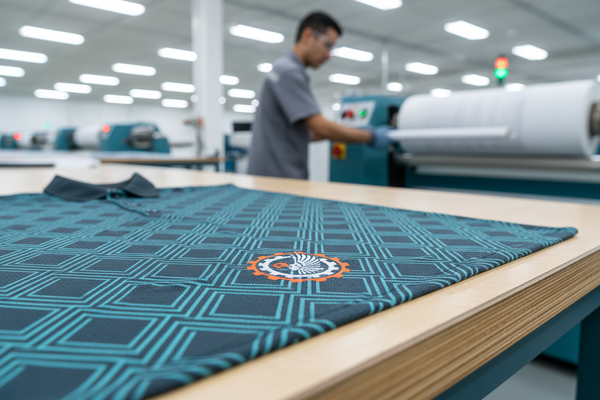
During routine floor audits across contract print facilities, technical inspectors consistently find that print failures originate in the drying tunnel rather than the screen press or digital print head. Factories operating under tight margin pressure routinely adjust conveyor belt speeds to maximize hourly garment throughput. When conveyor speeds increase without a corresponding increase in tunnel chamber length or burner BTU output, dwell times drop below critical thermal thresholds. Ink films dry on the outer skin while remaining un-cured at the fabric interface layer, creating latent quality defects that pass initial inline end-of-line inspections.
What actually determines print longevity on heavy fleece is the mechanical anchor depth into the yarn bundles rather than surface binder thickness. When printing on 350 GSM loopback cotton fleece or heavy brushed fleece, the raised surface texture presents a complex dimensional landscape. Inks applied with insufficient squeegee pressure or improper viscosity simply ride on top of the surface fibers. Subsequent mechanical washing wears away these elevated fibers, causing severe Dimensional Fabric Texture Adhesion failures. The print does not peel off cleanly; instead, the top fiber layer detaches from the yarn bundle, taking the ink film with it.
Factories see this pattern regularly when processing Direct-to-Film (DTF) transfers on heavy brushed fleece or coarse rib knits. DTF relies on a granulated thermoplastic polyurethane (TPU) adhesive powder melted onto the back of a digitally printed PET film. During heat press application, the TPU powder melts and flows into the fabric interstices. If the press pressure is set below 4 bar or the press time is cut short by 5 seconds to speed up assembly, the melted adhesive fails to penetrate the outer cotton fibers. The result is DTF Shear Peel-Off Degradation, where the entire graphic peels away under light shear stress like a sticker.
Another major floor-level failure point occurs when mills attempt to apply standard ink formulations across synthetic or blended fabrics without accounting for thermal migration. On 100% polyester or poly-cotton blends, disperse dyes within the synthetic fibers liquefy when exposed to heat press or tunnel dryer temperatures above 130°C. These free dye molecules migrate upward into the wet print ink layer, a phenomenon known as dye bleed or gas sublimation migration. A crisp white graphic printed over dark navy polyester transforms into a muddy blue within 48 hours of heat curing if low-bleed barrier underbases are omitted to save pennies per unit.
3. Testing and Sampling: Standardized Validation Protocols
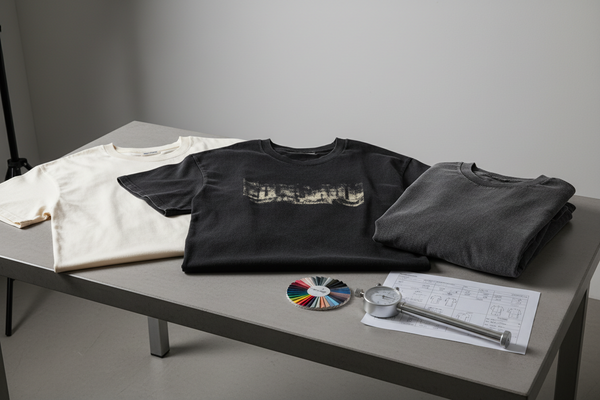
Relying on informal in-house wash tests—such as tossing three sample shirts into a home washing machine with generic detergent—provides zero actionable data for enterprise supply chain contracts. Validating decoration durability requires disciplined, repeatable laboratory testing governed by standardized industry frameworks like AATCC Method 135 (Dimensional Changes of Fabrics after Home Laundering) and AATCC Method 8 (Crocking Resistance). These protocols expose printed textiles to quantified mechanical agitation, water temperatures, detergent alkalinity levels, and drying cycles to measure real-world performance degradations.
In most cases, lab dips pass dry crocking easily, but wet crocking fails as soon as synthetic fibers undergo thermo-mechanical stress. Dry crocking measures pigment transfer caused by simple surface friction, whereas wet crocking evaluates color bleeding when the printed fabric is saturated with moisture or sweat. A Grade 4.0 or higher rating on the AATCC Gray Scale for Color Change is mandatory for commercial distribution. Achieving this rating on 100% polyester activewear demands precise control over Polyester Sublimation Cross-Linking Chemistry, ensuring dye molecules remain permanently bound inside the synthetic fiber matrix rather than floating near the surface.
During sampling for a similar corporate workwear program, a procurement manager specified 200 GSM 65/35 poly-cotton polo shirts with a multi-color chest print. The supplier provided pre-production samples that passed a 5-cycle home wash test with zero visible damage. However, when the buyer submitted the same samples to an independent certified lab for a 25-cycle commercial laundering evaluation at 60°C under ISO 105-C06 standards, the prints suffered severe color loss, surface cracking, and edge delamination. The elevated water temperature and alkaline wash chemistry dissolved the low-grade acrylic binder used in the print paste.
To establish a bulletproof quality control framework, contract tech packs must require three mandatory laboratory tests prior to mass production release. First, execute a 20-cycle AATCC 135 wash test at 40°C with tumble drying to verify film cracking resistance and border adhesion. Second, perform AATCC Method 8 wet and dry crocking tests across all printed color blocks to confirm pigment fixation. Third, run an ASTM D2261 tongue tear and elongation test across the print boundary to verify that the ink layer does not reduce the natural tensile strength or tear resistance of the host fabric.
4. Comparison: Technical Analysis of Decoration Technologies
Selecting the optimal decoration method requires balancing technical durability, fabric compatibility, order volume, and unit cost. No single decoration method excels across every performance metric. A decoration technique that delivers exceptional 50-wash durability on 100% cotton can fail instantly when applied to high-stretch nylon activewear. Sourcing directors must evaluate the mechanical and chemical characteristics of each process against the target garment's end-use scenario.
The difference between plastisol screen printing and digital transfer durability comes down to binder elastic modulus versus fiber elongation rates. Plastisol screen printing utilizes a high-solids PVC resin suspension that forms a tough, durable surface film. On heavy cotton tees and structural fleece, properly cured plastisol provides extraordinary wash longevity, withstanding 50 to 100 home laundering cycles with minimal degradation. However, because plastisol sits as a heavy film on top of the fabric, it exhibits poor breathability and can feel stiff on lightweight garments. Furthermore, if applied to high-stretch fabrics without stretch additives, plastisol cracks under tension.
Water-based screen printing represents the technical opposite of plastisol. Formulated with water-soluble acrylic or polyurethane resins, water-based inks sink deep into natural cotton fibers, dyeing the yarn bundles directly rather than coating them in plastic. This creates a soft hand-feel that is completely undetectable to the touch after the first wash. Water-based prints exhibit high wash durability on 100% cotton because there is no thick surface film to crack or peel. The primary trade-off is process complexity: water-based inks require exact humidity controls on the press, higher thermal energy to evaporate water during curing, and strict monitoring to prevent ink drying inside fine screen meshes.
Direct-to-Film (DTF) technology has reshaped short-run custom apparel production by eliminating screen setup costs and enabling unlimited color complexity. DTF prints digital water-based pigment inks onto a coated PET film, applies a layer of thermoplastic polyurethane (TPU) hot-melt powder, cures the powder into a flexible adhesive backing, and heat-presses the transfer onto the garment. While modern DTF systems deliver respectable durability—typically surviving 25 to 35 domestic wash cycles before minor edge wear appears—they cannot match the long-term structural integrity of direct screen printing. Under continuous hot water washing, the TPU adhesive layer experiences gradual hydrolysis, leading to edge lifting and surface dulling.
Polyester Sublimation represents the gold standard for high-durability decoration on 100% synthetic performance garments. Rather than laying a film on top of the fabric, sublimation utilizes heat (typically 190°C to 205°C) and pressure to convert disperse dyes directly from a solid state into a gas. Simultaneously, the heat opens the polymer chains of the polyester fibers, allowing the gaseous dye to penetrate deep into the fiber cores. As the fabric cools, the polymer chains close, trapping the dye permanently inside the fiber matrix. The resulting print possesses zero hand-feel, total breathability, and infinite wash fastness. Sublimation prints cannot crack, peel, or delaminate because the graphic is structurally fused into the fabric itself. However, sublimation is chemically constrained: it only bonds with polyester or high-polyester blends and cannot be applied to dark substrates.
Direct-to-Garment (DTG) printing offers a digital alternative for 100% cotton fabrics, printing water-based pigment inks directly onto pre-treated cotton fibers. DTG delivers incredible graphic detail and soft hand-feel, making it ideal for low-MOQ, highly complex artwork. Durability hinges entirely on the quality and application density of the liquid pre-treatment solution. The pre-treatment acts as a liquid cross-linker that flashes-cures on the fabric surface, holding the ink droplets near the top of the cotton fiber rather than letting them sink deep and lose color vibrancy. If the pre-treatment application is uneven or under-cured, DTG prints wash out rapidly, losing up to 30% of their color density within five laundry cycles.
Silicone Heat Transfer represents a specialized technical solution designed for high-stretch activewear, compression garments, and technical outerwear. Constructed from liquid silicone rubber formulations screen-printed onto release film and backed with specialized hot-melt adhesives, silicone transfers offer extraordinary elasticity—stretching up to 200% without cracking or memory distortion. Silicone transfers provide a raised, tactile 3D finish with high wet/dry crocking resistance and excellent chemical stability against sweat and detergents. The trade-off is cost: silicone transfer production requires expensive tooling, precise temperature-controlled heat presses, and higher raw material costs, making it suitable primarily for technical performance lines.
| Decoration Option | Primary Material Pairing | Wash Longevity (AATCC 135) | Mechanical & Process Trade-Offs | Target MOQ & Lead Time |
|---|---|---|---|---|
| Plastisol Screen Print | 100% Cotton, Heavy Fleece, Heavy Tees (200+ GSM) | 50+ Cycles (Grade 4.0 Fastness) | Heavy hand-feel; risk of cracking on stretch fabrics without additives. | 500 pcs | 10–14 Days |
| Water-Based Screen Print | 100% Combed Cotton, Lightweight Jersey, Fashion Knits | 40+ Cycles (Grade 4.5 Fastness) | Requires precise dryer temperature control; harder to achieve bright colors on dark fabrics. | 500 pcs | 12–16 Days |
| Direct-to-Film (DTF) | Poly-Cotton Blends, Canvas, Blended Outerwear | 25–30 Cycles (Grade 3.5 Fastness) | TPU adhesive layer can feel stiff; vulnerable to high-temperature commercial drying. | 100 pcs | 5–7 Days |
| Polyester Sublimation | 100% Polyester Mesh, Performance Activewear, Athletic Tops | 100+ Cycles (Permanent Dye Fusion) | Strictly limited to white/light 100% polyester substrates; cannot decorate cotton. | 300 pcs | 7–10 Days |
| Direct-to-Garment (DTG) | 100% Ring-Spun Cotton Fine Gauge Knit | 20–30 Cycles (Grade 3.0 Fastness) | Durability is highly dependent on pre-treatment consistency; high per-unit decoration cost. | 1 pc | 3–5 Days |
| Silicone Heat Transfer | Nylon Spandex, Compression Fabrics, High-Stretch Technical Outerwear | 50+ Cycles (Grade 4.5 Fastness) | High unit cost and custom tooling fees; requires exact dwell/pressure heat press settings. | 500 pcs | 10–12 Days |
A common outcome when this gets skipped is pairing high-stretch performance fabrics with rigid decoration systems. For instance, putting standard DTF prints onto a 15% Spandex athletic legging causes immediate micro-tears in the print adhesive as soon as the wearer puts on the garment. Matching fabric stretch characteristics with ink film modulus of elasticity is mandatory for long-term survival.
When evaluating high-volume apparel contracts, procurement teams must analyze the total lifecycle expectation of the end product. A heavy corporate workwear jacket designed for three years of daily field use requires plastisol screen printing or stitched patches. Conversely, a short-turnaround event t-shirt drop can safely utilize DTF or DTG technologies to minimize setup overhead while achieving complex multi-color branding.
5. FAQ: Technical Sourcing Questions Answered
The real risk with heat transfer graphics on high-stretch activewear isn't wash temperature—it's polymer fatigue along high-elongation seam borders. Procurement directors frequently face specific operational dilemmas when negotiating decoration tech packs with overseas mills. Below are technical answers grounded in factory-floor practices and standardized testing frameworks.
Q: What is the primary cause of ink cracking on 100% cotton heavy tees after initial laundering?
A: Ink cracking on 100% cotton typically stems from incomplete cross-linking polymer curing during the heating cycle. If the plastisol or water-based ink fails to reach its full fusion temperature (160°C for plastisol, 165°C for water-based) throughout the entire thickness of the ink film, the binder resin remains weak. During washing, water absorption causes the cotton fibers to swell and contract, exerting mechanical tension across the print layer. An under-cured ink film lacks the tensile cohesion to handle fiber movement, fracturing along knit rows.
Q: How can buyers prevent dye migration when printing white graphics onto 100% polyester or poly-cotton blended fabrics?
A: Dye migration occurs when disperse dyes in synthetic fibers gasify under heat (above 130°C) and bleed upward into the decoration layer. To prevent this, mandate the use of high-bleed-resistant low-cure plastisol inks or liquid poly-block barrier underbases. These specialized underbase inks contain active dye-blocking chemistry or carbon activated black layers that trap gasified disperse dyes before they reach the decorative white topcoat. Additionally, ensure the factory utilizes low-temperature curing tunnels that cure inks at 130°C–140°C rather than standard 160°C settings.
Q: What specific wash testing parameters should be written into a factory contract tech pack?
A: Tech packs should explicitly require AATCC Method 135 laundering verification consisting of 25 continuous home wash cycles at 40°C with standard AATCC detergent and tumble drying. Specify that post-wash evaluations must show no visible edge lifting, film cracking, or surface flaking, maintaining a minimum Grade 4.0 color fastness rating on the AATCC Gray Scale. For wet and dry friction resistance, mandate AATCC Method 8 crocking tests with a minimum Grade 4.0 pass threshold before bulk lot shipment authorization.
Q: Why do Direct-to-Film (DTF) prints sometimes feel stiff and papery on lightweight t-shirts, and how can this be mitigated?
A: Stiff hand-feel in DTF printing is caused by excessive application of TPU hot-melt adhesive powder or using high-grade adhesive formulations with high shore hardness ratings. On lightweight fabrics (under 160 GSM), a thick TPU layer overpowers the drape of the thin knit. To mitigate this, specify fine-particle TPU adhesive powder (80–160 micron particle size), reduce adhesive shaker application density, and utilize rasher-pattern digital white backing layouts rather than solid white blocks behind thin vector lines.
6. Ending Insight: Building Failure-Proof Sourcing Specifications
Long-term supply chain stability relies on writing exact curing temperatures and adhesive micron ratings into purchase orders rather than accepting vendor samples on faith. Procurement executives cannot eliminate decoration quality risks through superficial visual inspections or verbal vendor promises. True risk mitigation demands translating technical textile chemistry into rigid, enforceable contract specifications that leave zero room for mill-level shortcuts.
During a recent sourcing overhaul for a multi-national uniform distributor, the brand replaced generic contract phrasing like "high quality durable print" with precise technical parameters: "Plastisol print cured at 160°C core temperature for 60 seconds dwell time; zero fiber leg showing; AATCC 135 25-cycle wash fastness Grade 4.0 minimum; wet crocking AATCC Method 8 Grade 4.0 minimum; maximum allowable wet-shrinkage 3%." This single change reduced post-delivery decoration claims by 94% across an annual volume of 450,000 units.
Factories see this pattern regularly: suppliers respect buyers who speak the language of the shop floor. When a tech pack explicitly mandates specific mesh counts, flash cure temperatures, TPU powder particle sizes, and AATCC testing sign-offs, factory managers understand that quality shortcuts will be caught during pre-shipment inspections. By mastering decoration mechanics and embedding strict technical controls into purchase agreements, sourcing directors protect their inventory investments, secure brand reputation, and ensure consistent product durability across global supply chains.