High-Denier Reactive Coloring: Locking Deep Navy and True Burgundy inside Basic Tees
What Actually Determines Whether a Deep Navy Tee Stays Deep Navy?
The question every event buyer asks after the first sample wash: "Why did my navy turn purple?"
The short answer is fixation efficiency—the percentage of dye molecules that actually bond to the cotton fiber versus the percentage that wash away. Reactive dyes form covalent bonds with cellulose fibers, meaning the dye molecule chemically attaches itself to the fiber molecule-9. But here's the catch: in exhaust dyeing, fixation rates rarely exceed 90%-9. For deep shades like navy and burgundy, that 10% unfixed dye is enough to turn a white undershirt pink in a mixed load.
What separates a tee that survives 20 washes from one that fades in five comes down to three variables: alkali control during fixation, wash-off thoroughness after dyeing, and the specific reactive group chemistry of the dye itself.
Procurement Perspective: Most buyers focus on the color itself—"match this Pantone"—without asking how the mill achieves it. That's usually the wrong priority. A mill that can articulate their fixation process and show you wash test results is worth more than one that simply says "yes" to your color request.
Here's where it gets more nuanced.
The dye-fiber bond forms under alkaline conditions, typically at a pH between 10.5 and 11.5-9. If the alkali is added too quickly, too late, or in excess, hydrolysis increases and fixation efficiency drops-. Hydrolysis is the competing reaction where the dye bonds with water instead of the fiber—and once that happens, the dye is permanently unfixable-9.
That's why the Flash Assembly Lead-Time Constraint matters here. Rushing the dye cycle to meet a tight deadline often means cutting the fixation time short or skimping on the wash-off step. The result? A tee that looks perfect coming off the line but bleeds in the first wash.
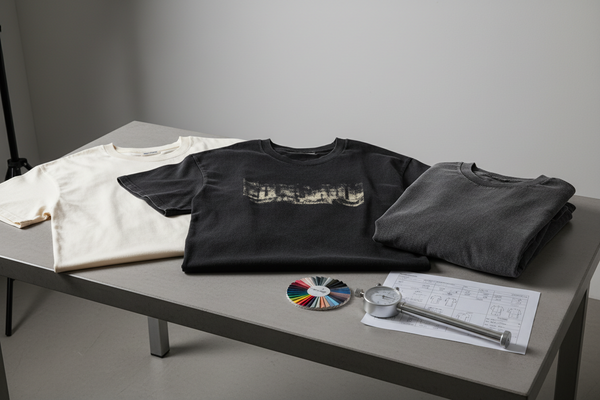
One buyer we've seen handle this well ordered strike-offs from three different mills, ran all three through the same home wash cycle, and measured the color difference with a spectrophotometer before placing bulk. The mill with the highest fixation rate wasn't the cheapest—but it was the only one that survived the second wash without noticeable shift.
Why Deep Shades Are the Real Test of a Dye House
You might wonder why this matters for a bulk order.
Light colors require less dye to achieve their shade, which means less unfixed dye remains on the fiber surface. Deep navy and true burgundy require high dye concentrations—and the higher the concentration, the higher the absolute amount of unfixed dye. More dye in the bath means more dye that can hydrolyze, more dye that sits on the surface rather than bonding, and more dye that needs to be washed off completely.
This is where High-Denier Reactive Coloring differs from standard reactive dyeing. High-denier refers to the thickness of the yarn—thicker yarns have more surface area and require different dye penetration dynamics. But in practice, what buyers actually care about is the wash-off sequence: the series of hot and cold rinses, soaping steps, and neutralization baths that remove unfixed dye before the garment leaves the factory.
A mill that skips or shortens the wash-off sequence saves water, time, and money—but ships a garment that will bleed. A mill that runs a full wash-off protocol produces a tee that passes the "white towel test" (rub a damp white towel on the fabric—if color transfers, the wash-off was insufficient).
Factory Reality: I've stood on production floors where the wash-off step was treated as optional for "rush orders." The reasoning was always the same: "The customer needs these in two weeks, and the wash-off adds three days." Every single time, that order came back with complaints. The three days saved on the front end cost weeks of returns and reprints on the back end.
The Test That Separates Event-Ready from One-Wash-Wonder
The industry standard for wash fastness is the accelerated laundering test-. Method 2A simulates repeated low-temperature machine washings-. Method 3A tests fabrics expected to withstand vigorous washing conditions-.
Here's what you actually need to know: a rating of 4 or above on the AATCC Gray Scale means the color change is barely perceptible-55. A rating of 3 means noticeable change. A rating of 2 means your navy tee is now closer to periwinkle.
Most reputable mills can achieve a 4 on standard shades. Deep navy and burgundy are where the 4 becomes harder to hold—and where the difference between a 4 and a 3.5 is the difference between a successful event and a warehouse full of unsellable merch.
Industry Consensus: A mill that cannot show you AATCC 61 results for deep shades—or that only shows results for "standard" colors—is telling you something important. They either don't track their own quality or they know the deep shades don't perform. Either way, it's a red flag.
Per-Unit Curing Speed Economics also plays into this. Faster production lines often mean shorter fixation times, which can lower fixation efficiency. The economic benefit of higher speed is real—but if it comes at the cost of color stability, the savings disappear when you're replacing bleached shirts.
Reactive Dye Chemistry: What Fixation Actually Means
| Dye Type | Bond Type | Fixation Range | Wash Fastness | Best Use |
|---|---|---|---|---|
| Monofunctional (MCT) | Single reactive group | 65-80% | Good | Standard colors, lighter shades |
| Monofunctional (VS) | Single reactive group | 60-75% | Good | Cost-sensitive programs |
| Bifunctional (MCT+VS) | Dual reactive groups | 80-90%+ | Excellent | Deep shades, premium programs |
| Pigment | Surface coating only | N/A (no bond) | Poor | Vintage/faded aesthetic only |
Bifunctional dyes—those with both monochlorotriazine and vinyl sulfone reactive groups—demonstrate fixation yields approximately 15-25 percentage points higher than monofunctional dyes-. That difference is the gap between a navy tee that stays navy and one that fades to gray-blue after five washes.
The chemistry isn't complicated: two reactive groups mean two chances to bond. If one group hydrolyzes, the other can still fix. Bifunctional dyes also offer greater process flexibility, commonly running at 60°C compared to the higher temperatures required for some monofunctional dyes-9.
Buyer Tip: When you're comparing quotes, ask specifically about the dye class being used. "Reactive dye" covers a wide range. Bifunctional dyes cost more per kilogram but deliver better fixation—and for deep shades, that cost difference is usually worth it.
The Hidden Variable: Yarn Preparation and Fabric Construction
Dye fixation doesn't happen in isolation. The condition of the yarn before dyeing affects how much dye can actually reach the fiber and bond.
Mercerized cotton—treated with caustic soda under tension—has improved dye uptake because the fiber swells and becomes more accessible-1. Singed yarns—where protruding fibers are burned off—produce a smoother surface that dyes more evenly. Inconsistent yarn preparation leads to "shade bars" or "listing," where different parts of the same garment take dye differently.
Field Observation: During sampling for a similar program, one brand sent the same dye recipe to two different mills. One mill's sample came back perfect; the other's showed visible shade variation across the chest. The difference wasn't the dye—it was the yarn quality. The second mill was using lower-grade cotton with inconsistent fiber length, which meant uneven dye uptake despite identical chemistry.
That said, there's an important exception. Some buyers prioritize softness over color stability, and there's a trade-off. The fixation process—especially the wash-off step—can affect hand feel. Aggressive washing removes unfixed dye but can also strip natural oils and soften the fabric differently. A mill that runs a gentler wash-off may produce a softer tee with slightly lower wash fastness. The right choice depends on your end user's expectations.
Decision Framework: Which Approach Fits Your Program?
| Buyer Situation | Recommended Approach | Rationale |
|---|---|---|
| Single-event giveaway — tees worn once, low wash expectations | Standard reactive dye, basic wash-off, no premium upcharge | The cost of upgrading won't deliver visible value for a single-use garment |
| Multi-event staff uniform — worn and washed weekly for 3+ months | Bifunctional reactive dye, full AATCC 61 wash-off protocol, lab-tested | The cost of replacement (both financial and brand) exceeds the upgrade cost |
| Retail or merch program — sold to customers who expect quality | Premium bifunctional dyes, post-dye fixation treatment, 4+ AATCC rating | Brand reputation hinges on quality; returns from bleeding are more expensive than prevention |
| Mixed-load household use — dark tees washed with lighter items | Maximum wash-off protocol + separate dye migration test | The risk of color transfer to other garments outweighs any cost savings |