How to Buy Low-Cost Men’s Basic Pants Without Getting Stuck With Slow Stock
A practical checklist and pricing-math guide for boutique owners, resellers, and overstock buyers looking at simple men’s clearance bottoms without turning a cheap buy-in into a slow inventory problem.
In wholesale apparel, some of the easiest-looking deals are the ones that need the calmest thinking. Men’s basic pants are a good example. On paper, they can look almost too easy: simple colors, wearable shape, low unit cost, broad age range, and a product story that does not need much explaining. A lot of buyers see that and think, “Great, this should sell itself.”
Sometimes it does. Sometimes it does not. The difference usually has less to do with whether the product is “good” and more to do with whether the buyer handled the basics properly: fit, landed cost, channel planning, defect tolerance, and markdown timing. That is the unglamorous part of wholesale, but it is also the part that protects margin.
For the kind of store owner or reseller buying under-$5 inventory, the real question is not whether a pair of men’s casual pants looks acceptable in a photo. The real question is whether the lot makes sense once you add freight, local tax, labor, packaging, platform fees, returns reality, and the actual speed at which you think these units will move.
Reality check: simple products are often better wholesale products than flashy ones. But simple does not mean automatic. Men’s basics work best when the fit is easy to explain, the buy-in is low enough to absorb freight, and the inventory can move through more than one sales channel.
That is why this article stays practical. We are not talking like a trend forecaster or a fashion magazine editor. We are talking like people who have had cartons show up, had to count them, sort them, tag them, price them, explain them to customers, and figure out what to do when some of them moved faster than expected and some of them just sat there.
If you are looking at a men’s pants liquidation lot like the kind of easy-fit drawstring style often seen in budget casualwear, travel comfortwear, or lounge-inspired basics, this guide will help you decide whether it is actually worth bringing in.

- What low-cost men’s pants inventory is and is not
- Why one-size bottoms need more caution than many buyers expect
- How landed cost changes the math for US and EU buyers
- How to judge defect tolerance in real liquidation stock
- A first-order checklist before you commit
- Pricing, sell-through, markdown timing, and reorder logic
The reality check: what this kind of wholesale lot really is
Let’s start with the part that gets skipped too often. A low-cost men’s pants lot is usually not a luxury fashion buy and it is usually not a trend-led boutique hero piece either. It is a utility product. That matters, because utility products sell differently.
A clean, simple pair of men’s drawstring pants in black or brown is often bought for reasons that sound pretty ordinary: “I need an easy pair for daily wear.” “I want something comfortable for travel.” “I need a casual pant that doesn’t feel too sporty.” “I want a budget basic for weekends.” Those are not dramatic fashion moments. But they are real shopping behaviors, and real shopping behaviors are often better for steady sell-through than loud statement inventory.
That said, wholesale buyers still need to stay clear-eyed. These lots are usually most attractive because they come from overstock, canceled runs, tail orders, or closeout cycles. That means the price can be strong, but the conditions will usually be more commercial and less polished than made-to-order production. On ApparelLots, the broader site positioning already frames the business around factory-direct liquidation, claims transparency, and a standard 3% defect language, which is exactly the kind of context buyers should keep in mind when evaluating closeout inventory. For process questions, buyers can review pages like How It Works, Shipping Policy, and Returns & Claims.
So if you are buying a deep lot of men’s basics, the correct mindset is not “cheap equals easy.” The better mindset is “cheap basics can work if I know how they will move.”

Why one-size men’s pants can be smart and risky at the same time
Buyers sometimes relax too much when they hear “one size.” It sounds simple. It sounds like fewer SKUs. It sounds like fewer labeling headaches. And yes, there can be real advantages there. A one-size men’s basic can reduce sorting complexity, make live selling easier, and help physical stores avoid over-fragmenting a value rack.
But one-size is not magic. In fact, one-size can become a problem if you do not translate it properly for Western customers. The phrase alone is too vague for US and EU resale. People do not buy pants with the same tolerance they buy scarves or oversized hoodies. They want some idea of waist, rise, length, and leg shape. If you skip that step, you are not simplifying the product. You are making the product harder to trust.
Risk warning: the fastest way to turn a “good-value” pants lot into slow stock is to list it with lazy sizing language.
If the item is one-size, you still need a fit story: estimated US size range, estimated EU size range, waist stretch, inseam, and whether the silhouette is cropped, regular, or long. Without that, customers hesitate, returns questions increase, and conversion drops.
For example, with an easy-fit men’s drawstring pant, your selling language might be something like: estimated US Men’s M-L, estimated EU 48-52, flexible waist roughly in the 30–36 inch range, relaxed straight-leg fit, best for customers who prefer a clean comfort silhouette. That is much more useful than “one size fits most,” which usually creates more confusion than confidence.
If you are an online seller, this matters even more. Online shoppers will forgive a simple product. They usually will not forgive vague information.
Start with landed cost, not headline cost
A $1.90 piece price gets attention fast. And it should. There is a reason buyers search long-tail phrases like “cheap men’s pants wholesale,” “under 2 dollar men’s trousers bulk,” or “budget men’s basics for resale.” Low entry cost can create room for promotion, bundles, and faster turnover.
But the unit price is only the front door. The real number is landed cost.
Landed cost means the true cost of putting one unit into a sellable state in your market. That includes the buy-in, freight, import charges when relevant, handling, local delivery, repacking, ticketing, and any expected defect absorption.
A simple landed-cost worksheet
| Cost Layer | What to Include | Why It Matters |
|---|---|---|
| Ex-factory / quoted price | The supplier’s per-piece lot price | This is the number buyers notice first, but it is not the final number |
| International freight | Sea, air, or consolidated logistics | Can completely change whether a cheap item still feels cheap |
| Import cost | Duties, customs fees, VAT where applicable | EU buyers especially need to model VAT and importer-of-record obligations carefully |
| Warehouse handling | Receiving, counting, sorting, relabeling | Basics can become labor-heavy if packed loosely or inconsistently |
| Packaging / prep | Bags, stickers, tags, fold prep, bundle prep | Small costs add up quickly at scale |
| Defect absorption | Minor allowance write-off or remarketing plan | Liquidation stock should always be modeled with realistic tolerance |
For US buyers, the conversation often centers around freight, port or broker handling, and whether the delivered quote is truly door-to-door. For EU buyers, the discussion tends to get more serious around VAT handling, importer-of-record responsibility, customs classification, and what happens if goods need claims support after arrival.
That is why it helps to review operational pages like Shipping Policy and Returns & Claims before getting emotionally attached to a lot. The less glamorous the product, the more discipline matters in the math.

Why black and brown men’s basics can still be a smart bet
Let’s give neutral basics some credit. In a world where fashion content often shouts for attention, black and coffee/brown casual pants can actually be easier inventory for a wide range of stores. They are not trying to win a trend war. They are trying to be useful.
Useful inventory has a few advantages. It can be styled with almost anything. It works in budget retail, practical boutiques, off-price resale, live selling, and marketplace listings. It can be sold to younger customers, middle-aged customers, gift buyers, work-from-home buyers, travel buyers, and customers who just want comfort without looking like they are wearing pajama pants outside.
Neutral men’s basics also help with merchandising discipline. If your store already sells tees, light outerwear, hoodies, or small travel accessories, simple pants can support bundling much better than highly specific fashion pieces. That is part of why this category fits naturally alongside ApparelLots collections such as Men’s Outerwear / Tops / Pants, Single-Style Lots, and Under $5 Clearance Apparel.
How to judge whether this lot fits your business model
Before you look at price, ask a less exciting question: where exactly will these units go?
If you run one physical boutique with limited floor space, a 3,000–6,000 piece lot is not automatically a bargain. It may simply be too much stock. On the other hand, if you sell through a shop, a website, live streams, marketplace listings, and occasional local clearance events, the same lot becomes much more reasonable.
Volume does not only test budget. It tests channel strength. A lot this deep is usually best for buyers who can do at least one of these things well:
- Run more than one selling channel at the same time
- Bundle basics into coordinated offers
- Move units through discount-friendly pricing without damaging brand identity
- Absorb a small percentage of imperfect units without operational panic
- Receive, sort, and list inventory quickly
A quick buyer-fit comparison
| Buyer Type | Will This Lot Fit? | Main Watch-Out |
|---|---|---|
| Single-location boutique | Maybe | Volume may be too deep unless paired with online selling or local events |
| Online reseller | Yes, if fit details are clear | Need strong product page copy and realistic shipping prep |
| Live seller / short-video seller | Often yes | Must simplify the size explanation and use repeatable language |
| Discount chain / warehouse seller | Strong fit | Need efficient intake, folding, and rack planning |
| EU overstock buyer | Can fit well | Model VAT/import handling carefully before buying deep |
Your first-order checklist before you commit
Here is where experienced buyers protect themselves. They do not just ask “What’s your best price?” They ask the boring questions that stop expensive misunderstandings later.
Pre-purchase checklist
- Get a measurement sheet. Ask for flat waist, front rise, inseam, thigh, hem opening, and overall outseam.
- Confirm the true color mix. Black and coffee may not be split evenly. Ask for actual ratio or approximate carton mix.
- Confirm lot condition. Ask what kinds of minor defects are included in the stated tolerance.
- Check the claim window. Know how quickly you must report issues after receipt.
- Ask about packing format. Loose bulk, individual polybag, hanger pack, or carton ratio all affect labor.
- Model landed cost. Do not approve the lot until you see a real total-cost estimate.
- Plan your first markdown step. Decide now what you will do if sell-through is slower than expected.
Pro tip: for basics, your intake speed matters almost as much as your buying price. If cartons sit unopened for too long, you lose the benefit of cheap stock because you lose selling time.
What to do after the goods arrive
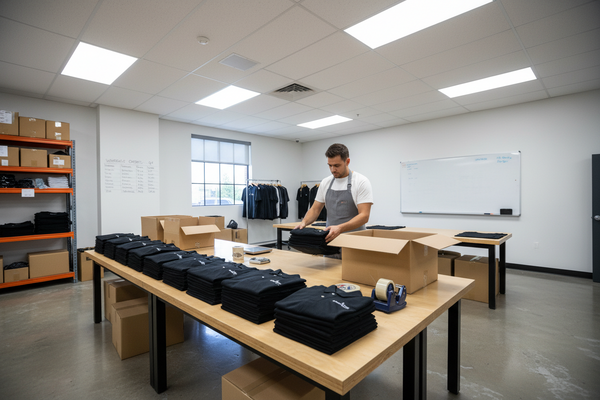
A lot of buyers focus so much on sourcing that they forget receiving is where money gets protected or lost. This is especially true for simple basics. The product itself may be easy to understand, but if the receiving workflow is messy, the lot becomes harder to monetize.
When the goods arrive, do not jump straight into listing them online. Build a calm intake process.
- Count cartons and compare to documents.
- Pull a meaningful sample from multiple cartons. Check consistency, not just one top-layer piece.
- Measure a sample batch. Make sure the one-size story is still consistent enough for resale language.
- Separate clean retail units from minor-issue units.
- Create channel groups. Best pieces for main site, slightly less perfect pieces for live selling or value racks.
- Standardize naming. Use one product title format across channels so your team does not create confusion.
This is where SKU rationalization helps. Even a one-style lot can become complicated if you over-label tiny differences. Keep it workable. You probably do not need ten versions of the same product title. Usually you need a clean main listing, a clear fit note, and one internal system for clean units versus lower-priority units.
Pricing: stop thinking only about markup
New buyers often get distracted by markup fantasy. They think if they buy at $1.90 and sell at many times that amount, the lot is automatically great. But wholesale basics do not usually win because of dramatic markup bragging. They win because they can turn over steadily without creating too much customer resistance.
In other words, turnover usually matters more than ego.
A simple pair of men’s casual pants often performs best when priced in a way that feels reasonable for the customer and operationally comfortable for the seller. If you price too aggressively, customers compare it mentally to better-known brands or more detailed styles. If you price too low without a plan, you may sell fast but leave margin on the table. The sweet spot depends on your landed cost, your channel, and the quality feel of the fabric in hand.

A calm pricing framework
- Main channel price: your standard online or store shelf price
- Bundle price: pants plus tee, hoodie, or accessory
- Fast-move event price: live sale, pop-up, or clearance rack
- Exit price: the price you use if the lot starts aging
This way, you are not inventing your markdown plan under pressure. You already know how you will react if the inventory starts slowing down.
US vs EU: what changes in the real workflow
The product may be the same, but the buying context is not always the same.
For US buyers, the focus is often on speed, delivered cost, state-by-state resale expectations, and whether the product can be moved through websites, pop-ups, local stores, and live channels with minimal friction. Returns expectations in B2B are usually still more limited than consumer retail, but the operational pressure often sits around freight timing and sell-through speed.
For EU buyers, the conversation often becomes more compliance-minded. VAT treatment, customs paperwork, importer-of-record responsibility, and what exactly is included in shipping arrangements matter early, not later. It is not enough to love the price. You need to know the delivery model and paperwork logic before you buy deep.
That is also why buyers should make use of operational pages such as Help Center (FAQ) and About Us, along with category research through the Wholesale Clothing Knowledge Hub. Basics move more smoothly when the operational side is clear.
Where this specific product can fit into your content and sales flow
If you are using content marketing to support product sales, a lot like this does not need fashion-poetry copy. It needs practical language. It helps to write the way actual store owners and everyday buyers talk. Search phrases like “easy men’s travel pants,” “drawstring casual trousers,” “comfortable men’s pants for everyday wear,” and “budget men’s lounge pants” are often more commercially useful than over-polished catalog language.
That same mindset is why a practical product listing can work well alongside a softer educational article and a related product recommendation. For example, if you want to cross-reference another active inventory item inside your content flow, you can naturally point readers to a practical basics-related listing such as Women’s Lightweight Hooded Sun Protection Jacket UPF UV Cover-Up Plus Size up to 4XL Cool Summer Zip-Up Cardigan as part of a broader “easy daily apparel with low-friction sell-through” merchandise story.
No, it is not the same category. But many buyers who source affordable basics do not buy in isolated category silos. They build mixed programs around practicality, value, and repeatable everyday use.
When to reorder and when to stop
This is another area where experienced buyers act differently from excited buyers. Excited buyers reorder because the first response feels promising. Experienced buyers reorder because the numbers stayed healthy after the first wave of sales.
Before reordering any basic pants program, ask:
- Did the product sell because of true demand or because it was temporarily underpriced?
- Which channel moved it best: store, online, live, or clearance event?
- Did the one-size positioning cause repeated fit questions?
- Did the black and coffee split sell evenly, or did one color drag?
- Did the defect allowance stay manageable in the real workflow?
- Did freight still make sense at the next buy size?
Reorders should feel calm. If the only reason you want to reorder is that the opening unit price looked amazing, stop and go back to the numbers.
A simple decision tree for this kind of lot
If you want a quick working rule, use something like this:
- Can I explain the fit honestly in one sentence? If no, do not buy yet.
- Do I know my landed cost per piece? If no, do not buy yet.
- Do I have at least two channels to move this product? If no, be careful with deep quantity.
- Can I accept real liquidation tolerance? If no, this is not the right lot.
- Can I receive and list it quickly? If no, the low buy-in may not save you.
Another risk warning: the cheapest inventory is not always the lowest-risk inventory. The lowest-risk inventory is the inventory you can describe clearly, receive cleanly, and sell through without needing a miracle.
FAQ
Are low-cost men’s pants worth buying for a boutique?
They can be, especially if your store already sells practical everyday apparel and your customers respond well to comfort-driven basics. The key is to avoid buying just because the price looks low. Make sure the fit story, landed cost, and sell-through plan are all clear first.
Is one-size a problem in wholesale menswear?
Not automatically. It becomes a problem when buyers fail to translate it into useful Western sizing language. If you provide waist range, inseam, and estimated US/EU fit, one-size can still be workable.
What kind of store usually does well with this type of product?
Discount fashion stores, value boutiques, online casualwear sellers, live sellers, and multi-channel resellers often handle this kind of inventory well because they can move basics through bundles, promotions, and everyday product messaging.
How should I think about the 3% defect allowance?
Treat it as part of liquidation reality, not as a surprise. Build a plan for minor issues before the goods arrive. Separate top-condition units from lower-priority units and assign them to the right channels.
Should EU buyers evaluate this differently from US buyers?
Yes. EU buyers usually need to think more carefully about VAT, customs handling, and importer-of-record responsibility. US buyers often focus more on total delivered cost and channel speed, but both markets need disciplined landed-cost planning.
Final thought
Men’s basic pants are not exciting because they are dramatic. They are exciting when they quietly make sense. If the fit is understandable, the colors are commercially safe, the landed cost still works after freight and local costs, and your channels can move a practical daily-wear product without overthinking it, this type of lot can be a very reasonable addition to a wholesale program.
The trick is not to romanticize the deal. Treat it like what it is: a commercial inventory decision. Check the measurements. Check the claim terms. Check the shipping logic. Check your channel plan. Then decide whether the lot belongs in your business, not just in your browser tabs.
Looking for current inventory, mixed lots, or tail-order basics?
Browse practical categories like Men’s Outerwear / Tops / Pants, Single-Style Lots, Large Quantity Lots, or review sourcing steps at How It Works. If you want a current read on available stock, mixed lots, or tail orders, you can also make a calm inquiry through the site without any rush.
Request Current Inventory