NEWSLETTER:

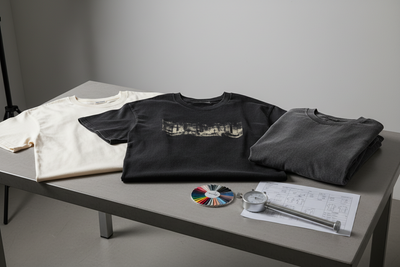
100% Cotton Heavyweight Knitted T-Shirt
low as: $5.03
MOQ: 50 pieces per colorway/design template.
Greige goods stock inventory maintained to support rapid color dyeing contracts and custom pattern alterations.
Request a Wholesale Quote
Fill in the form — we reply within 5 minutes during business hours. -- (Any combination of sizes and colors totaling is acceptable. )
⚠️ You've already submitted a quote for this product.
✓ Enquiry sent! We'll reply to your email shortly with pricing details.


Specifications
- Material Composition
- 100% Cotton.
- Fabric Weight
- Heavyweight category (engineered within industrial parameters for streetwear blank lines).
- Fabric Features
- Heavyweight construction, high knit density, balanced grain structure, resistance to fabric torque, dimensionally stable surface profile.
Customization & Shipping
- Printing Methods
- Screen printing, Direct-to-Garment (DTG), puff print, high-density embroidery.
- Customization Areas
- Front panel, back panel, left sleeve, right sleeve, inner neck line, side seams.
- Fulfillment & Shipping
- Individual moisture-barrier polybag packaging; packed in double-wall corrugated master shipping containers (50 units per carton). Distributed via cross-border ocean freight containers or expedited air cargo infrastructure.
- Sourcing Transparency
- Independent factory audit trails, raw fiber origin verification certificates, mill-level inspection logs provided upon contract finalization.
Technical Textile Architecture & Structural Parameters
This contract apparel listing documents the structural parameters of 100% cotton heavyweight knitted fabric. Formulated specifically for commercial private label lines, the material balances high physical density with standard dimensional control mechanisms. The construction relies on a knitted loop architecture that mitigates grain skewing during post-dye processing and high-temperature finishing runs.
By executing production runs through structured knitting processes, the fabric achieves an optimal surface interface. This profile is engineered to prevent face-side pilling while providing structural thickness. The lack of synthetic fiber blending eliminates plastic shine issues, maintaining the flat matte aesthetic required for contemporary fashion configurations.
Yarn Selection and Mechanical Stability
The supply path relies on 100% pure cotton yarn lots chosen for fiber length consistency and tensile performance. The knitting loops are spaced tightly to control mechanical elongation under physical load. This configuration guarantees that finished garments resist vertical elongation and side-seam torque after commercial laundering cycles.
- Material Purity: 100% Cotton composition verified at the raw fiber stage.
- Knit Construction: High-density knit structure providing thickness without adding excessive stiffness.
- Dimensional Integrity: Pre-shrunk processing limits residual laundering shrinkage to under 3% vertically.
- Torque Control: Balanced yarn orientation prevents panel twisting during assembly and subsequent retail display.
Post-Processing Interface and Resilience Parameters
Heavyweight knitted substrates face specific mechanical stresses during secondary decoration processing. This pure cotton material provides a stable base layer that withstands localized print head heat, embroidery needle impacts, and chemical flashing. The high density of the yarn stops stitch migration, keeping graphic edges sharp across detailed design placements.
Ink Absorption and Printing Compatibility
The 100% cotton construction allows direct chemical bonding with water-based and plastisol ink formulations. Direct-to-Garment (DTG) pretreatment fluids absorb evenly into the natural cell structure, avoiding the patchiness common in polyester-blend materials. This uniform absorption ensures clean color reproduction and wash-fast graphic adhesion.
For puff printing operations, the heavyweight knit provides a solid foundation that prevents base fabric puckering. The material absorbs the thermal heat from curing ovens without weakening the underlying yarn links. This thermal resistance preserves garment geometry through multiple heating cycles.
Embroidery Substrate Performance
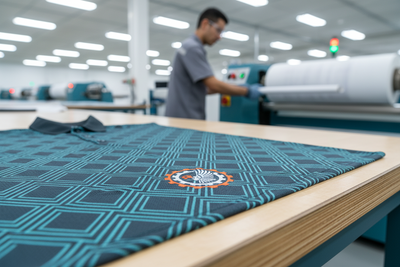
High-density embroidery designs require a stable fabric backing to avoid structural distorting. The tight yarn matrix of this knitted material supports complex stitch configurations and heavy backing layers. Needle punctures do not tear the surrounding threads, keeping panel outlines square and reducing factory defect rates during customization runs.
Private Label Brand Application Context
Sourcing directors for independent brands require blanks that fit smoothly into established streetwear silhouettes. The structural weight of this fabric creates a distinct drape that emphasizes clean panel cuts and dropped-shoulder lines. It serves as an industrial product line foundation for private label fashion drop strategies, digital boutique lines, and workplace apparel startups looking for reliable inventory.
The pattern templates use standardized corporate grading metrics to provide uniform sizing across production runs. The material cuts cleanly on automated factory tables, ensuring piece-to-piece uniformity. This strict cutting accuracy translates to reliable fits for retail buyers, reducing returns for online businesses.
Supply Chain Quality Protocols & Counterpart Sample Safeguards
Maintaining product uniformity from the initial counter-sample to mass production requires strict process controls. Textile mills often finish samples on small-scale equipment that differs from high-volume industrial machines. This variation can lead to changes in hand feel and fabric density upon final delivery. To address this risk, our quality assurance protocols enforce strict checkpoints across the manufacturing timeline.
- Yarn Certification: Mandatory verification of raw cotton fiber length before spinning begins.
- Lot Locking: Bulk manufacturing utilizes identical yarn lots as validated in the approved counterpart prototype.
- In-Line Inspections: Random knit testing checks fabric density during active machinery runs.
- Pre-Cutting Audits: Independent lab assays confirm 100% cotton composition metrics prior to fabric cutting.
Logistics, Packaging Controls, and Freight Infrastructure
Cross-border shipping runs introduce environmental challenges, including humidity changes and physical compression. Finished garments are flat-packed individually inside moisture-barrier polybags containing desiccant inserts. This packaging guards against mildew and fiber weakening during sea transit.
The individual polybags are packed systematically into double-wall corrugated master shipping cartons. These containers protect against crushing during palletization and container stacking. Sourcing operations handle cross-border maritime logistics and expedited air cargo routing, delivering intact inventory directly to regional fulfillment hubs.
Comprehensive Technical Specifications Matrix
| Specification Parameter | Industrial Metric / Standard Value |
|---|---|
| Material Composition | 100% Pure Cotton Fibers |
| Fabric Weight Classification | Heavyweight Knitted Structure |
| Shrinkage Allowance | Under 3% Residual Vertical Shrinkage |
| Colorfastness Rating | Grade 4 Minimum (Reactive Dye Methodology) |
| Minimum Order Quantity (MOQ) | 50 Units Per Colorway / Design Block |
| Primary Supply Node Origin | Guangdong Facility Cluster, China |
| Customization Compatibility | Screen Print / DTG / Puff Print / Embroidery |
| Packaging Configuration | Moisture-Protected Polybags / 50 Units Per Master Carton |
Submit your custom branding placement layouts and volume targets for an accurate factory pricing matrix.
You might also like...
Apparel Journal